


Your Pet Interrupting You Isn't Rude. It's a Wellbeing Nudge.
The paw on the keyboard, the nose under your elbow, the flop-and-sigh at your feet. Researchers now think those little interruptions are one of the quiet ways pets keep us healthy, if we let them.

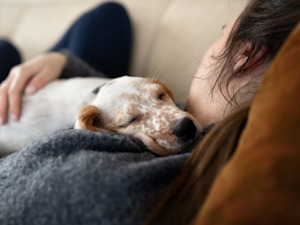
You are three hours deep into something on the laptop, shoulders climbing toward your ears, and a paw lands on the keyboard. Or a cold nose works its way under your elbow. Or your dog crosses the room, sighs, and flops down against your foot for no reason you can name. The reflex is to feel mildly interrupted and nudge them off so you can get back to it.
Here is a better way to read that moment. The interruption is not the cost of living with an animal. On a lot of days, it is the benefit.
The “nudge” is the point, not the problem
There is a growing body of research on what scientists call human-animal interaction, and the through-line is unglamorous: living with a pet is quietly good for us in ways we rarely notice while it is happening. The keyboard paw, the elbow nose, the settle at your feet are small bids for attention, and every one of them pulls you out of your head and back into your body for a second. That reset, repeated a dozen times a day, adds up.
The interesting part is how little we credit it. We will happily tell you a dog “makes us happy” in the abstract, then spend the actual day brushing off the specific behaviors that deliver the happiness. The reframe worth keeping is simple.
The behaviors people find slightly annoying are usually the same ones doing the work. A pet that pushes into your space when you have been still and tense for too long is, without any grand intention, prompting you to move, breathe, or soften. I tell people to treat the interruption as information: your animal often clocks that you need a break a beat before you do.
What the science actually says
The health story here is not folklore. Interacting with a friendly dog reliably lowers cortisol, the body’s main stress hormone, and the effect shows up after just five to twenty minutes, even when the dog is not your own. Petting, gentle eye contact, and calm handling nudge oxytocin upward in both the person and the animal at the same time, which is part of why the exchange feels mutual rather than one-directional. None of this requires a special session or a candle. It is the ordinary stuff: a hand on the flank, a minute of eye contact, a walk you took because someone at the door would not let it go.
Two things make those benefits real rather than theoretical. The first is that a pet gives your day structure, refilling the bowl, the morning walk, the evening settle, and structure is itself protective for mood. The second is presence. An animal cannot follow you into tomorrow’s worry or yesterday’s argument. Its entire pitch is that something good is available right now, in this room, and that pitch is a small, steady correction against the human habit of living everywhere except the present.
How to actually use it
You do not need an app or a program to get this. You need to stop overriding the nudges.
When the paw lands, take it as a cue to check in with your own body: unclench your jaw, drop your shoulders, take one real breath. When your pet parks themselves against you, let it be a thirty-second pause instead of an obstacle to work around. If a dog is pestering you toward the door, the walk is very often as much for you as for them. The bond runs both directions, so the minute you spend answering the nudge is a minute that benefits the animal too. Reframing “annoying” as “opportunity” costs nothing and changes the texture of an entire day.
The one caveat: a sudden change in nudging deserves attention rather than a reframe. A pet who abruptly becomes clingy, restless, or attention-seeking in a way that is new for them may be telling you about pain, anxiety, or a change they cannot name. Baseline nudging is wellbeing. A sharp break from baseline is a reason to look closer, and sometimes to call your vet.
What’s new since this was written
The idea that pets are good for us has moved from warm anecdote toward large-scale science. In early 2025, Mars launched a multi-year global research program, run through its Waltham Petcare Science Institute with academic partners, built specifically to measure how cats and dogs affect human stress, anxiety, loneliness, and overall wellbeing. The opening phase alone involves more than 35,000 people across over 20 countries, which makes it one of the largest efforts of its kind.
Early survey work tied to the program is striking in its consistency. In a poll of more than 30,000 pet owners across 20 countries, 83 percent said their pet has a positive effect on their mental wellbeing, and large majorities credited their animals with pushing them off screens and outside more often. That is the “nudge” showing up in the data: not a grand health intervention, just an animal in the room reminding you, over and over, to come back to the present.
The research is still building, and no study says a pet replaces care for a real mental health concern. But the direction is clear. The small, ordinary, slightly inconvenient moments with your animal are not noise around the relationship. They are a lot of the relationship’s value.
Dr. Park is a board-certified emergency and critical care specialist. She reviews our health and safety content for clinical accuracy and contributes guides on recognising urgent conditions. Her focus is helping owners act quickly and correctly when it matters most.
Meet our experts ↗Keep reading
 Living8 Absurdly Pampered Pets, Ranked by Whether the Money Bought Them AnythingNina Vasquez · 8 min
 LivingThe Internet's Coziest Corner Is Run by One Woman and a Lot of SheepJordan Ellis · 4 min
 LivingIn Gemini Season, Your Pet Contains Multitudes TooJordan Ellis · 5 min
 LivingEnd the Pet-Chore Fight With a Contract, Not Another ArgumentMarcus Webb · 6 min
 LivingVirgo Season Is Basically a Holiday for Type-A Pet ParentsNina Vasquez · 5 min
 LivingGive Your Pet a Job: The Case for a Capricorn-Season ResetNina Vasquez · 6 min