


The Best Thing in Your Cat's Life Is Also the Most Dangerous
An open window is the richest enrichment your indoor cat gets all day, and the screen is not holding them in. New research on 1,125 falls shows exactly who gets hurt, when, and how badly.

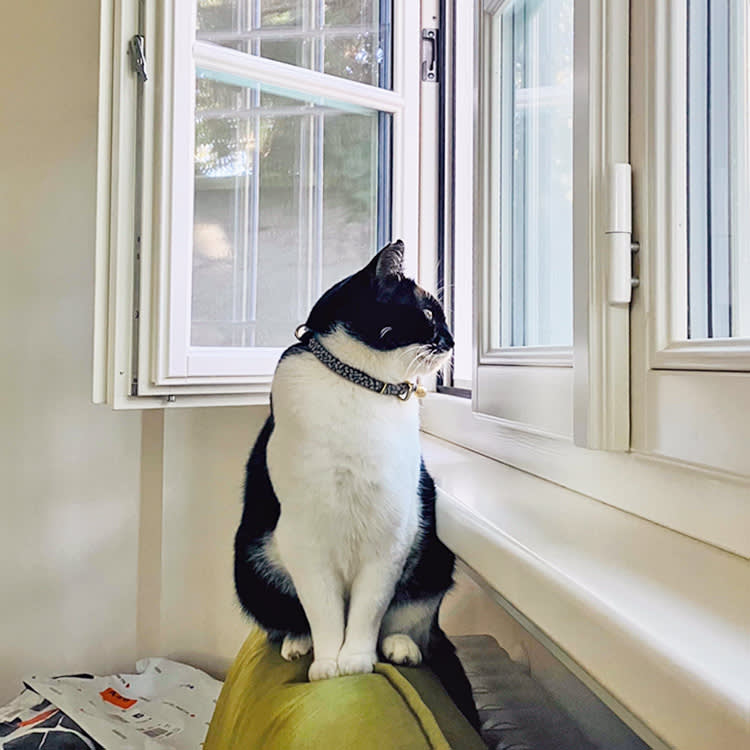
Your cat has a spot. It’s the windowsill, and they are on it right now, ears swiveling, tail thumping, absolutely locked in on something you can’t see.
That window is the single best thing in their day. It’s also the object in your home most likely to send them to an emergency vet.
Both of those are true at once, and the reason this article exists is that most people know the first half and badly underestimate the second. A window screen is not a barrier. It’s a suggestion. And new research puts hard numbers on what happens when a cat takes it up on that.
Why the window matters so much
Start with what it’s replacing.
An outdoor cat’s day is not the leisurely lounging we imagine. It’s patrol, investigate, stalk, and repeat. Cats are efficient hunters that go after prey many times a day, and they roam, climb, and track scents in between. They are built to spend their waking hours gathering information.
Your indoor cat has a hallway and a couch, and they are, statistically speaking, bored a great deal of the time. Boredom in cats isn’t a mood; it’s the engine behind a lot of what owners call “bad behavior,” from countertop demolition to overly rough play to stress-related litter box problems.
The open window is the closest thing an indoor cat has to their real job. It is a wall of live, changing, high-resolution information, and it costs you nothing.
What’s actually going on up there
Scent. This is the part people miss, because we can’t perceive it. A cat’s sense of smell is vastly better than ours, and a breeze through an open window is not “fresh air,” it’s a running feed of data about everything within a considerable distance: other cats, food, plants, weather, animals. Closed window, no feed. This is the single biggest reason open beats closed.
Movement. Anything that moves is content. Birds, obviously, but also insects, squirrels, blowing grass, a falling leaf, water running down the glass. Cats will watch, and paw at, a raindrop with total commitment.
Bugs. Insects gather at windows from both sides. To a cat, a moth climbing a screen is a full-length feature film with audience participation.
The blinds and curtains. A breeze moves them, which makes them prey. It also makes them cover, and cats love cover. A cat who spots something outside will often dart behind a curtain first, because stalking requires concealment.
Routine. Cats build schedules around reliable events. If a mouse crosses the patio at 9 p.m., or your car pulls up at 6, the window becomes a nightly appointment. That predictability is itself calming.
The one open-window “benefit” that isn’t
There is a version of window-watching that is not enrichment at all, and it’s worth naming.
If a neighborhood cat is passing through your yard, and your cat can see or smell them, the window stops being television and starts being a threat. That’s a known driver of spraying, redirected aggression, and chronic stress, and it can turn ugly fast: a cat wound up by an outdoor intruder will frequently take it out on whoever is nearest, which is often another cat in the house or your ankle.
If your cat is fixating tensely on one window, growling, spraying near it, or getting reactive afterward, that window needs management: frosted film on the lower panes, a temporary block, or a deterrent in the yard. That is a different problem from boredom, and more enrichment won’t fix it.
Now the part that gets cats killed
Cats fall out of windows often enough that veterinary medicine has a name for it: high-rise syndrome.
Here’s the mechanism, and it is not carelessness. A cat locked onto prey does not conduct a risk assessment. Prey drive is a reflex, and when it fires, the cat lunges. A screen that would hold against a lean will not hold against a full-body strike from a determined cat, and the cat has no plan for what happens if it gives.
They also don’t need to be high up for it to matter. Which brings us to the numbers.
What the newest research shows
A pair of 2025 studies in the Journal of Feline Medicine and Surgery reviewed 1,125 cats treated for high-rise syndrome at a single university clinic over roughly a decade. It is the largest look at this we have, and the findings are specific enough to change what you do this weekend.
Who falls. The typical patient was young: the average age was around 2.3 years. This is not an old, unsteady cat problem. It’s a young, fast, confident cat problem.
When. Falls clustered in summer (about 77%) and happened mostly at night (around 62%). That is exactly when windows are open and exactly when moths, bats, and rodents are moving.
How badly they’re hurt. Among the cats in the study, chest trauma occurred in roughly 58%, orofacial injuries in 51%, circulatory shock in nearly 49%, limb fractures in 47%, and pelvic fractures in 11%. Injury severity correlated with age, fall height, and what the cat landed on.
Whether they survive. With veterinary treatment, the overall survival rate was around 87%. That number gets quoted as reassurance, and it shouldn’t be. It’s a survival rate for cats who got to a clinic, and it comes attached to a broken jaw, a chest injury, and a bill.
The summer-and-night pattern is the actionable part. If you are going to secure exactly one window in your home, secure the one you leave open on warm nights.
The cats I see after a fall are almost never elderly or clumsy. They’re two years old, they’re in perfect condition, and they were doing the thing they were built to do. The screen just happened to be the last thing between them and it.
How to make the window safe
The goal is to keep every benefit above and remove the fall.
Reinforce the screen, don’t trust it. Standard window screens are held in by friction and a bit of plastic. They pop out under load. Screw the screen frame into the window frame on the windows you actually open. You don’t have to do this to every window in the house; do it to the ones that get opened.
Use pet-resistant screen mesh. Heavy-duty mesh resists claws and climbing far better than standard fiberglass. Understand what it does and doesn’t do: it stops your cat from tearing through the screen. It does not stop the whole screen from coming out of the frame. You still need the reinforcement above.
Add a window guard or security gate. Removable gates and bars that mount inside the window opening give you a real physical stop. Two cautions: bar spacing must be too narrow for your cat to squeeze through or get their head stuck, and you should be able to remove it in an emergency. Adding a screen layer over the bars handles both the gap problem and the bug problem.
Borrow from baby-proofing. Window security screens and child window guards are a mature product category and most of them work perfectly well for cats. The test is simple: can your cat climb it, squeeze through it, or knock it out? If no to all three, it’s fine.
Then make the spot good. Once it’s safe, invest in it. A window perch, a cushion, a warming pad in winter or a cooling mat in summer, and a set of steps if your cat is older or arthritic and can’t jump like they used to. A senior cat who can’t reach the sill has lost their best hour of the day, and a two-step ramp gives it back.
Watch the cleaning products. Cats lick condensation and drips off windows and sills. Use cat-safe cleaners on any glass or sill your cat has access to.
Bottom line
An open window is genuinely one of the best things you can give an indoor cat. Scent, movement, prey to watch, weather to feel, a routine to keep. It is real, cheap, meaningful enrichment and you should absolutely provide it.
And a standard screen will not stop a two-year-old cat who has decided a bird is worth it. The falls happen in summer, at night, to young healthy cats, and the injury list is brutal.
Fix the screen. Then open the window.
FAQs
Why does my cat love sitting at an open window? Scent, mostly. A breeze carries an enormous amount of information a cat can’t get through glass, along with movement, insects to swat, and the chance to watch and stalk. It’s the richest sensory input an indoor cat gets.
Is a window screen enough to keep my cat safe? No. Standard screens are held in place by friction and can pop out when a cat lunges. Screens should be reinforced, screwed into the frame, or backed with a window guard.
What is high-rise syndrome in cats? It’s the pattern of injuries cats sustain from falling out of windows and off balconies. A 2025 review of 1,125 cases found chest trauma in about 58%, limb fractures in 47%, and an overall survival rate near 87% with treatment.
Do cats always land on their feet? They have a righting reflex, but it does not prevent injury. Cats in the research routinely arrived with fractured limbs, pelvises, jaws, and chest trauma.
My cat stares tensely out one window and then attacks my other cat. What’s going on? That’s likely an outside cat triggering territorial stress and redirected aggression. Block the sightline on that window rather than treating it as enrichment.
References
- Candela Andrade, Mario, et al. “High-Rise Syndrome in Cats (Part 1): Epidemiology and Risk Factors.” Journal of Feline Medicine and Surgery, 2025. https://doi.org/10.1177/1098612X251334091
- Candela Andrade, Mario, et al. “High-Rise Syndrome in Cats (Part 2): Injury Patterns and Survival Rate.” Journal of Feline Medicine and Surgery, 2025. https://doi.org/10.1177/1098612X251334096
- Herron, Meghan E., and C. A. Tony Buffington. “Environmental Enrichment for Indoor Cats.” Compendium: Continuing Education for Veterinarians, vol. 32, no. 12, Dec. 2010, p. E4. https://pmc.ncbi.nlm.nih.gov/articles/PMC3922041/
- Ellis, Sarah L. H., et al. “AAFP and ISFM Feline Environmental Needs Guidelines.” Journal of Feline Medicine and Surgery, vol. 15, no. 3, 2013, pp. 219–230. https://doi.org/10.1177/1098612X13477537
- “Feline Behavior Problems: Destructive Behavior.” Cornell Feline Health Center, Cornell University College of Veterinary Medicine. https://www.vet.cornell.edu/departments-centers-and-institutes/cornell-feline-health-center/health-information/feline-health-topics/feline-behavior-problems-destructive-behavior
Dr. Nair is a veterinarian focused on diet and feeding. She covers everyday nutrition, treats, and the many "can they eat this?" questions owners ask, grounding each answer in what is actually safe and sensible for dogs and cats.
Meet our experts ↗Keep reading
 Health & WellnessOne Common Bouquet Flower Can Put a Cat in Kidney Failure. Here's the Full List.Dr. Amara Solis · 8 min
 LivingYour Party's Biggest Risk Isn't the Cat Getting Scared. It's the Front Door.Dr. Amara Solis · 7 min
 LivingWhether a Cat Tolerates Water Is a Coat Question, Not a Willpower OneDr. Ravi Mehta · 8 min
 LivingA Five-Month-Old Kitten Turned On a Faucet, Blocked a Drain, and Closed a Cat CafeSara Lim · 6 min
 Health & WellnessHalloween Is Your Cat's Least Favorite Night. Six Ways to Fix That.Dr. Lena Park · 5 min
 Health & WellnessCats Don't Always Land on Their Feet. Scientists Just Found the Part That Does the WorkDr. Priya Nair · 6 min