


"My Last Dog Syndrome": Why Your New Dog Keeps Losing to a Ghost
The dog you grew up with wasn't perfect. Your memory just edited out the hard parts. Here's the cognitive science behind why every new dog feels like a downgrade, and how to stop grading a real animal against a highlight reel.

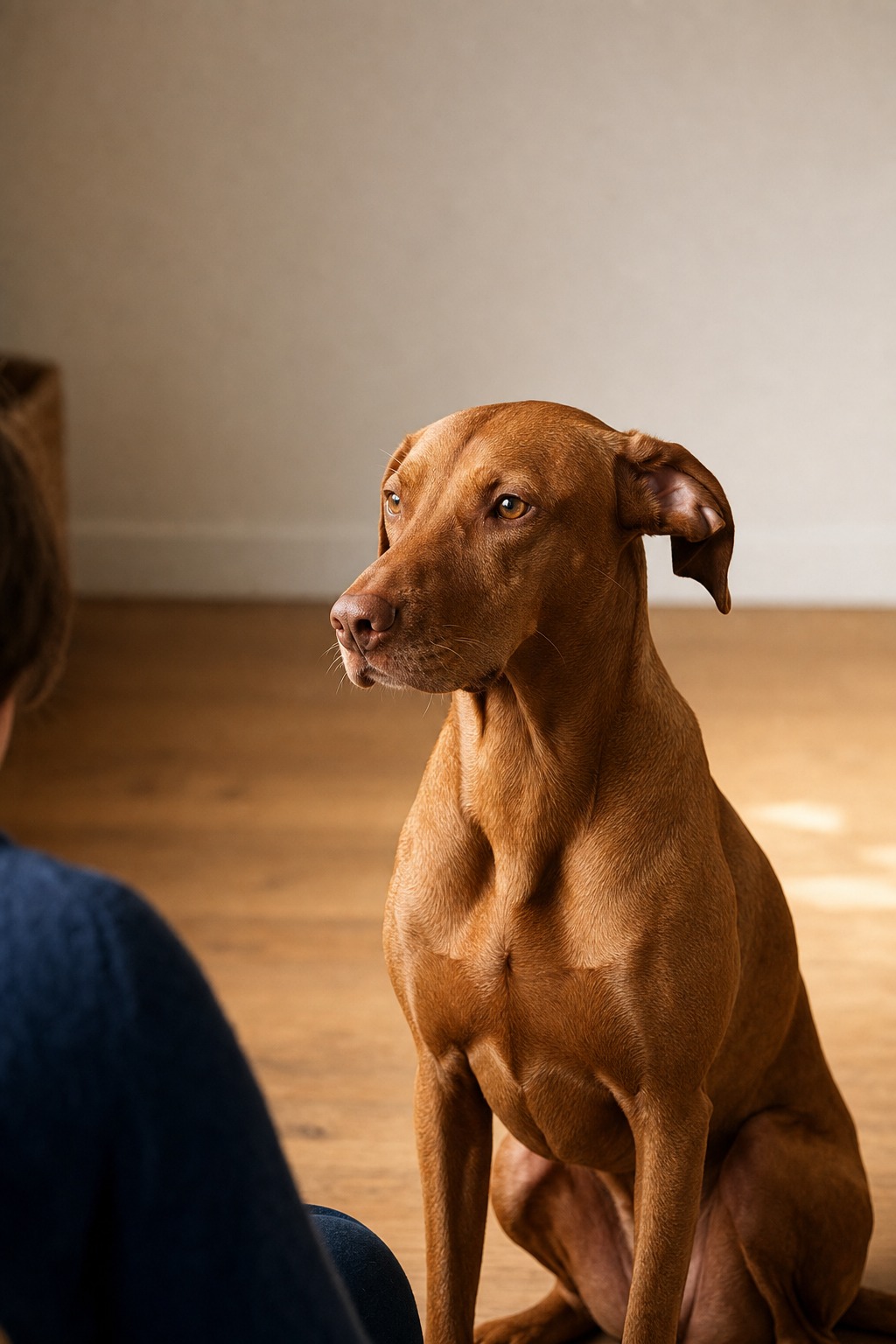
Your new dog is not competing with your last dog. Your new dog is competing with a memory of your last dog, and that is not a fair fight, because memory cheats.
Trainers hear it constantly, enough that they have a nickname for it: “My Last Dog Syndrome.” It is the quiet, nagging conviction that the dog you had before, and especially the dog you grew up with, was calmer, smarter, more devoted, and simply better than the one currently shredding your baseboards. The feeling is real. But the comparison at the heart of it is built on a flawed source. Understanding exactly how it is flawed is the fastest way to stop it from poisoning a perfectly good new relationship.
Your memory is running a highlight reel, not a documentary
There is a well-documented cognitive bias called rosy retrospection: people tend to recall past experiences as more positive than they actually rated those same experiences while living through them. The mind quietly files away the tedium, the frustration, and the mess, and keeps the warm parts. A childhood dog is an almost perfect target for this editing. You are not remembering the dog. You are remembering the best cut of the dog.
That editing does specific, predictable things. It deletes the puppy months. The dog you picture snoozing loyally at your feet spent his first two years eating drywall and bolting out the front door, but that footage got left on the cutting-room floor decades ago. It deletes the decline, too, or reshapes it into something gentler than it was. What survives is the long, easy middle stretch, when the dog was fully trained, fully settled, and required almost nothing of you. Then you take a brand-new dog, who is by definition at the beginning, and hold him up against a memory of a dog at his peak. Of course he loses. Any dog would, including the childhood dog himself if you could somehow put his younger self in the room.
You were a kid. You did not actually raise that dog.
Here is the second distortion, and it may be the bigger one. Being raised alongside a dog and raising a dog yourself are not the same job. They are barely the same species of experience.
When you were young, someone else did the hard parts. Someone else paid the vet bill and wrestled the dog into the carrier while he screamed the whole drive there. Someone else booked the groomer, cleaned the car after a bout of diarrhea, scrubbed vomit off the dog bed at 2 a.m., and absorbed the financial sting when the dog ate a new pair of shoes or the steaks that were supposed to be dinner. You got the walks, the fetch, the sleeping in your room instead of your sibling’s, the tears licked away after a bad day. You got the dog’s entire upside with almost none of the cost.
Now you are the one holding the leash and the credit card and the roll of paper towels. So when your current dog feels harder than your childhood dog, part of what you are noticing is not a worse dog. It is a fuller, more honest view of what having a dog actually demands, one you were mercifully shielded from the first time around.
A dog is not a reboot of an old dog
Even setting the memory tricks aside, the comparison misunderstands what a dog is. Personality in dogs is driven far more by the individual animal, their early experiences, and the specific relationship you build than by breed, lineage, or any resemblance to a dog you loved before. A landmark 2022 genetics study of more than 2,000 dogs found that breed explained only about nine percent of the variation in behavior, and that within any single breed the range of individual personalities was enormous. Translated out of the lab: two dogs of the same breed, raised in the same house, can be wildly different animals, so the odds that a new dog will replicate a specific past dog are close to zero by design.
This is why the search for a look-alike so reliably disappoints. Trainers can tell you about the client who wanted a dog with an eye patch shaped exactly like the one his boyhood dog had, as if the spot were the source of the magic. The spot was never the source. Picking a dog to match a remembered silhouette almost guarantees a letdown, because you have selected for the one trait that carries none of what you actually miss.
The clients who struggle longest are the ones auditioning a new dog for an old dog’s role. The moment they stop casting and start getting curious about the animal actually in front of them, the resentment usually drains out of the relationship within weeks.
When the comparison is really grief
Sometimes “My Last Dog Syndrome” is not about the new dog at all. It is unfinished mourning wearing a disguise.
Researchers who study pet bereavement describe what they call continuing bonds: the ways people stay emotionally connected to an animal after death, through keepsakes, rituals, storytelling, and yes, comparison. Continuing bonds are usually healthy and comforting, and a systematic review of the research links them to better adjustment after a loss. But the same research finds they can curdle into distress, especially for people with an anxious attachment style, for whom the strength of the past bond directly predicts more severe and prolonged grief. If you find yourself measuring every new dog against a lost one and feeling worse each time, the work in front of you may not be dog training. It may be grief that has not finished moving through you, and that is worth naming plainly, and sometimes worth talking through with a person who handles loss for a living.
What to actually do about it
The fix is not to love your childhood dog less. That love is not the problem, and trying to suppress it only makes the comparison louder. The fix is to catch the comparison in the act and correct for the two distortions behind it.
When the thought arrives that your old dog was better, add the missing footage on purpose: remember the puppy chaos, the vet bills you never saw, the year he barked at the mailman without fail. Give yourself the whole dog, not the highlight reel. Then look at the animal in front of you and go hunting for one thing that is entirely his own, a quirk your last dog never had. Do it daily. You are training your attention away from a memory and toward a relationship, and relationships are built on discovery, not comparison.
And if, after all that, you remain unshakably convinced that you grew up with the single best dog who ever lived, keep the belief. Whether it is empirically true does not matter in the slightest. There is something quietly beautiful about a love so complete that no evidence could ever talk you out of it. Just do not make your new dog pay the tax on it.
References
- Mitchell, Terence R., et al. “Temporal Adjustments in the Evaluation of Events: The ‘Rosy View.’” Journal of Experimental Social Psychology, vol. 33, no. 4, 1997, pp. 421–448. https://doi.org/10.1006/jesp.1997.1333
- Morrill, Kathleen, et al. “Ancestry-Inclusive Dog Genomics Challenges Popular Breed Stereotypes.” Science, vol. 376, no. 6592, 2022. https://doi.org/10.1126/science.abk0639
- Hughes, Ben, and Beth Lewis Harkin. “The Impact of Continuing Bonds Between Pet Owners and Their Pets Following the Death of Their Pet: A Systematic Narrative Synthesis.” OMEGA – Journal of Death and Dying, 2025. https://doi.org/10.1177/00302228221125955
- “Attachment Styles, Continuing Bonds, and Grief Following Companion Animal Death.” Death Studies, 2023. https://pubmed.ncbi.nlm.nih.gov/37801468/
Dr. Kohl is a board-certified veterinary dentist with a particular interest in preventive oral care. She reviews all dental health content at The Pet Times and contributes practical guides on home dental routines, professional cleaning, and oral disease prevention.
Meet our experts ↗Keep reading
 LivingDoes Raising a Dog Together Prep You for a Kid? Yes and No, ExactlySara Lim · 5 min
 LivingIt Was Never Really About Pets vs. KidsSasha Ford · 10 min
 LivingADHD Doesn't Make You a Bad Dog Parent. Your Reminder App Does.Leila Torres · 8 min
 LivingThe Best Dog Breeds for Kids, and Why Breed Matters Less Than You ThinkDr. Nina Kohl · 11 min
 LivingThe 8 Dogs Who Built the Entire Pet-Influencer EraLeila Torres · 5 min
 LivingThe Dog Who Calms Olympians Needed Help Himself. How Beacon Pulled ThroughDr. Mara Chen · 4 min