


How Do You Direct a Dog to Grieve? The Trainers Behind 'The Friend' Explain
Bing the Great Dane delivers something movies almost never capture: a dog's interior grief. His trainers say the secret was a method that's the opposite of how movie dogs are usually made.
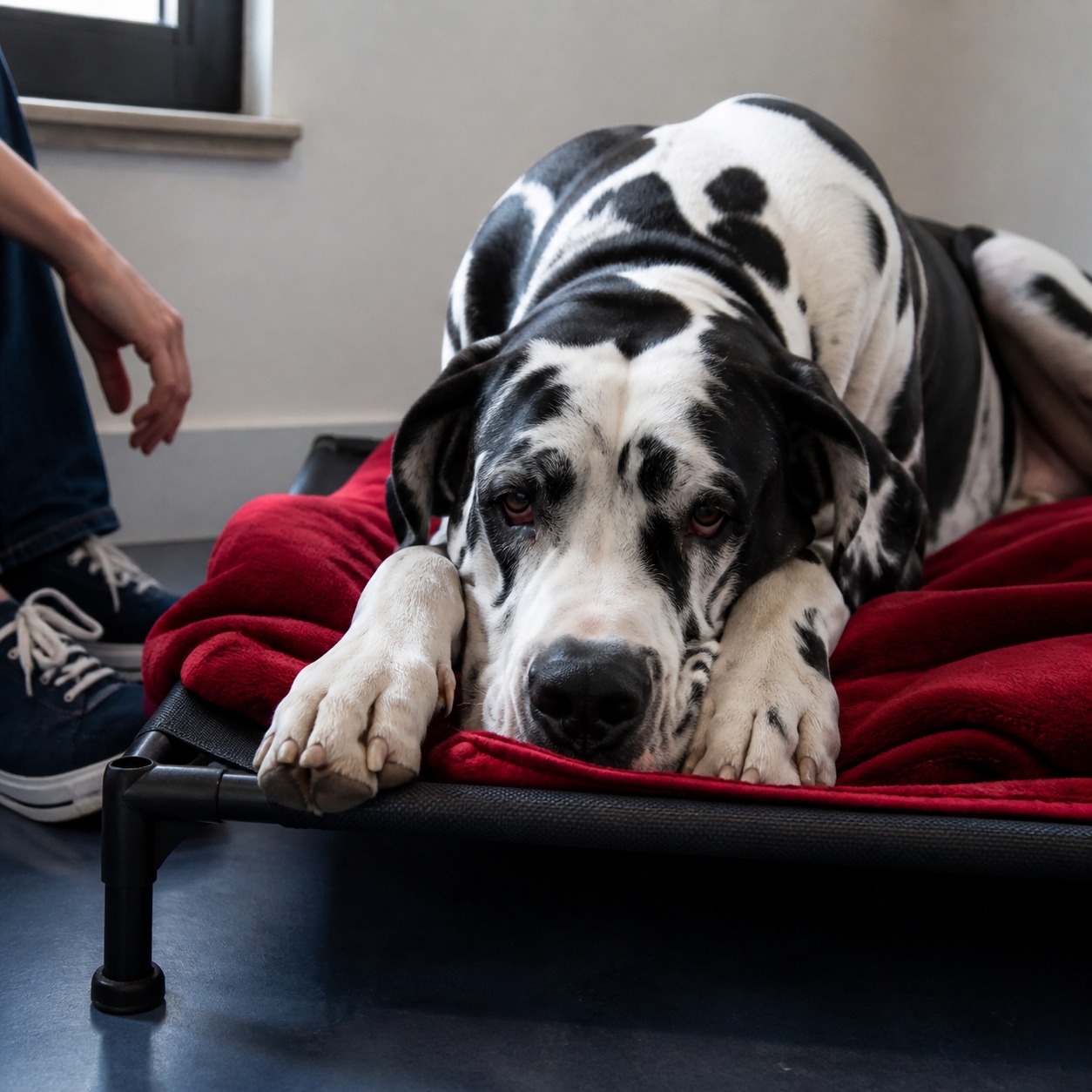
Most movie dogs are made the same way: a trainer just off-camera, a clicker, a treat, and a dog hitting marks like any other prop that happens to wag. It works, and it’s why so many film dogs read as adorable but blank. Bing, the 150-pound Great Dane who carries long stretches of The Friend opposite Naomi Watts and Bill Murray, is doing something almost no movie dog has done before: he’s playing grief from the inside. The performance lands because the people behind it threw out the standard playbook, and how they did it is a small master class in what dogs are actually capable of when you stop treating them like trick machines.
The Friend, adapted from Sigrid Nunez’s 2018 novel, casts Bing as Apollo, a Great Dane left behind when his person, the writer Walter (Murray), dies, and reluctantly taken in by Walter’s friend and mentee Iris (Watts). Apollo upends Iris’s life and her tiny New York apartment while quietly falling apart himself, and the bond they build pulls them both back toward the living. After a whirlwind press day at the Crosby Street Hotel, where Bing did interviews bookended by The View and Late Night with Jimmy Fallon while every guest went home with a poster bearing his enormous paw print, his pet parent and trainer, Bev Klingensmith, and veteran animal behaviorist Bill Berloni sat down to explain how the performance came together.
The method: build the relationship before you build the scene
The single most unusual thing about Bing’s training wasn’t a technique. It was a relationship, and the time everyone spent protecting it. Because of pandemic and strike delays, Watts and Bing had a full month together before the first day of shooting, something Berloni says no actor he’s worked with had ever agreed to.
“We had the month before the first day of shooting to figure out the dynamic,” he says. “So it was certainly fate and kismet in all those delays.” Watts invited the trainers into her own home to do that pre-production work, and both credit much of Bing’s on-screen ease to the space she gave them.
“How many celebrities invite strangers into their homes? That’s her level of dedication,” Berloni adds. Klingensmith describes a co-star who simply did not care about the realities of living with a giant dog: “She never let dog hair or slobber bother her. She had no problem getting up in there, just enjoying the dog, and allowing the bond to happen that way.”
That bond wasn’t a performance, either. When Berloni told Watts she could let go of Bing’s leash if she ever felt unsafe on a city street, her answer stayed with him: “If he pulls me into traffic, I’m not going to let go. I’m going to hold on.” She meant it. The two still have a real relationship, and even performed a song together on Late Night.
Finding the right dog took a year and 30 auditions
Klingensmith has trained Great Danes since the 1990s and teaches public obedience classes around Newton, Iowa, where she and Bing live on 10 acres. When Bing was just a year and a half old, she got an email from Berloni, a film, TV, and theater animal trainer whose résumé includes casting the original Sandy for Broadway’s Annie. He had spent more than a year and met nearly 30 dogs hunting for the right one. What sold him on Bing wasn’t a trick repertoire; it was temperament, plus a training style in Klingensmith that mirrored his own. In the intelligent, sweet-natured dog, he’d found his Apollo.
Getting Bing ready meant more than commands. He had to acclimate to New York itself, which meant a schedule overhaul and a lot more leash-walking than a dog used to romping across 10 rural acres had ever done. Klingensmith and Berloni walked him through city streets to get him comfortable with the noise, the crowds, and the smells before a camera ever rolled.
How you actually direct a dog to look heartbroken
Here’s the genuinely hard part, the one that separates this film from the usual dog movie. Moving Bing from one mark to another was easy; Berloni and Klingensmith just made kissing noises to get him from point A to point B. But you cannot command “grief.” So instead of imposing an expression, they reverse-engineered one from Bing’s own natural behaviors, like the heavy way he drops his head between his paws when he settles.
“We took every individual scene and individual shot,” Berloni says, building the camera setup around the dog rather than forcing the dog to perform for a fixed camera. “It was a collaboration between us and the directors and the writers to figure that out. It’s never really been done before. Many films I’ve done haven’t gotten into the inner lives of dogs like we did.” Directors Scott McGehee and David Siegel gave them room to work that way, and the result is a portrait of canine mourning assembled out of real, observed dog behavior rather than anthropomorphic cuteness.
Klingensmith kept being surprised by what Bing could do with barely any rehearsal. A late scene has him walking along a wall on a beach; they ran it only a few times before he nailed it. He learned to poke his head through a screen almost instantly. “He never ceases to amaze me,” she says, glancing at Bing, who is sprawled out resting during the interview, paws hanging off his bed. “He’s good, but sometimes even I’m amazed.”
There were practical hurdles, too. Cast at a year and a half, Bing was far younger than the aging Apollo of the novel; the film’s delays conveniently let him grow into the part (very method of him), and a little gray chalk on his muzzle did the rest. A second dog with similar markings stood in as a walking double for a scene meant to show an even older Apollo.
The part everyone in rescue is bracing for
There’s a predictable aftershock to a hit dog movie, and the trainers know it. After the John Wick films, audiences fell hard for the dogs and rushed to get their own. The Friend could do the same for Great Danes, and Klingensmith has mixed feelings about that.
She’d welcome more love for the breed, but with a firm caveat that’s worth repeating before anyone clicks “adopt.” Great Danes are not the gentle couch ornaments the movie might suggest. “They need a lot of exercise and a lot of training from early on,” she says. “That takes some dedication, so people looking to get a Great Dane really need to make sure they have the time and energy to devote to that.” Beyond the exercise demands, the breed’s short lifespan (typically seven to ten years) and predisposition to serious conditions like bloat and dilated cardiomyopathy make them a significant, sometimes heartbreaking commitment, not an impulse buy. For anyone genuinely Dane-curious, she points to the Great Dane Club of America as the place to start.
As for Bing himself, his trainers are open to more roles, though maybe something a little less demanding next time. Then again, Berloni jokes, with all this attention, “some Hollywood movie person may come up and offer him another part.”
References
- Nunez, Sigrid. The Friend. Riverhead Books, 2018.
- Great Dane Club of America. “Is a Great Dane Right for You?” gdca.org.
- American Kennel Club. “Great Dane Breed Information.” akc.org.
Nina Vasquez writes about life at home with pets and the relationships at the heart of it. Her work covers day-to-day living, people-and-pet stories, and the products that fit into a real household, with a warm, grounded take on everyday pet ownership.
Meet our experts ↗Keep reading
 LivingThe Dog Always Dies? Not on This Watchlist. 15 Films Where Everyone Makes It.Nina Vasquez · 8 min
 LivingThe Dog-Walking Rules Your Neighbors Wish You KnewSasha Ford · 5 min
 TrainingThe Walk Isn't Cardio. 9 Myths That Ruin It.Dr. Nina Kohl · 8 min
 Living10 Chinese Dog Breeds Whose History Is Stranger Than Their FacesJames Okafor · 7 min
 LivingA Shelter-Style Mutt Just Topped a 350-Dog Field at Westminster. Meet Nimble.Marcus Webb · 4 min
 LivingYour Senior Dog Isn't Slowing Down. He's Bored.Dr. Nina Kohl · 8 min