


The Pet Portrait Artist Who's Allergic to Every Animal He Paints
Ben Lenovitz has painted thousands of dogs and cats on cardboard from his studio at his parents' store, Fishs Eddy, and he's deeply allergic to all of them. What his approach reveals about why pet portraits work, and how to get a good one.
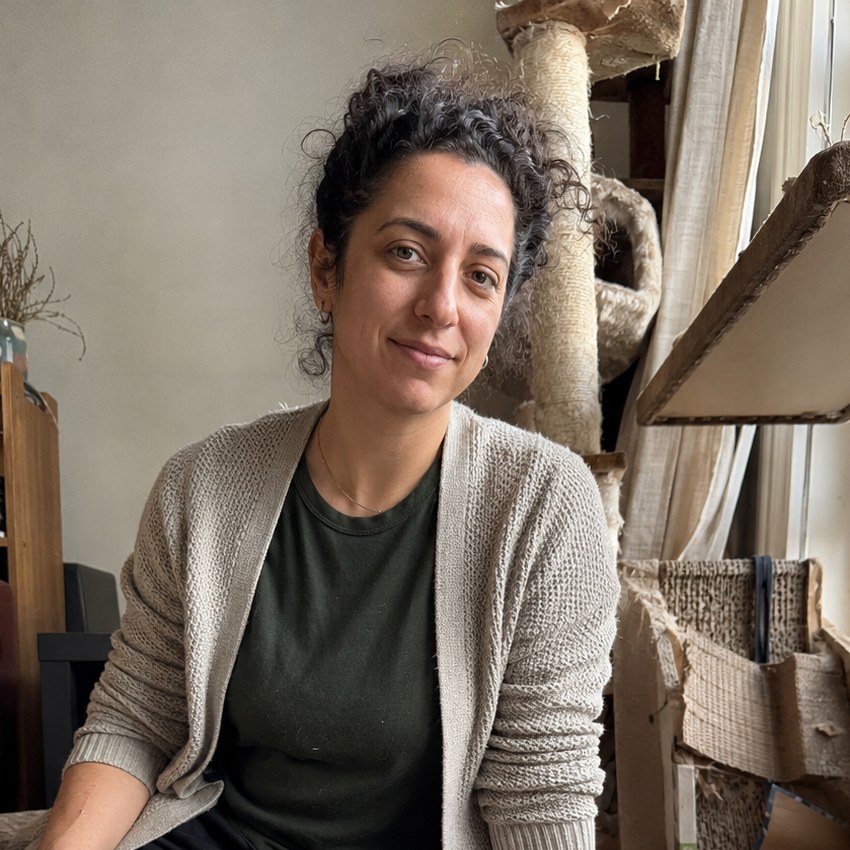
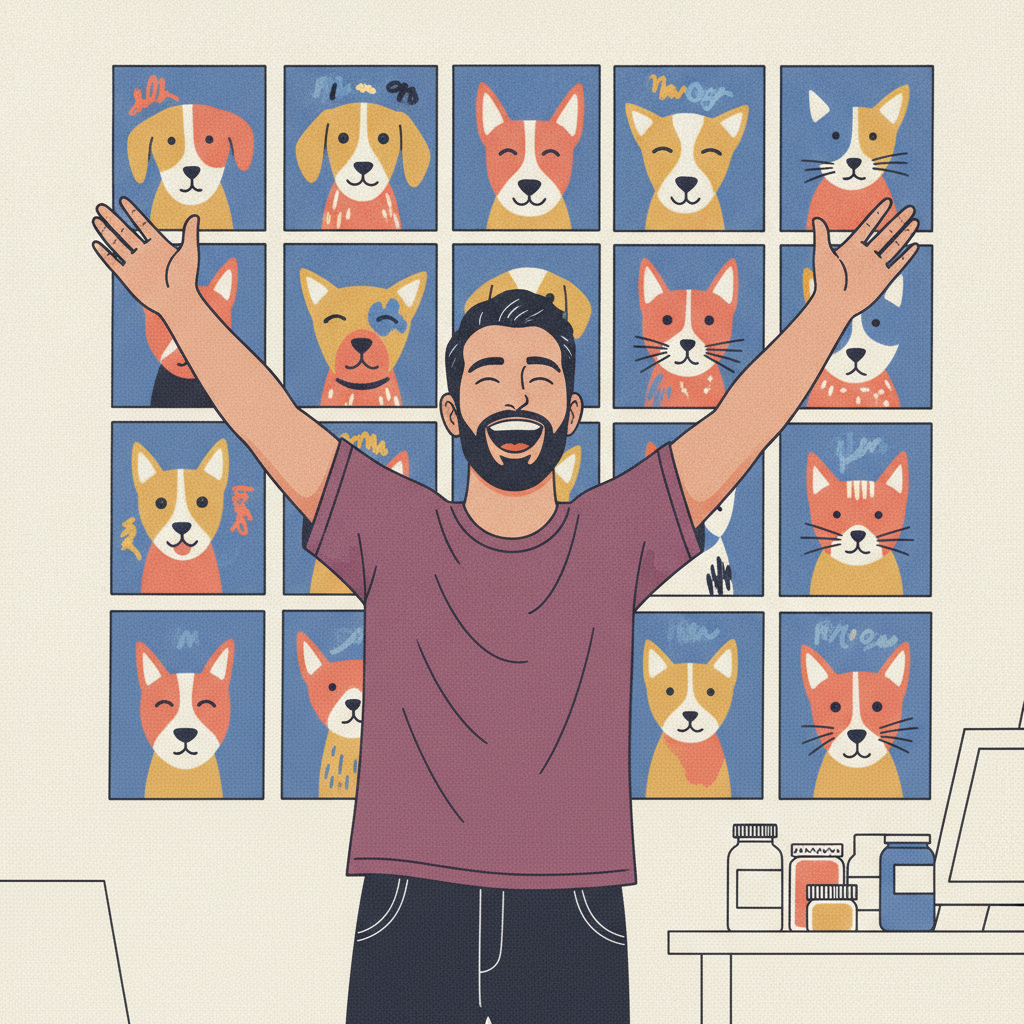
Here is the contradiction at the center of Ben Lenovitz’s career: the man has painted thousands of dogs and cats, and he is so allergic to both that a dog’s saliva drifting through the air can raise a rash on his skin. He pets dogs anyway, when he cannot help himself, then goes home and showers immediately. Before a big event he premedicates with allergy pills. He has built a livelihood, and a recognizable artistic signature, on animals he physically cannot keep in his own home.
That tension turns out to be the most interesting thing about his work, because it forces a question most pet owners never think to ask. What actually makes a pet portrait good? Lenovitz cannot rely on years of living alongside a particular breed or the muscle memory of a dog leaning against his leg. He has to see the animal, really see it, from the outside, the way a stranger does. And the answer he has arrived at, after roughly five years and thousands of commissions, is a small, practical philosophy that any owner can borrow the next time they want a portrait, a good phone photo, or simply a better look at their own pet.
An accidental specialty, born in an Osaka mall
Lenovitz did not set out to paint animals. He was an obsessive notebook draftsman, drawn to pen on paper because a single continuous line felt immediate in a way that brushwork, with its constant reloading of paint, never did. The notebook was private, low stakes, a place to take risks for himself. “It wasn’t serious,” he says. “It was fun.”
The pivot happened by accident, and abroad. After college, a modest antiques store over in Osaka that had stuck with him through a failed product line flew him out to draw New York City icons at a fair. Picture a twelve-story, windowless mall hosting a “NY fair,” with Lenovitz stationed between a Sbarro and a souvenir stall, cranking out Lady Liberties and skyline landmarks onto sheets of cardboard. Being from New York was credential enough; it made him, in the eyes of the crowd, an authentic NYC artist. Then the requests shifted. Shoppers began asking him to draw their inu and neko, dog and cat in Japanese.
He had never painted either. He fell for it instantly, the funny faces, the eyes, and especially a photo with the tongue out. “This is way more fun than painting the Statue of Liberty nonstop,” he remembers thinking, followed quickly by the thought that it might be a whole career. Back home, he started painting pet portraits at Fishs Eddy, and the specialty stuck. Thousands of portraits later, the menagerie has expanded well past dogs and cats to donkeys, turtles, bulls, spiders, and at least one crab.
The family store that made it possible
Fishs Eddy is not a gallery that took a chance on him. It is his parents’ store. They founded it three decades ago in their mid-twenties, selling flea-market dishes from upstate New York, and the last thing they wanted, by Lenovitz’s own account, was their son hanging around the shop all day. He earned his way in. After he had built the beginnings of a portrait business, they let him run an event at the store. It was a hit, and they handed him a small studio in the back, where he still does weekly pop-ups painting pets on the spot.
He credits the store, and his parents, completely. “There’s simply no version of me as an artist that exists without them,” he says, with the caveat that his mother still tells him, plainly, when a portrait is not good enough. That backstory is worth knowing because it explains the looseness in his work. The cardboard, the willingness to throw out a piece and start over, the refusal to treat any single painting as precious: that is the confidence of someone working in a place that has always been home.
What he learned about seeing a pet clearly
The practical heart of Lenovitz’s approach is the part owners can actually use. Working from the outside in, allergic and unattached, he has reverse-engineered what makes a pet portrait land, and most of it comes down to a few repeatable choices.
He paints from phone photos, not from life, and not by preference but by necessity, and he insists it is the better way regardless. Pets do not hold still. A candid iPhone shot freezes the expression a live sitting never could. Owners already have thousands of these photos, which means the raw material for a great portrait is usually sitting in a camera roll, not requiring a studio appointment.
He has moved from full-body compositions to oversized heads, because a giant head, he has found, is funnier and far more revealing of personality than a tidy full-length pose. He looks specifically for the photo with character in it, the tongue out, the slightly absurd expression, the moment that actually looks like the animal rather than a generic handsome dog.
His process is deliberately two-staged: a paintbrush first, for the hair and the general shape, then acrylic markers for the precise features, the eyes and the nose. He calls it surgical, broad strokes to establish the creature, fine marks to bring out the individual. And his signature blue background is not decoration but a trick of contrast; blue sits opposite the warm tone of cardboard, so leaving thin cracks of bare cardboard showing through makes the whole thing vibrate.
Underneath the technique sits a single influence he names: children’s art. “Stripping things back is where the strongest work comes from,” he says. His running risk, like a lot of skilled artists, is overcomplicating, so he trusts the process and tries not to overpaint.
How to get a portrait worth hanging
If Lenovitz’s method tells you anything as an owner, it is that a good portrait starts with you, before any artist touches a brush. A few takeaways translate directly.
Choose the photo for character, not polish. The blurry, tongue-out, faintly ridiculous shot will almost always make a better painting than the perfectly posed one, because it carries the personality an artist can build on. Favor good natural light and a clear view of the eyes, since the eyes do most of the emotional work in any animal portrait. Get reasonably close or be ready to crop in; the head and face hold the likeness. And if you commission a portrait in person, talk to the artist while they work. Lenovitz says the stories owners tell him as he paints, the funny ones and the sad ones alike, are what elevate a painting from accurate to alive. The likeness is craft; the character comes from you.
What’s next
Lenovitz is restless. He has been making oil and spray paintings for their own sake, pet-related as often as not, simply because, he says, pets have become such a fixture in his life that they wander onto the canvas even when he does not plan it. He is rolling out a line of paper goods, gift wrap and cards, and reworking his Cat Person and Dog Person patterns. His current obsession is a series of pigeon prints, each bird taking on the attitude of a different New York neighborhood, the Lower East Side, Flatiron, Williamsburg, that became a surprise holiday bestseller and has since spun off into cats and dogs of NYC in the same style. The throughline, as ever, is the city and its animals, rendered with a child’s simplicity by a man who loves them from a careful, antihistamine-assisted distance.
References
- Lenovitz, Ben. Artist’s portfolio and shop. https://www.instagram.com/benlenovitz/
- Fishs Eddy. https://www.fishseddy.com/
- “Pet Portraits and the Human-Animal Bond.” Human Animal Bond Research Institute. https://habri.org/
Sasha Ford is a certified cat behaviour consultant who has worked with shelters, catteries, and private clients across the country. They review all feline behaviour content at The Pet Times, with expertise in multi-cat households, indoor enrichment, and stress-related disorders.
Meet our experts ↗Keep reading
 TrainingThere Are Two Kinds of Anthropomorphism. One Helps Your Pet, One HurtsSara Lim · 7 min
 LivingAn Animal Communicator Told Me My Dog Wanted a Cleaner Water Bowl. She Was Right.Claire Sutton · 7 min
 LivingThe Photographer Who Kept Finding Cats Inside Refugees' CoatsNina Vasquez · 6 min
 LivingWhy Your Late Pet Keeps Showing Up in Your DreamsNina Vasquez · 7 min
 LivingYou Can Break Up With a Partner. You Can't Break Up With Your Dog.Sasha Ford · 5 min
 LivingThis Bright Yellow Bus Is Basically Uber, but Every Passenger Has Four LegsNina Vasquez · 4 min