


The Photographer Who Kept Finding Cats Inside Refugees' Coats
Chris Furlong went to the Ukrainian border to photograph people. What kept appearing in his frames was the animal they refused to leave behind.
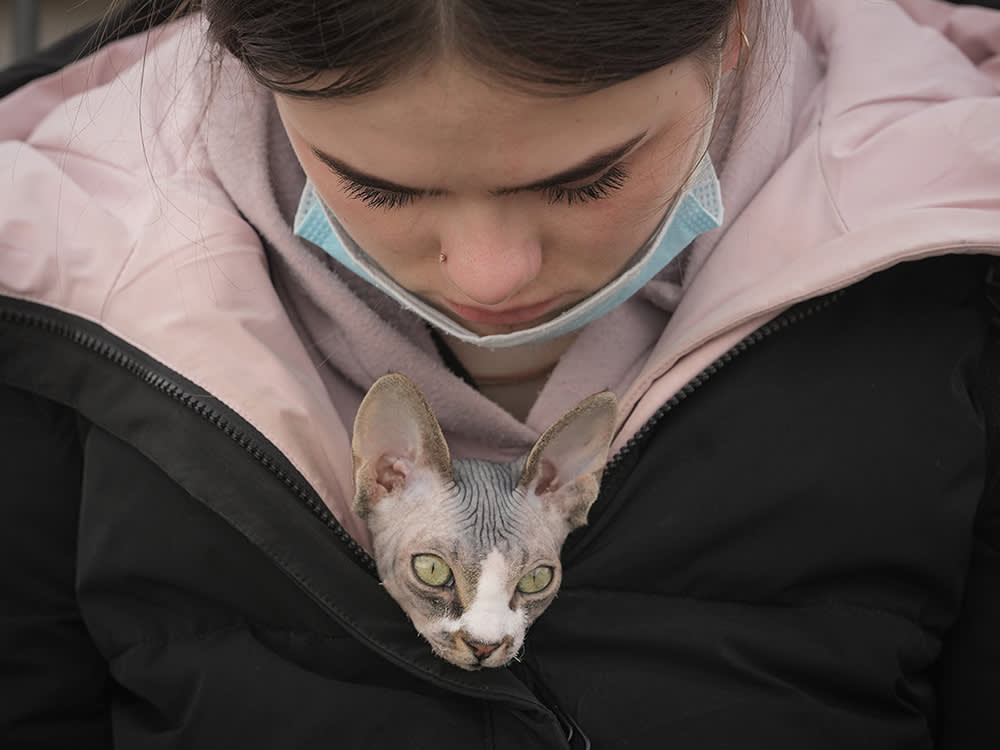
A young girl stands at a border crossing in subfreezing weather. Her eyes are down. Her coat is zipped almost to the chin, and out of the gap at the top, wide-eyed and slightly stunned, a cat is looking at the camera.
Chris Furlong, a staff photographer for Getty Images, took that photograph in March 2022 at Vysne Nemecke, Slovakia’s border crossing just west of Ukraine. It became one of the defining images of the exodus, and it is not really a photograph of a cat. It is a photograph of a decision.
What he kept seeing
Furlong went to document refugees. He has described being struck, on his first day in Hungary watching people come off the trains, by how many dogs there were. By his rough count, an animal came through with roughly every twentieth person, and locals confirmed the pattern for him: Ukraine, they told him, is a country full of dog people.
Once you know to look for it, the animals are everywhere in the coverage from that spring. Not as a sentimental garnish. As luggage that breathes.
Furlong’s read on the girl and the cat is worth repeating. The cat, to him, looked oddly settled, tucked into the coat and sitting there quite comfortably, while the girl carried all the sorrow in the frame. He wondered aloud whether the animal understood its assignment, whether it had registered that the human was suffering and that its job now was to stay calm and be a comfort. Dogs, he noticed, behaved differently: alert, watchful, either guarding their people or simply overwhelmed by unfamiliar ground.
Whether or not a cat can know that, the humans certainly did. Pets reduce stress and anxiety, a point the National Alliance on Mental Illness makes plainly, and there is no population on earth for whom that matters more than one that has just lost its home.
“When people flee, they take what they cannot survive without, and for a startling number of them that list includes an animal,” says Dr. Mara Chen. “It is not sentiment misfiring under pressure. That animal is the only piece of their old life that will still recognize them tomorrow.”
Why this exodus looked different
We have caught glimpses of this before. A handful of photographs of Afghans and Syrians carrying animals out. Scattered reporting on groups like Kabul Small Animal Rescue, SPCA International, and CatConnect, which have worked to get animals out of danger and back to the families who lost them.
Ukraine was different in scale and in visibility. Newsrooms actively went looking for the story, and found that a large share of the 6.3 million people who had already left, nearly all of them women and children, would not go without the animal. (Ukraine had barred men between 18 and 60 from crossing the border, in case they were needed as reserves, which is why the crowds in those photographs look the way they do.)
The other thing in the frame
There is a detail from Furlong’s account that gets less attention than the cat in the coat, and it deserves more.
At the crossings, hundreds of volunteers and aid organizations were handing out food, clothing, warmth, and hospitality. And standing right alongside them, in comparable numbers, were animal charities. Tents for dogs. Vets. Pet food. Cages. All of it set up and waiting, before anyone arrived, for animals nobody had counted and nobody was obligated to help. Furlong found it genuinely moving to see.
That is the part that says the most about what happened at those borders. Somebody, in advance, made the assumption that people would bring their animals, and built for it.
The rules bent, briefly
Ordinarily, walking a cat and a dog across an EU border from a high-rabies-risk country would be legally impossible without microchips, rabies vaccination, titer tests, and paperwork. In 2022 that machinery was, in Furlong’s phrase, relaxed: a lot of European governments loosened the rules on bringing animals in.
The loosening was real but not unlimited. Countries capped the number of pets per person, and some still required a quarantine period. And the United States remained far harder to enter with an animal, because federal health regulations did not bend the way Europe’s did.
The practical takeaway for anyone who has ever wondered whether they would be able to bring their pet in a genuine emergency: the rules that seem immovable can move. They just have to be moved deliberately, by governments, under pressure, in public.
Photographing people on the worst day of their lives
Furlong did not have an interpreter with him, which sounds like it should have made the work impossible and apparently did not. He encountered almost no antagonism. His sense was that most people understood why he was there, and that they wanted the story out.
He is unsentimental about the craft: the job is to photograph exactly what is in front of you, whatever it is, and it is never an easy one.
Another of his frames from the Hungarian border shows a nine-year-old boy named Kyryl in a bright red puffy coat, carrying his spaniel Hugo across the line after leaving Kyiv. Furlong’s description of the picture is the reason it works. The boy looks as if he is leading his whole family, as if he has quietly assumed some fatherly role, and he looks entirely in control. He has got Hugo in his arms.
That is a nine-year-old who is not in control of anything, holding the one thing he is.
How to help Ukraine’s animals
The organizations doing this work are the same ones that were standing in those tents at the border: rescue groups on the Ukrainian side moving animals out, veterinary teams running pop-up clinics for refugees and their pets, and shelters absorbing animals whose people could not take them.
Money is the useful contribution, and it is useful specifically because it is fungible. A group at a border crossing needs to buy crates this week and food next week, and cash lets them decide. Vetted rescue organizations working on the ground will tell you exactly what they need if you ask.
If you want the shortest version of why any of it matters, it is in the coat of a girl who had already lost her house and her country and would not lose one more thing.
Nina Vasquez writes about life at home with pets and the relationships at the heart of it. Her work covers day-to-day living, people-and-pet stories, and the products that fit into a real household, with a warm, grounded take on everyday pet ownership.
Meet our experts ↗Keep reading
 LivingIn a Colorado Divorce, Your Dog Is Legally a Toaster. A Bill to Fix That Just DiedClaire Sutton · 5 min
 LivingBroadway Barks Rehomed 2,000 Animals by Hijacking Actors' One Daily BreakNina Vasquez · 4 min
 LivingThe Internet's Favorite Grief Metaphor Just Got a Real AddressNina Vasquez · 4 min
 LivingYou Don't Have to Adopt a Dog to Get the BenefitClaire Sutton · 6 min
 Living5 Latinx-Owned Pet Brands Worth Your Money Every Month, Not Just OneLeila Torres · 4 min
 LivingYour Dog Dies and Work Gives You Zero Days Off. That's Starting to Change.Jordan Ellis · 5 min