
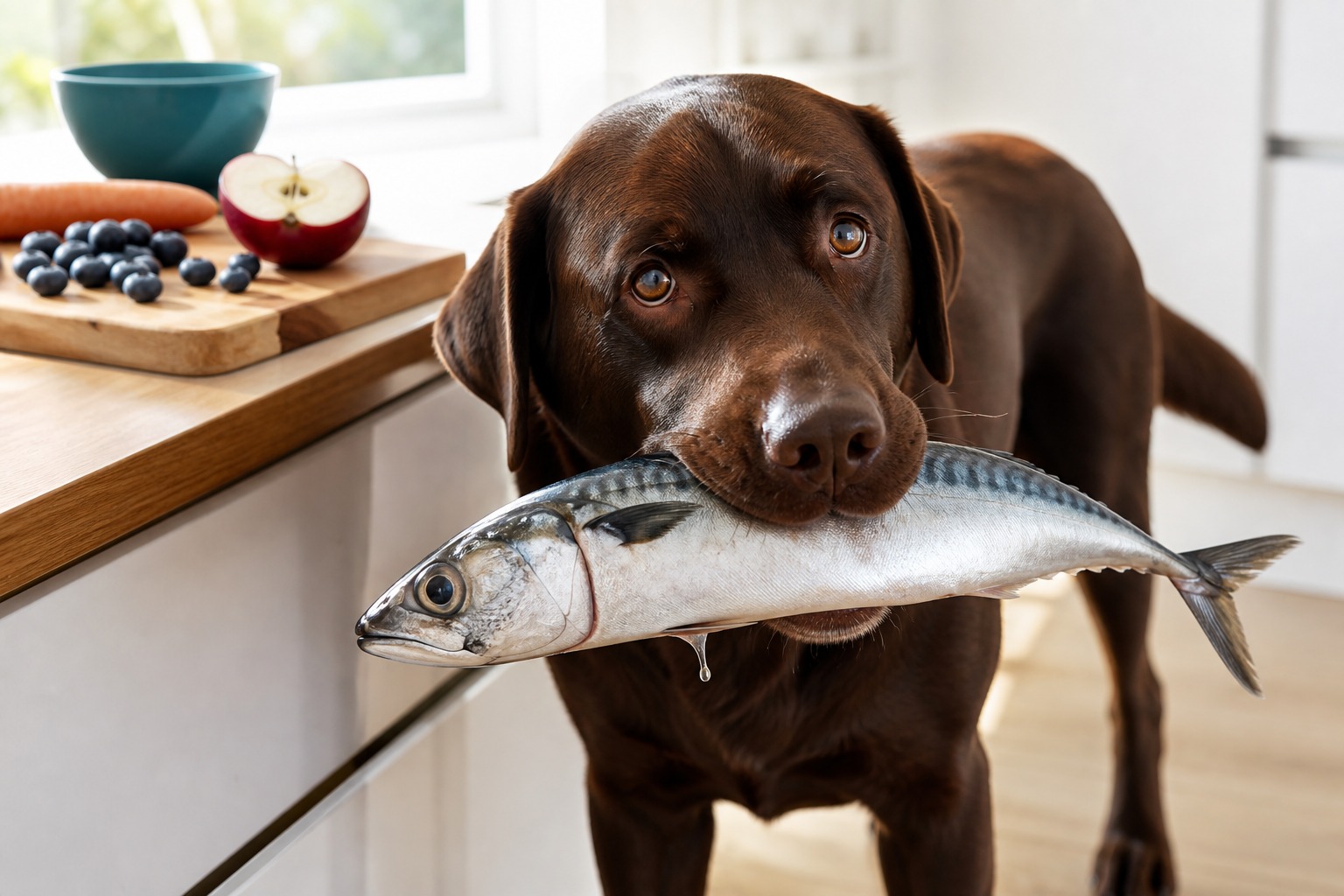
Walk down the supplement aisle and you’ll see “omega-3” stamped on flaxseed oil, chia blends, and a dozen plant-based dog products. Here’s the catch most of those labels skip: the omega-3 your dog’s body actually runs on isn’t really in any of them. Plants give dogs one form of the nutrient, and it’s mostly the wrong one. The forms that do the heavy lifting come from the sea, which is exactly why a spoonful of mackerel on top of dinner does something a drizzle of flax oil can’t.
Greyhounds can hit 45 miles per hour, briefly, one of the fastest land animals around, and then they want a nap. Alaskan Huskies cruise at about half that speed but hold it for hours while hauling a sled. Wildly different engines, same underlying need: the right fats to keep the body fueled, the joints working, and the brain sharp. That’s the real subject here, and it’s worth understanding before you spoon anything onto your dog’s food.
ALA, EPA, DHA: why the alphabet matters
Omega-3 fatty acids come in a few forms, and the distinction is the whole point. Flaxseeds, chia seeds, and pumpkin seeds are rich in alpha-linolenic acid (ALA), a plant-based omega-3 that supports brain function and has been studied for anti-cancer effects. Useful, but ALA is not the form the body uses directly.
What a dog actually runs on are two marine omega-3s: eicosapentaenoic acid (EPA) and docosahexaenoic acid (DHA), which come from animal and fish sources. Dogs can convert a little ALA into EPA and DHA, but nowhere near enough to meet their needs. That conversion bottleneck is the reason a plant oil can’t stand in for fish.
“This is one of the most common mix-ups I see,” says Dr. Priya Nair. “Owners buy a flax supplement thinking they’ve checked the omega-3 box, but the conversion rate to EPA and DHA in dogs is low enough that they’re really just feeding an expensive seed oil. If you want the joint and cognitive benefits, the source has to be marine.”
Working a fish high in omega-3s, mackerel is a great example, into the bowl a few times a week (aim for two or three) helps close that gap; meat from grass-fed animals can contribute too. Beyond fuel, EPA and DHA help reduce inflammation and support cognitive development, which is why they matter for growing puppies and aging dogs alike.
Buy the fish right
Not all canned mackerel is equal. Whenever possible, choose mackerel without additives like sugar or MSG (monosodium glutamate), a flavor enhancer best left out of your dog’s bowl. And reach for cans in water or tomato sauce rather than oil, since the fish already brings plenty of healthy fat on its own. One quiet advantage of mackerel specifically: it’s a small, short-lived fish, which means it accumulates far less mercury than big predators like tuna, making it a sound choice for regular feeding.
How much mackerel to feed
One cup of canned mackerel has about 300 calories, roughly equivalent to ¾ cup of commercial dry food. To keep it a topper and not a diet overhaul, replace about 10 percent of your dog’s regular meal with these amounts:
- 10-pound dog: 2 tablespoons
- 20-pound dog: 3 tablespoons
- 40-pound dog: ¼ cup
- 60-pound dog: ⅓ cup
- 80-pound dog: ½ cup
- 100-pound dog: ½ cup
For reference, canned mackerel is nutrient-dense in the ways that count. Per serving it runs roughly 6% calories, 30% protein, 15% total fats, 225% omega-3 (DHA), 123% omega-3 (EPA), 46% B3 (niacin), 26% B12, and 69% D3 of a dog’s reference values, a lot of nutrition for a small topper.
The no-cook mackerel topper recipe
With a mix of vegetables, fruit, and omega-3-rich fish, this topper is an easy addition to almost any bowl. Running everything through a food processor improves digestibility, and there’s no cooking involved. Those tiny mackerel bones are soft and break down in the blend, so leave them in.
Ingredients
- 1 (15.5-ounce) can mackerel or salmon
- 1 garlic clove
- 1 medium carrot
- 1 medium red bell pepper, seeded
- ½ cup frozen spinach, thawed
- 1 medium red apple, stemmed and cored
- ½ cup blueberries
Directions
- Drain and rinse the mackerel.
- Tip the fish and the garlic clove into a food processor and run it until uniformly minced.
- Give the carrot, bell pepper, and apple a rough chop, then add them along with the spinach.
- Drop in the blueberries and finish with a few short pulses, stopping once everything is confetti-fine.
Yield: about 5½ cups.
This is a once-a-day topper: swap a fifth of the regular meal for it, using these amounts:
- 10-pound dog: 1 to 3 tablespoons
- 20-pound dog: ¼ cup
- 40-pound dog: ⅓ cup
- 60-pound dog: ⅓ to ½ cup
- 80-pound dog: ⅓ to ¾ cup
- 100-pound dog: ½ to ¾ cup
Nutritional information per cup: about 133 calories, 42% protein, a carbohydrate-to-protein ratio of 0.4 to 1, 40% total fats, and 38% antioxidants.
A quick note on the garlic: in the very small amount this recipe spreads across 5½ cups of food, it’s a flavor accent, not a meaningful dose. If your dog is small, or you’d simply rather not, you can leave it out with no real loss.
What’s new since this was written
The clinical case for marine omega-3s in dogs has only gotten firmer. Controlled studies in dogs with osteoarthritis have found that diets enriched with EPA and DHA can improve mobility and, in some cases, let dogs reduce their anti-inflammatory medication, which tracks with what owners of stiff, older dogs often report anecdotally. Veterinary nutrition guidance now commonly points to EPA and DHA specifically, not omega-3 in general, for joint and skin support.
There’s a sensible ceiling, though. More fish oil is not automatically better; very high doses can affect blood clotting and upset the stomach, so a fish topper a few times a week is a smart, moderate way to get the benefit without overdoing it. If your dog has a health condition or is on medication, it’s worth running a regular fish addition past your veterinarian first.
References
- National Research Council. Nutrient Requirements of Dogs and Cats. National Academies Press, 2006. https://nap.nationalacademies.org/catalog/10668/nutrient-requirements-of-dogs-and-cats
- Roush, James K., et al. “Multicenter veterinary practice assessment of the effects of omega-3 fatty acids on osteoarthritis in dogs.” Journal of the American Veterinary Medical Association, vol. 236, no. 1, 2010, 59–66. https://avmajournals.avma.org/view/journals/javma/236/1/javma.236.1.59.xml
- U.S. Food and Drug Administration. “Mercury Levels in Commercial Fish and Shellfish.” Accessed May 2026. https://www.fda.gov/food/environmental-contaminants-food/mercury-levels-commercial-fish-and-shellfish-1990-2012