


The Saucer of Milk Is a Plot Hole: What Cats Actually Do With Dairy
The storybook bowl of milk gets cats almost exactly backward. Milk isn't poison, but most adult cats lose the very enzyme that would let them drink it. Here's the biology, when a lick is fine, and what to pour instead.

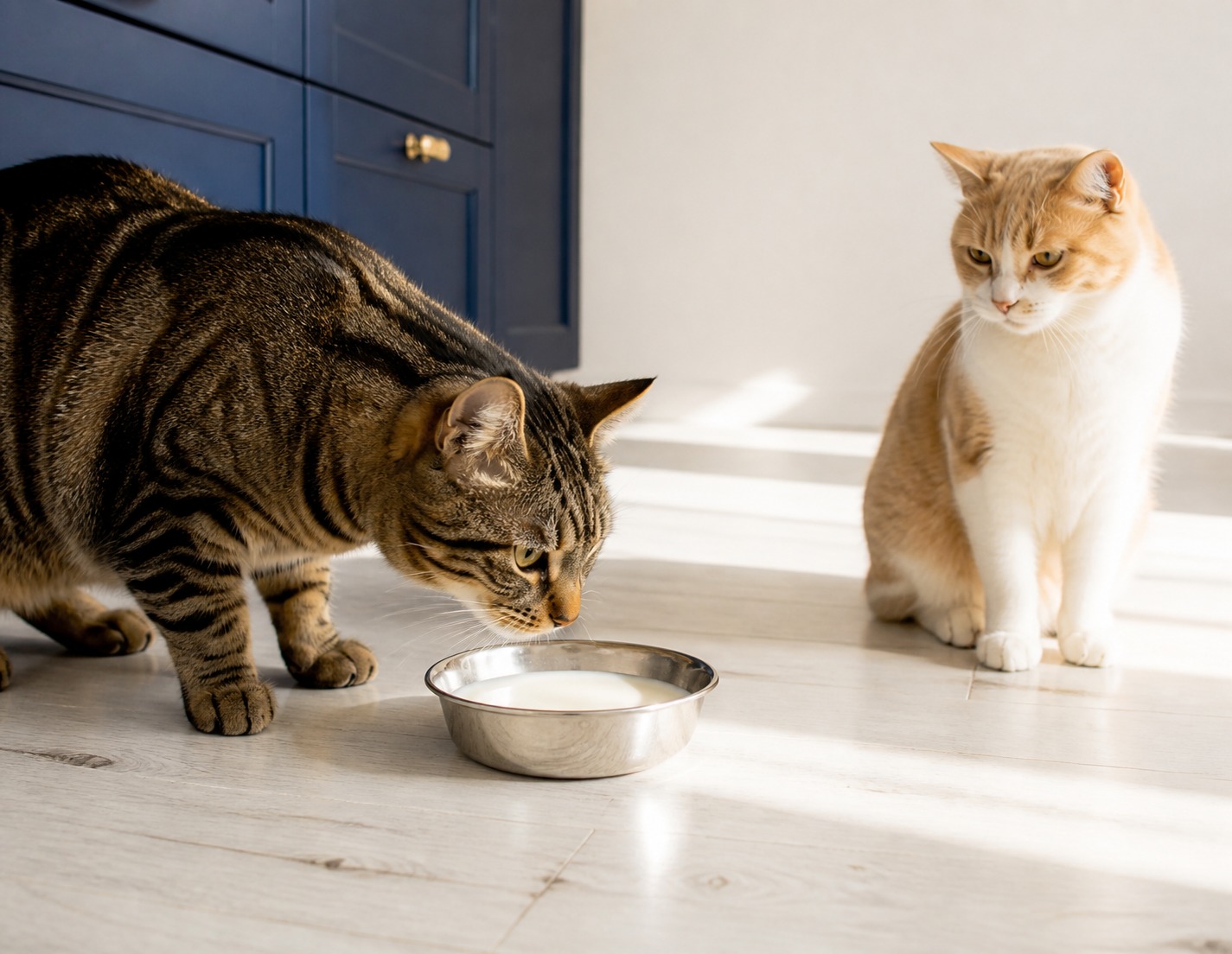
The saucer of milk is one of the most durable images in all of cat lore: the contented cat, the shallow bowl, the pink tongue. It shows up in picture books, cartoons, and cream commercials. It is also, biologically, a bit of a plot hole. The cat in that picture is almost always an adult, and most adult cats have lost the one piece of equipment that would let them enjoy a bowl of milk without consequences. Milk is not poison. But the storybook gets the cat backward: the animal we picture lapping happily is usually the animal least equipped to handle it.
Why kittens can and grown cats mostly can’t
The whole thing turns on a single enzyme called lactase. Kittens are born flush with it, because their first and only food is their mother’s milk, and lactase is what breaks the milk sugar lactose into pieces small enough to absorb. It is, in a real sense, the most important enzyme in a newborn kitten’s body.
Then weaning happens, and the body does something logical: it stops making an enzyme it no longer needs. As a kitten matures and moves onto solid prey-based food, lactase production winds down, often dramatically. The adult cat is left lapping up a sugar it can no longer digest.
People assume a cat that loves milk must be able to handle it, but enthusiasm and digestion are two different things. Most adult cats simply stopped making the enzyme that processes milk sugar after they were weaned. When they drink it anyway, the undigested lactose ferments in the gut, and a few hours later you get the vomiting, the diarrhea, and the gas.
That delay is part of why the milk myth survives. The cat drinks, seems delighted, and the stomach upset arrives hours later when no one is connecting it to the bowl.
”Not toxic” is doing a lot of work
It is worth being precise, because precision is where the myth either dies or hides. Milk is not on the list of foods that are dangerous to cats the way chocolate, onions, and grapes are. A cat that steals a lick of milk is not in danger. So when people say “milk is fine for cats,” they are technically right about toxicity and usually wrong about everything else.
The downsides are the ordinary kind, not the emergency kind. Whole milk and cream are high in fat and sugar, so offered regularly they pack on weight, and feline obesity is already one of the most common problems vets manage. Stack lactose intolerance on top and a regular milk habit becomes a recipe for a chronically uncomfortable, slowly fattening cat. Milk does carry real nutrients, protein, calcium, phosphorus, and vitamins, but a complete cat food already supplies all of those, so there is nothing in a bowl of milk a healthy cat actually needs.
The honest “is a lick okay” framework
Real cats live with real owners who occasionally cave to a begging face, so here is the practical version rather than a flat no.
Start by reading your individual cat. A minority of adult cats retain enough lactase to handle small amounts of dairy without any visible upset. If your cat has licked yogurt or ice cream before with no consequences, that cat is probably in that tolerant group.
“If a cat clearly enjoys a dairy treat and it never upsets their stomach, a tiny amount once in a while isn’t a problem,” says Dr. Mara Chen, DVM. “What I steer people away from is the daily saucer. A teaspoon as a rare treat is a very different thing from making milk part of the routine, which is where you start trading a happy moment for an unbalanced diet and a heavier cat.”
A few guardrails make the occasional indulgence safer:
- Keep it to a teaspoon, rarely. Once or twice a week at most, and never as a substitute for water or food.
- Watch the four-to-twelve-hour window. Lactose trouble shows up late. If a small taste leads to soft stool, gas, or vomiting, that cat is intolerant, and the answer is simply no more.
- Remember dairy is everywhere. Lactose is also in yogurt, ice cream, and cheese. The same logic applies to all of it.
- Lactose-free “cat milk” exists. Pet stores sell formulated cat milk with the lactose removed or reduced, designed as a treat. It is gentler than cow’s milk, though still a treat and not a beverage.
Goat’s milk gets talked up as a friendlier option. It does contain somewhat less lactose than cow’s milk and some cats tolerate it better, but “less lactose” is not “no lactose,” and the marketing claims about gut health outrun the evidence. If you are curious about it for a specific reason, raise it with your vet rather than the internet.
Kittens are the real exception, with one hard rule
Everything above is about adult cats. Kittens are the genuine milk drinkers, and they come with a rule that is worth stating bluntly: a kitten that still needs milk needs kitten milk replacer (KMR), never cow’s milk and never goat’s milk.
Cow’s and goat’s milk are not nutritionally balanced for a growing kitten, and feeding them to an orphaned kitten can leave it malnourished even while it appears to be eating. KMR, sold as a liquid or powder, is built to mimic queen’s milk and supply what a kitten actually needs. Once a kitten is old enough to eat kitten food, it no longer needs milk at all, although some people make a soft gruel of KMR and kibble to bridge the transition.
As for water, very young nursing or formula-fed kittens get all their hydration from milk and do not need a separate water bowl. Around four weeks, as weaning begins and they start tasting solids, you can offer water. They may not drink much yet, and that is normal.
What to pour instead
The replacement for the storybook saucer is delightfully boring: a bowl of fresh, clean water. Many cats are casual drinkers, descended from desert animals that historically got most of their water from prey, so if yours seems uninterested, the fix is to make water more appealing rather than to reach for milk. A pet fountain tempts cats who prefer moving water, a wider bowl spares sensitive whiskers, and a splash of the water from a can of tuna packed in water (not oil, not brine) can turn a plain bowl into something worth investigating. Feeding wet food helps too, since it is most of the way to water already.
The bottom line
Milk is not toxic to cats, but the cozy image of a cat happily lapping a saucer has the biology backward. Kittens are built for milk and lose the equipment for it as they grow, which leaves most adult cats unable to digest the very thing the storybook hands them. A rare teaspoon for a cat that tolerates it is harmless; a daily bowl trades a sweet moment for stomach upset and creeping weight. Keep milk a once-in-a-while treat at most, give orphaned kittens proper KMR and nothing else, and let water do the job milk was never built to do for a grown cat.
References
Common questions
What happens if my cat drinks a little milk?
It depends on whether your cat is lactose intolerant, which most adult cats are. A lactose-intolerant cat can get an upset stomach from even a small amount, usually within a few hours. Some cats tolerate a teaspoon now and then with no issue, but it should never be a regular thing.
Is there a milk that's safe for cats?
Lactose-free 'cat milk' sold in pet stores is formulated to be gentler and is meant as an occasional treat, not a drink. Goat's milk has somewhat less lactose than cow's milk but is not lactose-free. For orphaned kittens, the only correct milk is kitten milk replacer (KMR), never cow's or goat's milk.
What should my cat drink instead of milk?
Fresh, clean water, full stop. If your cat doesn't drink enough, a pet fountain, a wider bowl, or a splash of water from a can of tuna packed in water can encourage them. Cats get a lot of moisture from wet food, which is another reason it helps hydration.
Not a substitute for your vet. Our guidance is educational. For urgent symptoms, contact a vet or emergency clinic right away. Editorial standards
Dr. Nair is a veterinarian focused on diet and feeding. She covers everyday nutrition, treats, and the many "can they eat this?" questions owners ask, grounding each answer in what is actually safe and sensible for dogs and cats.
Meet our experts ↗Keep reading
 FoodRaw Chicken for Cats Got Measurably More DangerousDr. Mara Chen · 6 min
 FoodFor a Carnivore, 'Is It Safe?' Is the Wrong Question About Human FoodDr. Priya Nair · 6 min
 FoodThe 'Superfood' Strawberry Does Nothing for Your Cat. They Can't Even Taste ItDr. Priya Nair · 5 min
 FoodYour Cat Doesn't Need to Eat Catnip to Get High. Eating It Is the Risky PartDr. Mara Chen · 6 min
 FoodApples Won't Hurt Your Cat. Your Cat Just Won't CareDr. Priya Nair · 4 min
 FoodCats Can Eat Pineapple. They Literally Can't Taste the Point.Dr. Ravi Mehta · 3 min