


Her Cats Kept Sneaking Into the Drawings. Then They Took Over.
Livia Fălcaru's illustrations look like a joke until you notice what they're about. The Bucharest artist on why her rescue cats, Lily and Ida, ended up in almost everything she makes.
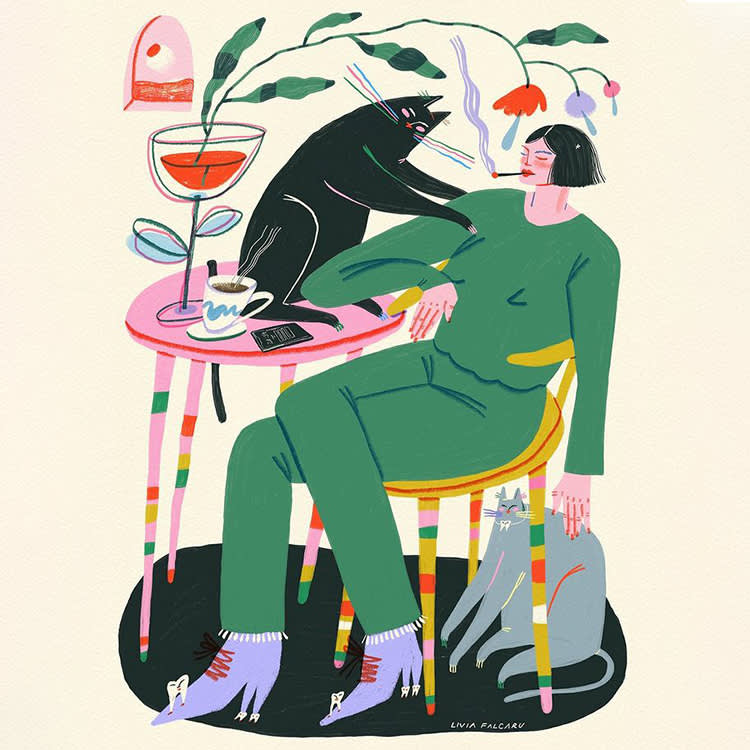
The first thing you notice in a Livia Fălcaru illustration is that it’s fun. The palette is loud, the shapes are round and cheerful, and there is very often a cat in it, drawn with whiskers about four times longer than any cat has ever had.
The second thing you notice, usually a beat later, is what the picture is actually about. Vulnerability. Fear. Getting through something. The cheerfulness is a delivery mechanism, and the payload is heavier than it first appears.
The Bucharest-based artist has built a serious following on that gap — plus partnerships with brands including Vans, Refinery29, and WWF. And running through nearly all of it are two rescue cats named Lily and Ida, who did not start out as subject matter and gradually became inescapable.
Her explanation for how they got there is almost aggressively unromantic. She draws whatever is in front of her, she says, and the cats are permanently in front of her. She likes cats and she likes the particular things cats do. That’s it. That’s the artistic statement.
The cats got in through the side door
Neither Lily nor Ida was a creative decision. They were a domestic fact that colonized the work.
The two cats are both four, and they arrived from different lives: Lily was Fălcaru’s, Ida was her boyfriend’s. When the couple moved in together two and a half years ago, the households merged and so did the cats. Both were adopted, which was not incidental — Fălcaru is firm that she doesn’t support the trade in animals.
They are, by her account, opposites in every respect. Lily is calm, lazy, quiet, and barely ever meows. Ida is energetic, climbs anything that will hold her, and is extremely talkative — the two of them, Fălcaru says, hold entire conversations in meows.
The morning routine is the one every cat person knows and pretends to resent: one of the humans gets dragged out of bed to produce food, having first been climbed on, sat on, and stared at unblinkingly until compliance. She finds it funny. That’s the tell. The stuff that ends up in her drawings is the stuff she finds funny.
Now the cats appear by reflex. Dropping one into a picture, she says, is something her hand does without being asked — and they have turned up everywhere, from custom wrapping paper to unannounced cameos in jigsaw puzzles.
Why a cat is a genuinely useful thing to draw
There’s a craft reason this works, and it’s worth saying out loud, because “artist likes her pets” doesn’t explain why the pets improve the pictures.
A cat in a frame does something specific: it lowers the stakes without lowering the meaning. If you draw a person in the middle of an existential crisis, the picture is about the crisis, and the viewer braces. Put a cat in the corner of that same picture, looking faintly unimpressed, and something loosens. The viewer comes closer. The hard thing becomes approachable.
Cats are also, structurally, wonderful to draw: they’re a bag of curves that will hold any shape you push them into, which is why illustrators from Louis Wain onward have kept coming back to them. Fălcaru exaggerates hard — round bodies, absurd whiskers — and the cat survives it. A cat still reads as a cat at almost any level of distortion. Very few subjects are that forgiving.
The work is a diary, and she knows it
She describes her working process as an intimate one, and says nearly everything she makes comes out of her own life and the things that have happened in it.
She’s clear about why: it’s the material she’s most comfortable with, because it lets her show what she’s feeling and how she’s seeing things, and it does something for her while she does it. The drawing is the processing. That’s not a metaphor she reaches for casually — she describes it plainly as a healing process.
The corollary is that the style has never held still. She sees the whole thing as a journey that keeps changing, and says her style has shifted enormously across the years, only recently arriving somewhere stable, after a long stretch of experiments — a point where she feels like she’s finally found her own voice.
Even that, she doesn’t intend to defend. Locking in a formula and running it for the rest of her career strikes her as a slow death by tedium, so she stays open to changing it again.
On sharing it, and the brands
Her Instagram is full of work-in-progress, and the strategy behind that is, refreshingly, no strategy at all. She’s spontaneous about it, almost never plans what she’ll post, and mostly shares things because she’s enjoying them too much to keep them to herself. She likes bringing people into the process.
On collaborations, she’s a “yes” person: if a project lines up with her values and beliefs, she’ll try it. But the mechanics are the part worth writing down for anyone building a creative career, because it’s the opposite of the advice usually handed out.
Almost every partnership she’s had came from a brand approaching her. Almost every time she pitched a brand herself, she got ignored. So she stopped pitching. Her working theory now is to produce consistently good work and let it do the reaching.
The dream, when asked, is Gucci — patterns or illustrations. She’s not tentative about it: the day will come, she says, it’s a matter of time.
The bigger thing she wants
Yes, she’ll accept “cat person,” although she’d rather be called an all-animals person. She and her boyfriend periodically float the idea of a third cat, then remember what three cats in one apartment would mean, and settle back down.
But the ambition underneath the cheerful drawings is not small, and it isn’t about cats specifically. What she’s wanted since she was a child is to get rich enough to open animal shelters in Romania, where — as she puts it — animals have no legal rights and are still treated badly. It’s a cause that sits very close to her, and she hopes she’ll get to do something real about it.
Which reframes the whole body of work, slightly. The cats in the corners of the pictures aren’t decoration, and they aren’t branding. They’re the argument, made gently enough that you’ll let it in.
References
- Fălcaru, L. Artist portfolio and illustration work.
- Four Paws International. Stray animal care in Romania.
- ASPCA. Why adopt from a shelter or rescue.
Leila Torres leads our Living coverage, from home life and travel to the products and rescue stories that come with sharing a life with animals. She edits and writes across the section, with a soft spot for pieces about the bond between people and their pets.
Meet our experts ↗Keep reading
 LivingBrooklyn's Cat Cafe Flipped the Model: It's a Rescue Clinic With a Cafe AttachedSara Lim · 6 min
 Living95% of Them Kept the Cat: What a Loneliness Study Proved About FosteringNina Vasquez · 5 min
 LivingThe 'Dog Guy' Is Quietly Becoming a Cat GuyNina Vasquez · 4 min
 LivingThe 'Sexy Cat Dad' Thing Isn't About Cats. It's About Consent.Leila Torres · 6 min
 LivingA Whole City Spent 20 Days Hunting for a Hardware-Store Cat. It Worked.Marcus Webb · 6 min
 Living95% of Them Adopted the Cat They 'Just' FosteredNina Vasquez · 5 min