


Your Dog's Tail Went Limp After a Big Day Out. It's Probably Not Broken
A suddenly droopy, painful tail after swimming or hard play looks alarming, but limber tail syndrome is usually a pulled muscle that heals on its own. Here's how to tell, and when the vet still matters.

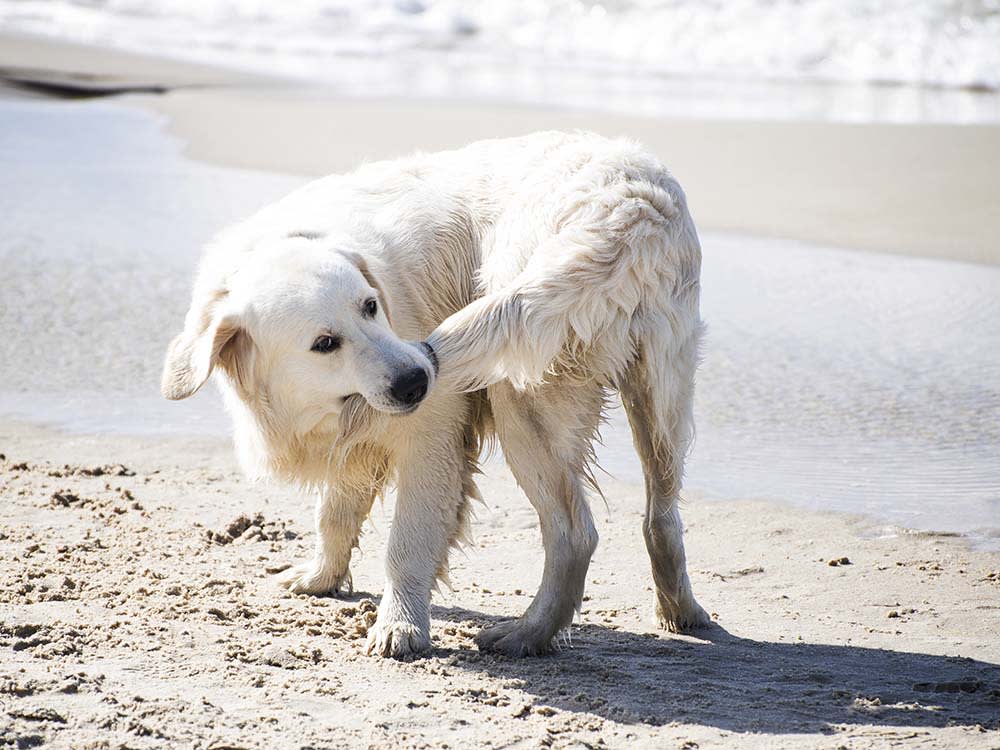
Your dog spent the day being gloriously themselves, a long hike, a swim, a marathon of fetch, and now something is off. That tail that usually clears a coffee table in one wag hangs dead-limp behind them. They lower themselves down slowly, gingerly, like a dog three times their age, and they won’t let you near the base of the tail. You rack your brain for the moment it snapped, a yelp, a slammed door, and come up with nothing. So what broke?
Most likely, nothing broke. What you’re almost certainly looking at is limber tail syndrome, and the reframe worth holding onto is this: the part that looks most alarming, a tail that’s gone completely slack and sore, is also the part that usually heals on its own within days to a couple of weeks. It’s not a fracture and not a nerve catastrophe. It’s a strained set of muscles that overdid it, which is oddly reassuring once you know what you’re seeing.
What limber tail actually is
The clinical name is acute caudal myopathy, which sounds far scarier than “your dog pulled a tail muscle,” but that’s essentially what it means: a sudden-onset problem with the muscles of the tail. The tail goes flaccid or limp, it’s painful (especially near the base), and then, in the vast majority of cases, it quietly resolves.
It has collected an entire drawer of folk names over the years, which tells you how familiar it is to the people whose dogs get it: cold tail, limp tail, frozen tail, swimmer’s tail, dead tail, rudder tail, and the almost too-cute “broken wag.” Veterinary medicine has known about it for a long time. What it still doesn’t fully know is the exact mechanism that causes it.
The things that tend to trigger it
Even without a nailed-down cause, the pattern of triggers is well established, and it clusters around one theme: the tail muscles doing more than they’re conditioned for.
- A hard day after a soft stretch. These injuries famously follow a big burst of activity that comes after a longer sedentary period, the weekend-warrior problem, but for tails.
- Swimming and cold water. Water activity is a classic setup, and the syndrome shows up more in cold, wet weather (though warm-weather cases happen too).
- Long crate transport. A dog braced in a crate for a long haul may strain the tail using it to balance in a cramped space.
There also appears to be a genetic thread. Related dogs tend to be affected together, and certain breeds get it more than others.
Which dogs are most at risk
Limber tail is a working dog’s injury. It shows up most in athletic, sporting, and working breeds, the Labrador and other retrievers, pointers, setters, and hounds, the dogs built to run hard, swim, and work in the field. That’s not a coincidence: these are the dogs most likely to throw themselves into exactly the kind of all-out exertion and cold-water swimming that sets the syndrome off. A couch-potato lapdog rarely finds the opportunity.
How a vet sorts it out
Here’s why the vet visit still matters even for a “harmless” condition: a limp, painful tail can also be caused by things that are not harmless, and telling them apart is the point. A fracture, a dislocated vertebra, impacted or infected anal glands, or a problem in the lower spine can all masquerade as, or hide behind, a droopy tail.
Diagnosis usually starts with the story, a history of recent swimming, hard exercise, or a long crate ride, paired with a hands-on exam. Your vet feels along the tail and its base, checks range of motion and pain, and rules out the more serious mimics. Imaging like an X-ray may be used when there’s any suspicion of a fracture or spinal issue. Often the history plus the exam is enough to land on limber tail with confidence.
How it’s treated
Because limber tail is self-limiting, treatment is mostly about comfort and rest while the muscles recover.
- Rest is the medicine. Cut back activity and let the tail heal; pushing more exercise onto a strained muscle only prolongs it.
- Anti-inflammatories and pain relief. Vets commonly prescribe anti-inflammatory medication to bring down swelling and ease pain. Don’t reach for human painkillers on your own, many are toxic to dogs, so let your vet choose the drug and dose.
- Warmth and time. A warm compress can help soothe the area, and most dogs are back to normal within days to a few weeks.
The main thing you’re buying with the vet visit isn’t a dramatic cure. It’s proper pain control for a genuinely uncomfortable dog, and the peace of mind that you’re not ignoring something more serious hiding underneath.
Owners are always braced for me to say ‘fracture’ or ‘nerve damage,’ and I love telling them it’s a strained muscle instead. The one thing I won’t let them do is dismiss the pain because the diagnosis is mild. A limp tail hurts, and a dog that’s hurting deserves relief while it heals, not a shrug.
The quick version
- Limber tail syndrome makes a dog’s tail suddenly go limp and painful, usually after hard exertion, swimming, or a long crate ride.
- The exact cause isn’t fully understood, but it’s tied to specific activities and to athletic, working breeds.
- It typically heals on its own in days to weeks, but it’s worth a vet visit for pain relief and to rule out a fracture, spinal problem, or anal-gland issue.
What newer research adds
For a long time limber tail was assumed to be rare, an occasional oddity in hard-working dogs. Newer data suggests it’s far more common than that impression implied. A large cohort study following Labrador Retrievers found a cumulative incidence of about 9.7 percent, meaning roughly one in ten Labs in the study experienced limber tail at some point. That’s not a fluke condition; it’s a real occupational hazard of being an active, water-loving dog.
The same line of research strengthened the genetic hunch, too. Affected Labradors were more likely to be related to one another than unaffected dogs were, pointing to a heritable component, a reason some dogs seem prone to it while their equally athletic friends never get it. None of this changes the home takeaway, though. If your working dog comes home from a big swim with a sad, limp tail, ease off the activity and call your vet, because the fix is mostly rest, patience, and a little help staying comfortable.
References
- Hall, E. J., et al. “Cumulative Incidence and Risk Factors for Limber Tail in the Dogslife Labrador Retriever Cohort.” Veterinary Record, 2016. Link
- Cornell University College of Veterinary Medicine, Riney Canine Health Center. “Limber Tail in Dogs (Acute Caudal Myopathy).” Link
- Steiss, J., et al. “Coccygeal Muscle Injury in English Pointers (Limber Tail).” Journal of Veterinary Internal Medicine, vol. 13, no. 6, 1999, pp. 540–548. Link
Not a substitute for your vet. Our guidance is educational. For urgent symptoms, contact a vet or emergency clinic right away. Editorial standards
Dr. Chen is a small-animal veterinarian who leads health and safety coverage at The Pet Times. She writes and reviews the bulk of our illness, condition, and safety content, translating clinical guidance into clear, practical advice owners can act on at home.
Meet our experts ↗Keep reading
 Health & WellnessRingworm in Dogs Isn't a Worm. And Half the Cure Happens at HomeDr. Priya Nair · 7 min
 Health & WellnessCooked Salmon Is a Gift. Raw Fish From a Lake Can Kill Your Dog.Dr. Priya Nair · 5 min
 Health & WellnessYour Dog Isn't Hungry. Your Litter Box Is Just Unlocked.Dr. Priya Nair · 8 min
 Health & WellnessThe Scary Headline Was Chemicals. The Real Culprit Is Your Dust.Dr. Nina Kohl · 4 min
 Health & WellnessMud Won't Hurt Your Dog. What's Living In It Might.Dr. Priya Nair · 6 min
 Health & WellnessOne Raw Fish Can Kill a Dog in Two Weeks. Most Owners Have Never Heard of It.Dr. Ravi Mehta · 6 min