


Labradoodle vs. Goldendoodle: You're Asking the Wrong Question
The two most popular doodles are more alike than the breeders selling them let on. The real decision isn't which doodle, it's whether you're ready for one at all.

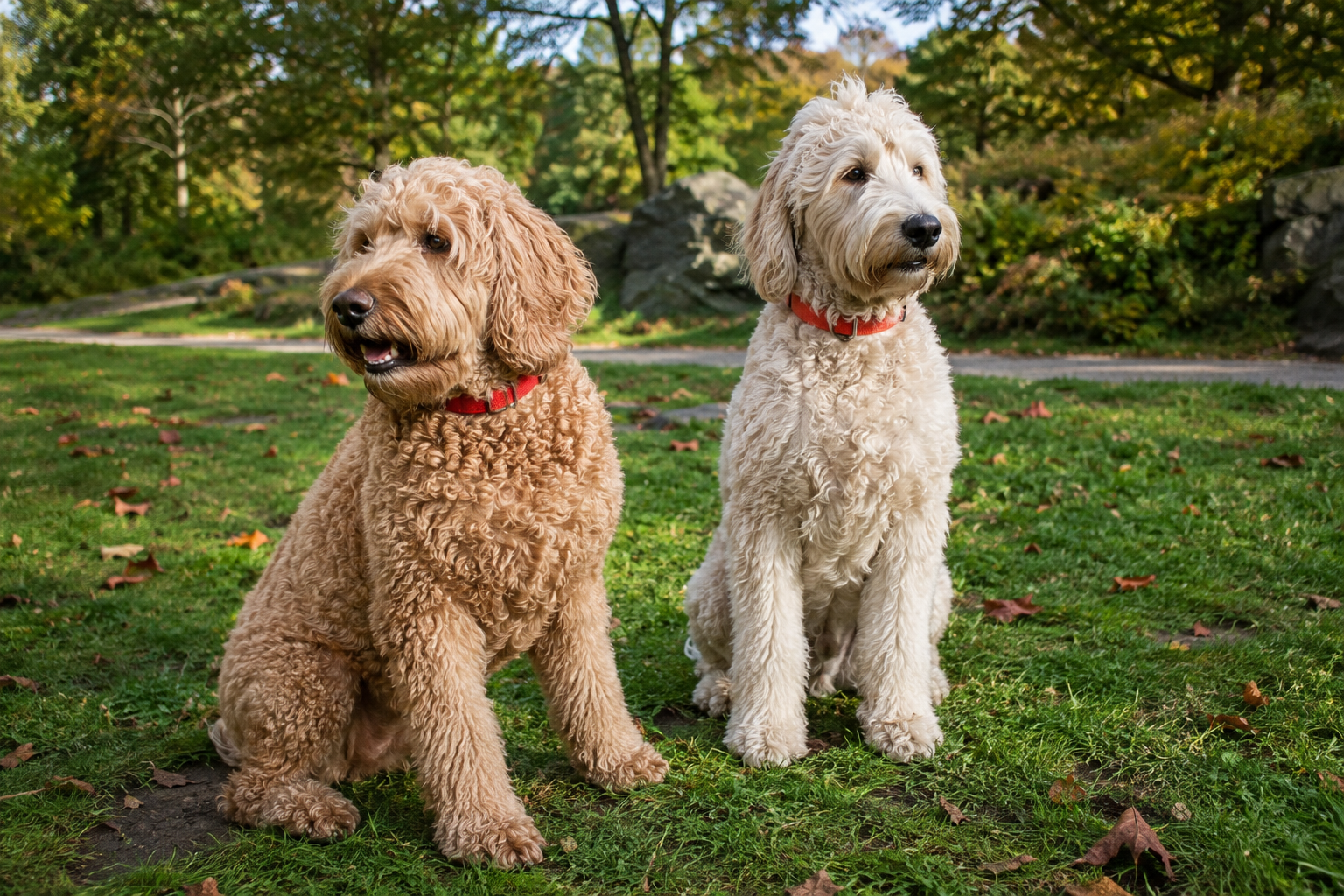
People agonize over Labradoodle versus Goldendoodle as if they are choosing between two very different dogs. They are not. Line the two breeds up honestly and the similarities swamp the differences: comparable sizes, near-identical grooming demands, the same friendly wiring, and a shared list of health risks. The gap between them is smaller than the gap between two individual dogs of the same type.
So the more useful question is not “which doodle.” It is whether you are ready for a doodle at all, a high-energy, high-maintenance, often expensive dog produced by a booming and largely unregulated breeding industry. Get that question right and the Labradoodle-or-Goldendoodle part mostly sorts itself out. Let’s take it in that order.
First, what they actually are
A Labradoodle is a cross between a Labrador Retriever and a Poodle. A Goldendoodle is a cross between a Golden Retriever and a Poodle. Both are usually considered hybrids of two purebreds rather than breeds in their own right, which is why neither is recognized by the American Kennel Club. That said, both have dedicated organizations that set breed standards and best practices for genetic testing and mating selection, so “not AKC-recognized” does not mean “unstructured.”
The Labradoodle has one wrinkle worth knowing: American versus Australian. An American Labradoodle is the straightforward Labrador-plus-Poodle cross. An Australian Labradoodle can also carry a small percentage of other breeds, such as Cocker Spaniel, in its lineage, the result of decades of deliberate breeding toward a consistent type.
The side-by-side
| Characteristic | Labradoodle | Goldendoodle |
|---|---|---|
| Height (at the shoulder) | Petite: under 14 in; Miniature: 14–17 in; Standard: over 21 in | Miniature: 14–16 in; Medium: 17–20 in; Standard: 21–24 in |
| Weight | Petite: 25 lb or less; Miniature: 26–35 lb; Standard: 51 lb or more | Miniature: 15–25 lb; Standard: 50–70 lb or more |
| Common colors | Apricot, red, chocolate, cream, black, and mixtures | Black-dominant, chocolate-dominant, and patterned* |
| Coat | Curly, wavy, or straight | Curly, wavy, or straight |
| Grooming | Frequent brushing and regular bathing | Frequent brushing and regular bathing |
| Temperament | Friendly, social, even-keeled | Affectionate, enthusiastic, work- and play-focused |
*Goldendoodle “dominant” color is judged by eye, nose, and paw-pad color.
The one temperament difference people notice: Goldendoodles may run slightly less intense than Labradoodles, though both are firmly in the energetic, people-loving camp. Neither is a low-key dog.
The history you should sit with before buying
The Labradoodle was first bred in 1989 by Wally Conron, then working at the Royal Guide Dogs Association of Australia, in response to a woman in Hawaii who needed a guide dog her allergic husband could tolerate. The Goldendoodle’s exact origin is murkier, but the breeding explosion took off in the late 1990s in both the United States and Australia, likely riding the Labradoodle’s wave.
Here is the part the breeders do not put on the website. Conron has said, repeatedly and publicly, that he deeply regrets creating and popularizing the Labradoodle, because of the flood of unethical breeders and puppy mills that followed the craze. That regret is the moral center of the whole doodle question. The demand these dogs generate is exactly what draws in bad actors, and it is why where you get a doodle matters far more than which of the two you pick.
Grooming and exercise: know what you’re signing up for
Both breeds need frequent brushing and regular bathing, full stop. That low-shedding coat everyone wants is a coat that mats if you neglect it, and professional grooming every several weeks is a real, recurring cost, not an optional extra. Both are also active, intelligent dogs that need substantial daily exercise and mental work. A bored, under-exercised doodle finds its own entertainment, and you will not like the curriculum.
Health: a shared risk list
Because both breeds descend from the same parent stock, they share health concerns, and this is where a veterinarian’s caution comes in.
The ‘hybrid vigor’ marketing oversells things. Doodles still inherit the problems of their parent breeds, hip and elbow disease, eye conditions, chronic ear infections under all that coat, and as deep-chested dogs, a real risk of bloat, or GDV, which is a true emergency. The single best predictor of a healthy doodle isn’t Labrador versus Golden. It’s whether the breeder did orthopedic and eye screening on the parents.
Take that literally. Both breeds are prone to ear infections (that floppy, hairy ear traps moisture), joint disease, eye issues, and gastric dilatation-volvulus (bloat). Ask any breeder for documented health screening on both parents, and treat vague reassurance as a red flag.
Training and temperament
Both breeds are smart, eager to please, and generally very trainable, which is a large part of their appeal and the reason Poodle crosses were chosen for service work in the first place. Early socialization and consistent, positive training bring out the best in either. The intelligence cuts both ways, though: a clever dog with nothing to do becomes a clever dog with problems.
So which one?
If you have made it this far and still want a doodle, the honest tiebreaker is small. Choose based on the specific size you want (the two breeds’ size charts overlap but are not identical), the individual puppy’s temperament, and, above all, the quality and ethics of the breeder or rescue. A well-bred, well-socialized Goldendoodle and a well-bred, well-socialized Labradoodle will feel far more similar than different. A poorly bred one of either type is the outcome Conron spends his retirement warning about.
What’s new since the doodle boom began
The scale of this has changed the whole dog landscape. Doodles have become a billion-dollar industry, and Goldendoodles in particular now rank among the most popular dogs in America, landing around number five on Rover’s popularity list, with reported registrations in the tens of thousands per year across North America and a roughly 300 percent surge in popularity over the 2010s and early 2020s. That boom has come at the expense of the parent breeds: insurance data from Nationwide showed Goldendoodles more than tripling their share of policies over roughly 2013 to 2021, while Poodles and Labrador Retrievers each dropped by close to a third.
The practical upshot for a buyer: demand this high keeps drawing in exactly the volume breeders and puppy mills Conron warned about, so the caution about sourcing is more relevant now, not less. If you want a doodle, spend your energy vetting the breeder or choosing rescue, not agonizing over Labrador versus Golden.
References
- Bloomberg, “Goldendoodle, Bernedoodle Dogs Have Become a Billion-Dollar Business” (2025). https://www.bloomberg.com/features/2025-doodle-dogs-billion-dollar-business/
- Nationwide, “Popular Poodle-cross pups outpacing purebred parents.” https://news.nationwide.com/popular-poodle-cross-pups-outpacing-purebred-parents/
- American College of Veterinary Surgeons, “Gastric Dilatation-Volvulus.” https://www.acvs.org/small-animal/gastric-dilatation-volvulus
This article covers general breed health tendencies and is not a substitute for veterinary care. Discuss any specific health concerns, and appropriate screening, with your veterinarian.
Dr. Mehta is a board-certified veterinary nutritionist who evaluates pet food formulations, ingredient quality, and the science behind dietary trends. He writes and reviews all nutrition content at The Pet Times, including our food rankings and feeding guides.
Meet our experts ↗Keep reading
 TrainingSix Weeks of Crate Rest Will Break You Both. Give the Dog a Job Instead.Dr. Nina Kohl · 8 min
 LivingThe Only People Who Should Own a Husky Walk 11 Miles a DayMarcus Webb · 7 min
 LivingThe World's Shortest Dog Is 3.59 Inches Tall. That's Not the Cute Part of the Story.Nina Vasquez · 5 min
 LivingThe Best Walk for Your Dog Is the Slowest OneSasha Ford · 6 min
 LivingThe Doodle Was Sold to You on Three Promises. The Data Backs None of ThemDr. Mara Chen · 9 min
 Health & WellnessThe Real Threat to an Old Dog Isn't Age. It's a World That Keeps Getting Smaller.Dr. Ravi Mehta · 8 min