


South Korea Banned the Dog Meat Trade. Nobody Planned for the Dogs.
The law passed in 2024 and takes full effect in 2027. It leaves roughly half a million animals with no farm, no shelter, and no country that especially wants them. One New York rescue has spent nine years preparing for exactly this.
Winning is the hard part. Everybody knows that in theory and nobody plans for it.
On January 9, 2024, South Korea’s National Assembly voted unanimously to outlaw the dog meat industry. Raising or slaughtering dogs for consumption, and the sale and distribution of dog meat, became criminal acts, punishable by up to three years in prison. The law carries a three-year grace period, which means full enforcement lands in 2027, with a stated government goal of zero farmed dogs by February 7 of that year.
It is a genuine, enormous, decades-in-the-making victory. It is also a logistics problem of a size nobody in animal welfare has ever faced.
Because when the farms close, the dogs do not vanish. There are on the order of half a million of them, and the Korean government is now in the position of having to help rehome an animal population roughly the size of a mid-sized city.
The rescue that has been rehearsing for this
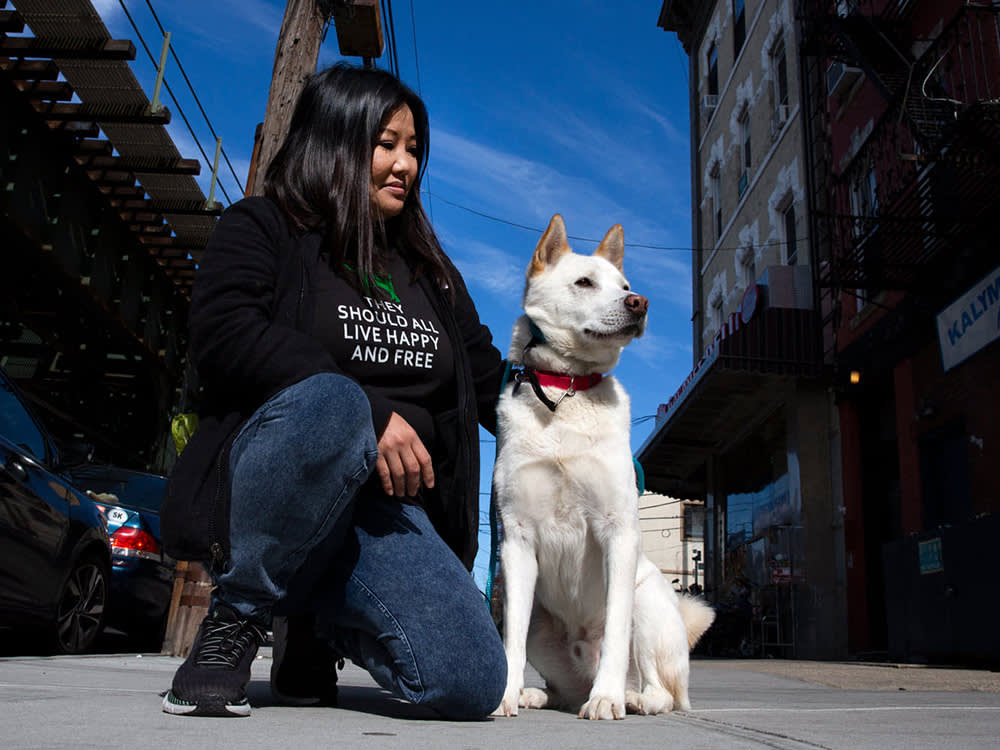
Gina Boehler runs Korean K9 Rescue out of New York City, and she has been building the pipeline this moment requires since 2017.
The origin was a single afternoon. She was visiting family in Korea in 2017 and toured a rescue facility in a rural stretch of Gimpo, out of curiosity about what homelessness looked like for dogs there. About three hundred feet down the road from that facility stood a dog meat farm holding over two hundred dogs.
What she saw there does not summarize well, and she does not try to soften it. Dogs turning circles in small rusted cages with no shelter from the weather. Rotten food waste. Waste dropping through steel-grate floors, or accumulating in a heap in the middle of the cage. She describes it as an image that burned itself into her and would not leave, and a helplessness she could not put down after she got on the plane.
She had a full-time office job at the time and no intention of quitting it. Then one dog became twelve, and twelve became twenty-four, and two years in she quit.
Since founding, Korean K9 Rescue has moved 2,500 dogs out of Korea and into fosters and homes in New York. They come from three places: slaughterhouses, farms raising dogs for meat, and shelters where the alternative was euthanasia. Some of the adopters are recognizable; Crazy Rich Asians star Awkwafina is one.
How a dog gets from Incheon to Queens
The mechanics are stranger and more human than you would guess.
The primary route is a flight volunteer program. If you are flying direct from Incheon to New York, for any reason at all, you can sign up to escort a dog, who is checked through as an extra piece of luggage. The dog rides in the temperature- and pressure-controlled pet hold. You do essentially nothing except exist on a plane you were already taking.
That model collapsed in early 2020, right as Korean K9 opened its Bundang rescue center, weeks before COVID shut down international travel and with it the entire volunteer pipeline for six months. They survived by fundraising and switching the dogs to cargo shipping.
The Korean facility today runs about 20,000 square feet, holds 125 to 150 dogs at a time, and employs 10 trainers caring for them around the clock. More than 35 volunteers come through every weekend, and Boehler is pointed about how much that last number matters: it is Korean residents, in Korea, showing up to walk dogs from the meat trade.
The rehabilitation nobody budgets for
This is the part of the story that the policy coverage skips, and it is the part that determines whether a half-million-dog rehoming actually works.
A dog out of the meat trade, or out of a puppy mill, has typically had zero positive experience of a human being. Not a bad experience. No experience. There is no baseline of trust to restore, because none was ever laid down.
So the work at the Korean center starts far below what most people would recognize as training. Trainers hand-feed timid dogs, purely so the dog learns the scent and touch of a person as something that precedes food rather than harm. Only then does anything else begin: a leash, a hand on the body, a door.
It is slow, and it does not scale the way a government spreadsheet needs it to.
“People assume a traumatized dog needs love, and love is the one thing that doesn’t work on its own,” says Dr. Nina Kohl. “What actually rebuilds these animals is predictability. The same person, the same hand, the same food, at the same time, for weeks, until the dog’s nervous system stops treating a human approach as an emergency. That’s not sentiment. It’s a protocol, and it takes staff.”
Boehler is candid that adopter expectations are the biggest obstacle on the American end. People arrive with a picture of the dog they want: not too barky, not too much exercise, already easy. She specializes in trauma dogs, and her pitch is simply time. Give them time, and what emerges is a personality nobody, including her, could have predicted at intake.
The industry was already collapsing
The 2024 law did not arrive out of nowhere. It ratified a decline that was well underway.
A decade ago there were roughly 17,000 dog meat farms across the Korean countryside. Korean rescue organizations put the figure now at about half that or less. Much of the pressure came not from animal-cruelty enforcement but from something more mundane: agricultural regulators shutting farms down over improper waste disposal.
And the consumer base was never what Western coverage implied. The number of Koreans who actually eat dog meat is tiny, a sliver of the country, and Boehler’s read is that even among them nobody defends it as a good thing.
Korea’s own domestic adoption problem persists, and it rhymes with New York’s: people live in small apartments in dense cities and do not feel able to take on a medium or large dog. The dogs left behind in Korean shelters are the big ones, for the same reason the dogs left behind in American shelters are the big ones.
What it costs the people who do it
Boehler does not perform resilience. She calls the work a roller coaster and names what is on it.
A local Pit Bull pulled from an abandoned drug house, lying out front among cockroaches and cockroach bombs, with the certainty that nothing good would happen to her if they did not take her that day. One of the Korean dogs, recently adopted, who had boiling water poured over her and lost half of her face.
Her mechanism for carrying that is not to look away from it. It is to keep her attention on the match: this dog, this family, this outcome. And to lean on the adopter community, who understand what taking one of these dogs actually requires. She says the good ones overshadow the horrific ones. It is not clear that this is true, but it is clear that she has decided to operate as though it is.
The dog underneath all of it is Fudgie, a brown Cocker Spaniel from her childhood, who used to sleep beside her in a tent she pitched in the backyard in summer, keeping her warm.
Ask her what the dogs have taught her and the answer is patience. Two of her own are disabled, and she describes them as the most patient beings she has ever encountered. They will wait five hours for her to get home from the office and hold no grudge about it.
What’s new since this was written
The ban happened. That is the headline, and it is bigger than anything in the original telling.
The implementation is further along than most people realize. South Korea’s Ministry of Agriculture has reported that roughly 70 percent of the country’s dog meat farms, 1,072 out of 1,537, have already closed with government compensation. Farmers are being paid to exit and are being offered subsidies and support to transition into other work. The state has committed to helping rehome the dogs.
But rehoming is where an industrial phase-out meets a biological reality. These are mostly large dogs, mostly Jindo and Jindo-type mixes and large mixed breeds, mostly with no history of living with people, in a country whose adopters, like everyone else’s, want small and easy. The domestic market cannot absorb them. International rescue can absorb a fraction.
Which is why the flight volunteer sitting in seat 34B, doing nothing more heroic than boarding a plane they were already boarding, is not a charming detail. Between now and February 2027, it is infrastructure.
Korean K9 has been expanding into Los Angeles, on the theory that the weather is good, the space is bigger, and the dogs will run. They are going to need it.
References
- Humane World for Animals. “South Korea passes law to end dog meat industry by 2027.” January 2024. humaneworld.org
- TIME. “South Korea Finally Passes Historic Ban on Dog Meat Industry.” January 2024. time.com
- Food Safety News. “The dog meat trade is banned in South Korea by the National Assembly starting in 2027.” January 2024. foodsafetynews.com
- Korean K9 Rescue. “Victory for Dogs: South Korea Bans the Dog Meat Trade by 2027.” koreank9rescue.org
- Korean K9 Rescue. koreank9rescue.org
James Okafor covers rescue, adoption, and the causes shaping animal welfare. His work follows the people and organisations working to give more pets a home, and the issues owners and advocates care about most.
Meet our experts ↗Keep reading
 LivingA Drug Raid Opened a Door. Behind It: a Dogfighting Ring and a 9-Foot Alligator Fed on the EvidenceJames Okafor · 5 min
 Living'Stray' Filmed a Country That Protected Its Street Dogs. That Country Is Gone.Tom Hadley · 7 min
 LivingMissouri Tops the 'Horrible Hundred' for a 14th Year. The 2026 Report Is Grim.Nina Vasquez · 6 min
 LivingYou Spotted a Dog That Looks Neglected. Here's How Not to Make It Worse.Nina Vasquez · 5 min
 LivingA Former Ringling Clown Is Rewriting the Pit Bull's Reputation, One Hoop at a TimeMarcus Webb · 5 min
 LivingHe Left 11 Dogs to Die in a Hot Van, Then Cremated the Evidence. A Jury Convicted Him.Nina Vasquez · 5 min