


Turn Your Living Room Into a Confidence Course: Indoor Agility for Cold Days
When it's too miserable to walk, a homemade obstacle course does more than burn energy. Here's how to build one that teaches your dog balance, focus, and bravery, safely.

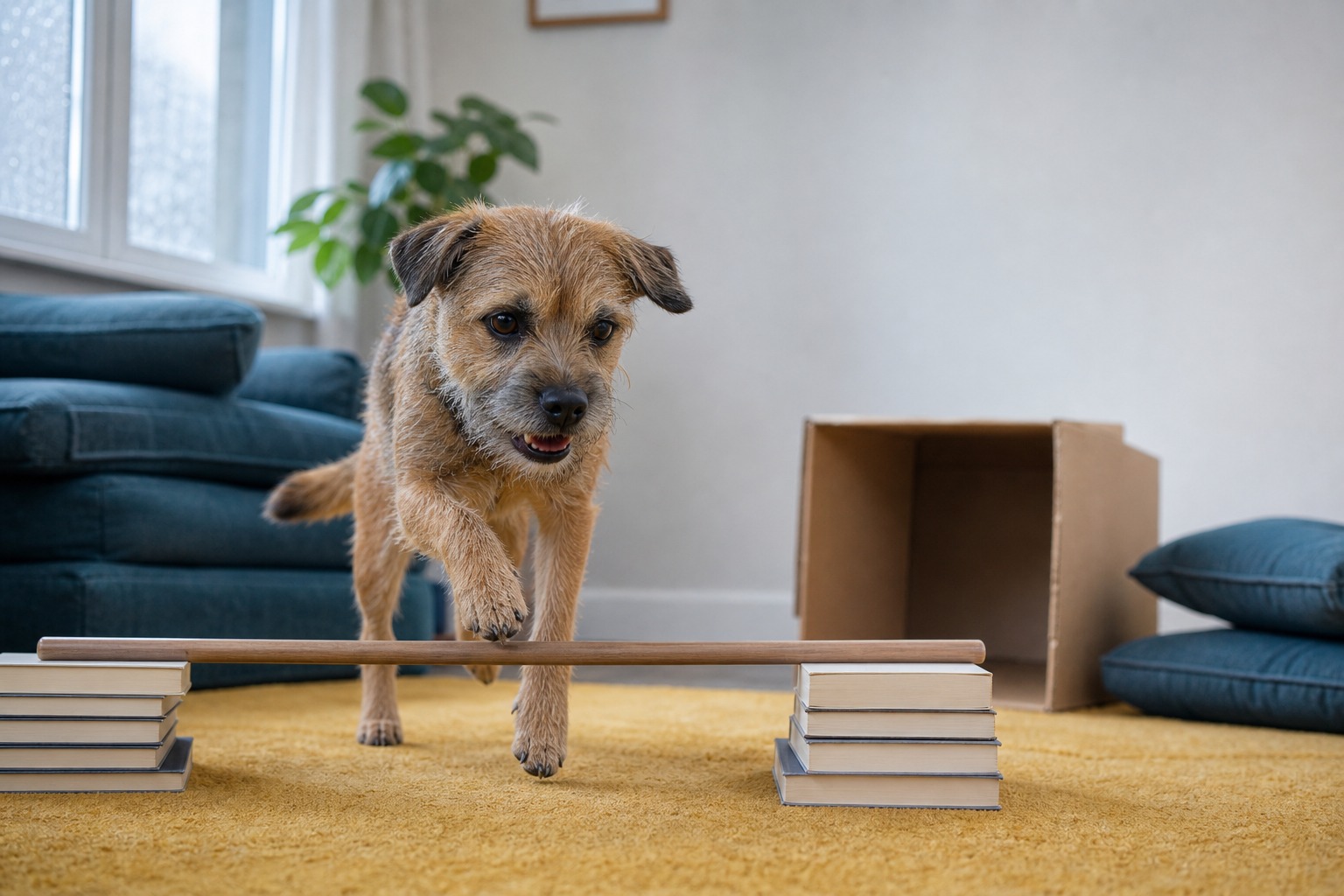
The first cold, gray week of the year tends to end the same way every time: you standing at the door with a leash, and your dog studying the rain through the window with the flat expression of someone who has decided this is not happening. They are not wrong to be skeptical. But a skipped walk is not just a skipped walk. A dog who gets no real activity for days gets restless, and a restless dog finds their own entertainment, usually involving your shoes.
The usual advice is to “tire them out” indoors. That framing sells the idea short. A homemade obstacle course is not a treadmill substitute, it is a small confidence gym. Picking a careful path over an unstable cushion, ducking through a box, or stepping onto a surface that feels strange underfoot asks your dog to think, balance, and trust themselves. That blend of light physical effort and real mental problem-solving is what actually settles a dog, and it is the part the “burn energy” version misses. Here is how to build one that works, and works safely.
Floor-proof the room before you build anything
This is the step almost every indoor-agility guide skips, and it is the one that matters most. Hardwood, tile, and laminate are slippery, and a dog launching off or landing on a slick floor is how living-room play turns into a torn cruciate ligament or a tweaked shoulder. None of the obstacles below are worth a vet visit.
Before you set out a single cushion, give your dog traction. Lay yoga mats, rubber-backed bath mats, or rugs across the take-off and landing zones so every paw has grip. Move the coffee table with the sharp corner. Clear a runway with no walls or furniture for your dog to clip a hip on. If your dog is a senior, recovering from an injury, very young, or a long-backed breed like a Dachshund or Corgi prone to disc trouble, keep everything at ground level: stepping over and walking through, never jumping up onto or off of anything. (Puppy growth plates do not finish closing until roughly a year of age, so skip real jumps with young dogs entirely.)
Build the course from what you already own
You do not need a single piece of bought equipment. Household objects make better beginner obstacles anyway, because they are low, soft, and forgiving.
- Couch cushions and rolled blankets make broad, stable platforms to walk across and gentle ridges to step over. Stack two for a low, soft hurdle once your dog is ready.
- A large cardboard box with both ends open becomes a tunnel. Start with a short, wide one so your dog can see daylight through it, then graduate to a longer box once they trust it. A play tunnel from the kids’ toy bin works too.
- Floor poufs or firm pillows raise the difficulty a notch. They wobble, so landing on one teaches your dog to engage the stabilizing muscles that protect their joints, the same balance work a canine physical therapist would prescribe.
- A broomstick across two stacks of books is an adjustable-height bar. Keep it on the floor at first as something to step over, and resist raising it for any dog under a year.
- Textured mats are an obstacle in themselves. A doormat with stiff bristles, a silicone baking mat, a strip of bubble wrap, or a sheet of foil all feel novel underfoot, and getting comfortable on weird surfaces is genuinely useful confidence-building for a nervous dog.
Set out one feature. Let your dog sniff it and figure out it is not going to hurt them before you ask for anything. Confidence is the whole point, and you cannot rush it.
Lure, never force
Hold a treat right at your dog’s nose and guide them through the obstacle slowly, letting them choose to follow the food. The instant they commit, the treat is theirs. What you are never doing is dragging a hesitant dog through a tunnel by the collar or boosting them onto a platform they are frightened of. A scared rep teaches your dog the course is a trap, and you will spend a week undoing it.
Once a single obstacle is easy and your dog is clearly enjoying it, chain on a second. Build toward five or six elements, but spread it across several short sessions rather than one marathon. Three or four happy minutes beats twenty grinding ones. When your dog flows through the whole sequence without hesitating, add a cue word (“course,” or “go”) as they start, and begin rewarding every other successful run instead of every single rep so the behavior holds up without a constant supply of food.
The dogs who get the most out of this aren’t the ones bouncing off the walls, they’re the shy ones. Watching a timid dog decide, on their own, to walk through a tunnel they were scared of five minutes ago does more for them than a two-mile run ever could.
When agility is not your dog’s thing
Plenty of dogs would rather use their brain than their body, and a dreary afternoon is a perfect window for that instead.
Run a fundamentals refresher. Spend ten minutes sharpening the cues that actually keep your dog safe in the real world: a rock-solid “come,” a “stay” that holds when the doorbell rings, and a “leave it” reliable enough to drop a chicken bone on the sidewalk. These decay without practice, and indoors with no distractions is the ideal place to rebuild them.
Play toy search. This is hide-and-seek dressed up as a job. Put your dog in a sit, place a toy in plain view a few feet away, then release them and reward the grab. Repeat, and start tucking the toy farther off, then behind a chair leg, then under a towel. Add a cue (“find it”) once they have the idea. Within a few sessions most dogs will happily work a whole room hunting for a hidden toy, which is far more tiring than it looks because scent work and problem-solving drain mental energy fast.
Try a snuffle session. Scatter a portion of your dog’s kibble into a folded towel or a snuffle mat and let them nose it out. Ten minutes of sniffing for food taps the most powerful sense your dog has and leaves them genuinely satisfied, no jumping required.
The goal on a bad-weather day is not to exhaust your dog into stillness. It is to give their body a little controlled challenge and their mind a real puzzle, and to make your living room a place where good, slightly daring things happen. Do that a few times and you may find your dog trotting over to the cushion pile on their own, rain be damned.
References
Sasha Ford is a certified cat behaviour consultant who has worked with shelters, catteries, and private clients across the country. They review all feline behaviour content at The Pet Times, with expertise in multi-cat households, indoor enrichment, and stress-related disorders.
Meet our experts ↗Keep reading
 TrainingYour Treat Is Late. That One Second Is Costing You the Whole Lesson.Dr. Mara Chen · 8 min
 TrainingRead the Human First: How to Greet a Dog You've Never MetMarcus Webb · 9 min
 TrainingOne Word, Two Jobs: Why 'Socializing' at the Dog Park Backfires for PuppiesClaire Sutton · 6 min
 TrainingYou've Been Walking Your Dog WrongMarcus Webb · 8 min
 TrainingEvery Dog Trainer Says They're 'Humane.' Here's How to Read Past ItDr. Amara Solis · 5 min
 TrainingYour Second Dog Is Copying Your First. That's the Risk, Not the Perk.Dr. Ravi Mehta · 6 min