


Your Treat Is Late. That One Second Is Costing You the Whole Lesson.
Most treat-training problems are not about the treat. They are about timing, value, and the order things happen in. Here's how to reward a dog so the lesson actually lands, and the four mistakes that quietly undo it.

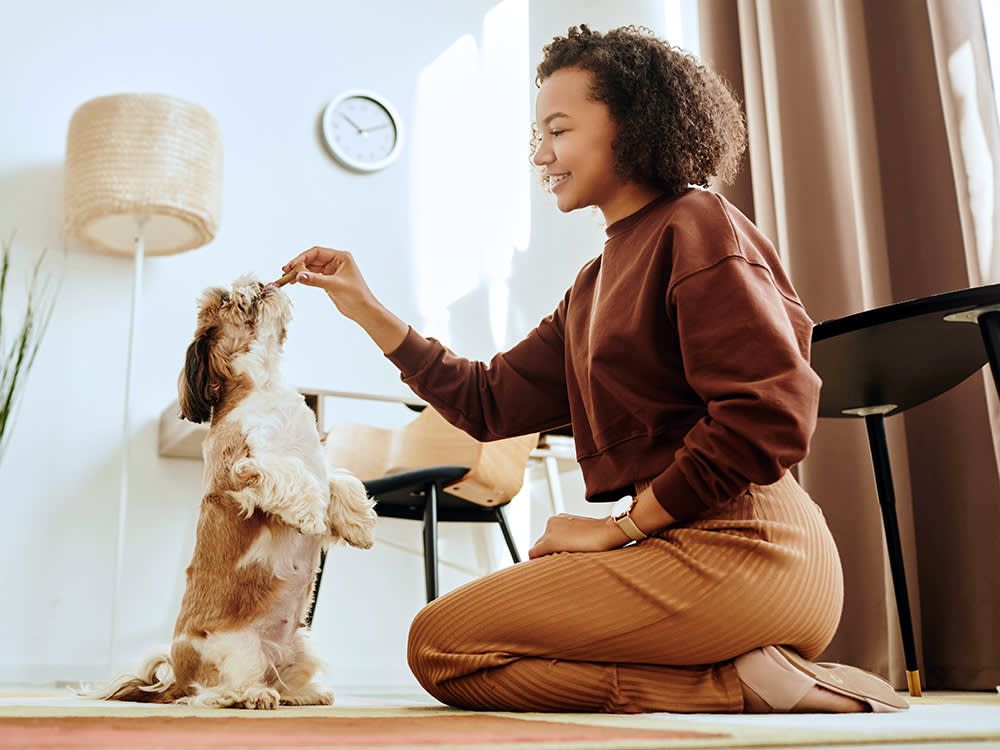
Here is a small, exact number that explains most failed treat-training: one second.
That is roughly how long you have between your dog doing the thing and your reward landing before the connection starts to blur. Wait longer and you are still giving your dog a treat, but you are no longer teaching them anything specific. You are handing out food to a dog who has, in the intervening moment, sat, stood, sniffed the floor, and looked at the door. Which of those did you just pay for? Your dog does not know either.
Almost every question people ask about training treats (which ones, how many, will my dog get hooked) is downstream of that one-second problem. So let’s start there, then work outward.
The mechanics: cue, mark, pay
The sequence is not complicated, but each step is doing a job.
Cue. One word, once. Say “sit,” not “sit down,” which contains a second cue your dog may also know. Do not narrate. Long sentences aimed at a dog bury the signal in noise, and if you have separately trained “stop” and “come,” a sentence like “will you stop that and come here” is two cues plus filler.
Mark. The instant the behavior happens, tell your dog “that, right there.” A clicker is the cleanest tool for this because it makes exactly the same sound every time, which no human voice does. A consistent word like “yes” works if you can keep it consistent.
If your dog has never met a clicker, spend three minutes teaching them what it means: click, treat, click, treat, ten or so times in fast succession. Then wait until they are distracted and click once. If they whip around, the association is made. If not, run another round.
Pay. Fast, and in the right place. The single most common invisible error is delivering the treat somewhere the dog has to move to reach. Ask for a sit, then hold the treat at your chest, and the dog stands up to get it. Congratulations, you just reinforced standing.
The treat itself: value beats volume
There is a real question hiding behind “which treats are best,” and it is not about brand.
Reward quality matters more than reward quantity. In controlled work on reinforcer effectiveness, dogs ran faster and worked harder for better rewards, while simply giving more of a mediocre reward did comparatively little. This has two useful consequences.
The first: your dog’s regular kibble is usually not a training treat. Being paid in the thing you already get for free is not motivating for anyone.
The second: a single excellent treat and a handful of the same treat are, to your dog, roughly the same event. So there is no benefit to stuffing your dog. The exception is deliberate: when your dog finally cracks something they have been struggling with, delivering several treats one after another, in a little stream, does land as a bigger deal than one. Save it for those moments.
What to use: liver, cheese, chicken, dried meat, and other high-value protein, cut to the size of a pea. Pea-sized is not stinginess. It is throughput. Your dog swallows it in half a second and is ready for the next repetition, instead of spending your training session chewing.
And the ceiling on all of this is health. It is entirely possible to train a dog with hot dogs and ice cream, and it would be a bad trade. Treats count toward your dog’s daily calories, and plenty of commercial ones are sugary, calorie-dense, and nutritionally empty. High value and reasonably healthy is the target, and it is not hard to hit.
The dogs I see with treat-related weight gain are not being over-rewarded, they are being over-fed per reward. You can run fifty repetitions on the calories in one biscuit if you cut it small enough. Portion the treat, not the practice.
Reward, not payment up front
The fear behind “will my dog get hooked on treats” is real, and it has one real cause.
Showing your dog the food, then asking for the behavior, is a transaction: here is the price, now perform. Asking for the behavior, then producing the food, is a consequence: that thing you did was worth something. Same treat, opposite lesson. The first builds a dog who checks your hands before deciding whether to bother. The second builds a dog who does the thing.
Using food to shape a brand-new behavior, guiding a nose into a down, is fine and normal. The rule is that it is temporary. Once your dog understands the behavior, the food goes back in the pouch until after.
Reward generously, then fade
Early on, be lavish. Reward the cued behaviors, and reward the good things your dog offers on their own: settling on the mat, checking in with you on a walk, choosing not to lunge at the delivery van. A treat pouch on your hip means you are never caught without a way to say yes.
Decades of comparative work back this up. The 2004 survey work on training methods in Animal Welfare found punishment-based methods were associated with a higher incidence of problem behaviors, with no performance advantage over reward-based training across tasks like sit, recall, walking to heel, and dropping an object. There is no version of this where shouting comes out ahead.
Then, once the behavior is reliable, fade. Not to zero, but to unpredictable. Reward sometimes, reward the good reps, mix in praise and play. A behavior maintained on a variable schedule is more durable than one maintained on a treat-every-time schedule, and it means you can eventually leave the pouch at home.
The four mistakes that quietly undo the work
Bribing instead of rewarding. Covered above, and worth repeating because it is the big one: if your dog will only do it when they can see the food, the food has become a bribe.
Paying for the wrong thing. Treat delivered where the dog has to break position to get it. Treat delivered a beat late, after the dog has already stood up and moved on. In both cases the dog was reinforced. Just not for what you thought.
Treats the size of a meal. Slows the session, adds calories, teaches nothing extra.
Not counting the calories. Treats are food. If your dog is getting a lot of them, the meals come down accordingly. This is the part that gets skipped, and it is why the trainer’s dog is lean and the neighbor’s is not.
What newer research adds
Two things have sharpened since this advice became standard.
First, the reward-quality finding above has held up and gotten more specific: what motivates a dog is not the amount of food in front of them, it is how much better this food is than what they expected. Which is a useful way to think about “high value.” Value is relative, and it is relative to your dog’s baseline, not to the price of the bag.
Second, the case against aversive methods keeps getting stronger rather than weaker. Reviews of the literature over the last decade consistently find reward-based training performs at least as well as aversive methods on obedience outcomes while producing fewer fear and stress indicators. This is now about as settled as anything in applied animal behavior gets, and it is why the modern argument is not “treats versus corrections.” It is about how precisely you can time the reward.
References
- Hiby, E. F., N. J. Rooney, and J. W. S. Bradshaw. “Dog training methods: their use, effectiveness and interaction with behaviour and welfare.” Animal Welfare, vol. 13, no. 1, 2004, pp. 63-69. cambridge.org
- Riemer, Stefanie, et al. “Reinforcer effectiveness in dogs: the influence of quantity and quality.” Applied Animal Behaviour Science, vol. 206, 2018, pp. 87-93. sciencedirect.com
- Gerencsér, Linda, et al. “Incentive motivation in pet dogs: preference for constant versus varied food rewards.” Scientific Reports, vol. 8, 2018. nature.com
- Ziv, Gal. “The effects of using aversive training methods in dogs: A review.” Journal of Veterinary Behavior, vol. 19, 2017, pp. 50-60. sciencedirect.com
Common questions
Will my dog only obey when I have food?
Only if you have been bribing rather than rewarding. If the food appears before the behavior, you have taught your dog to work for a visible payment. If it appears after, you have taught them the behavior itself pays, and the food can be faded.
What can I use instead of store-bought training treats?
Small pieces of cheese, cooked liver, chicken, or dried meat all work, and many dogs prefer them to processed treats. Size matters more than sophistication: pea-sized is the target.
Dr. Chen is a small-animal veterinarian who leads health and safety coverage at The Pet Times. She writes and reviews the bulk of our illness, condition, and safety content, translating clinical guidance into clear, practical advice owners can act on at home.
Meet our experts ↗Keep reading
 FoodThe Real Pig Ear Risk Isn't Your Dog's Stomach. It's Your Kitchen CounterDr. Lena Park · 6 min
 FoodBocce's Bakery Made a Pumpkin Spice Dog Treat. Why the Spice Part MattersMarcus Webb · 4 min
 FoodThe Fruit Bowl Has Landmines. The Fruit Usually Isn't One of Them.Dr. Priya Nair · 8 min
 FoodOne Lick of Cool Whip Won't Hurt Your Dog. The Habit Will.Dr. Amara Solis · 6 min
 Food6 Ingredients, One Sitcom's Worth of Time: The Dog Cookie Worth Turning the Oven On ForDr. Mara Chen · 5 min
 FoodThe Most Dangerous Thing in Homemade Dog Treats Is Hiding on the Peanut Butter LabelDr. Priya Nair · 6 min