


The Three Ways a Cat Lowers Your Anxiety (and the One Thing Research Can't Say)
A cat's calming effect is not one thing. It arrives through a measurable hormone drop, a purr tuned to a healing frequency, and the quiet structure of being needed. Here is what the science can and cannot prove.

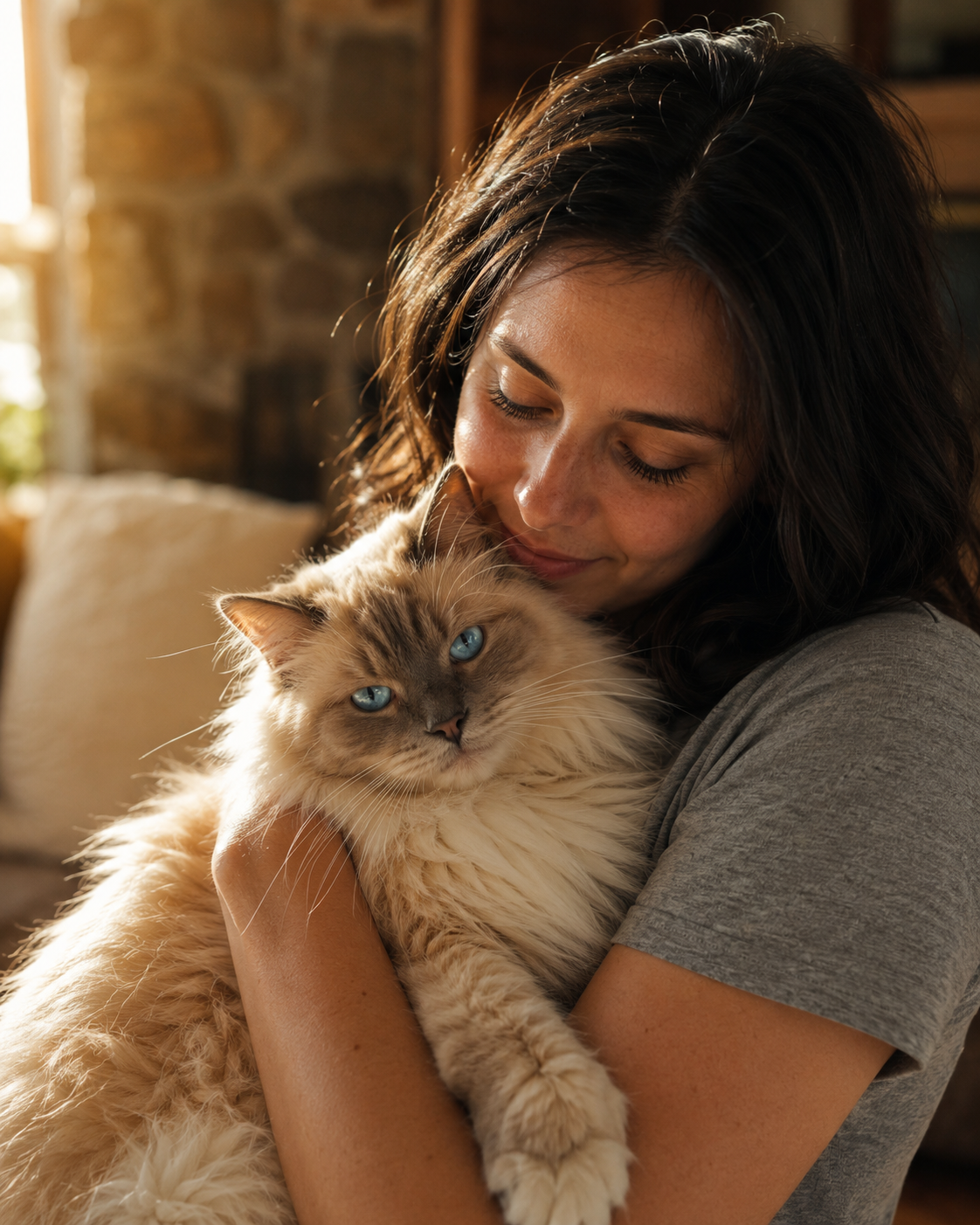
Most articles about cats and mental health make the same move: they gesture at a stack of studies, conclude that cats are good for you, and leave it there. That is true as far as it goes, but it flattens something more interesting. A cat does not soothe you in one vague, feel-good way. The calm reaches you through at least three separate channels, and each one has its own evidence, its own biology, and its own limits.
Here is the more honest version, mechanism by mechanism. Along the way there is one thing the research genuinely cannot promise you yet, and it is worth knowing before you lean on your cat as a coping tool.
Channel one: a stress hormone that actually drops
Start with the part you can measure in a lab, because it is the strongest link in the chain. In a 2019 randomized controlled trial published in AERA Open, researchers at Washington State University assigned 249 college students to one of four groups. One group got ten minutes of hands-on time with cats and dogs. The others watched someone else pet the animals, viewed a slideshow, or simply waited. Only the hands-on group showed a significant drop in cortisol, the body’s main stress hormone, and the effect held even for students who walked in with very high levels.
What makes this study matter more than the usual “petting is nice” claim is where it happened. It was one of the first to measure a real cortisol reduction from petting an animal in an ordinary setting rather than a controlled laboratory. Ten minutes of contact, real-world conditions, a chemical change you can put a number on.
The useful thing here is that the effect is physiological, not just a mood you talk yourself into. When your cortisol comes down, your body reads that as safety. A cat in your lap is one of the low-effort ways to send that signal.
Beyond cortisol, spending unhurried time with a cat has been linked to lower heart rate and blood pressure, and there is evidence that living with a cat may help some people manage long-term mental health conditions. The through-line is a nervous system shifting out of high alert.
Channel two: a purr in the healing band
The second channel is stranger and more specific. A domestic cat’s purr sits mostly between 25 and 150 Hertz. That is not a random detail. It overlaps the same low-frequency range used in some clinical settings to ease pain and encourage tissue and bone to heal.
Cats appear to purr partly to self-soothe, not only when content but sometimes when stressed, injured, or frightened, which is part of why researchers suspect the behavior is regulatory rather than purely emotional. Whether the vibration does anything therapeutic for the human holding the cat is not settled, but the felt experience is hard to argue with: a warm weight rumbling against your chest is a full-body cue to slow your breathing. Settle in and let it run, even if it sounds like a tiny lawn mower idling on your ribs.
Channel three: the quiet structure of being needed
The third channel has nothing to do with hormones or frequencies. It is about shape. A cat hands you a small, non-negotiable routine, feed, scoop, play, and routine is one of the most reliable stabilizers for an anxious mind. Having a creature that depends on you gives ordinary days a spine.
The numbers support the emotional read. A 2017 study found that cat parents reported lower feelings of depression, and 44 percent said their cat gave them “a sense of safety.” In interviews with cat parents, most everyday activities people did with their cats, from play to simply sitting together, increased enjoyment and a sense of purpose, lowered stress, and even improved people’s ability to weather hard stretches of life. Other work has tied pet parenthood to fewer symptoms of anxiety and depression, more frequent and spontaneous laughter, and a 36 percent lower likelihood of reporting loneliness.
“Cats give you companionship without demanding that you rebuild your life around them,” Dr. Nair notes. “For someone already stretched thin by anxiety, that low-maintenance quality is a feature, not a compromise. The support stays sustainable.”
The one thing the science still can’t say
Here is the caveat the cheerful version leaves out. Cats have been studied far less than dogs when it comes to mental health, and most of the strongest human-animal research uses dogs or mixes species together. So while the direction of the evidence is encouraging, we cannot yet say with confidence how much of the benefit is specifically feline versus simply having a companion you love.
There is also a selection effect worth naming. People who want a cat and bond well with the one they have are the ones who benefit; a cat is not a prescription you can hand to just anyone. The realistic summary is this: if you genuinely want a cat and build a good relationship with them, the regular, positive companionship is very likely doing you real good, through all three channels above. It is just not a guaranteed clinical intervention, and it should never replace treatment when anxiety is serious.
Cats get unfairly cast as aloof, especially next to dogs, but plenty of them are full-time cuddle machines if you let them be. The company tends to help. Just know why it helps, and know its edges, so you can lean on it wisely rather than magically.
If your anxiety feels persistent or overwhelming, a cat is a wonderful companion but not a substitute for professional care. Reaching out to a mental health provider is a strong move, not a failed one.
References
- Pendry, Patricia, and Jaymie L. Vandagriff. “Animal Visitation Program (AVP) Reduces Cortisol Levels of University Students: A Randomized Controlled Trial.” AERA Open, vol. 5, no. 2, 2019.
- “The Felid Purr: A Healing Mechanism?” The Journal of the Acoustical Society of America, vol. 110, no. 5, 2001.
- “The Relationship Between Pet Ownership, Anxiety, and Depressive Symptoms in Late Life: Propensity-Score-Matched Analyses.” Anthrozoös, 2021.
- “Ontological Security and Connectivity Provided by Pets: A Study in the Self-Management of the Everyday Lives of People Diagnosed With a Long-Term Mental Health Condition.” BMC Psychiatry, vol. 16, 2016.
- “Pet Ownership May Attenuate Loneliness Among Older Adult Primary Care Patients Who Live Alone.” Aging & Mental Health, 2014.
- “Cat-Human Related Activities Associated With Human Well-Being.” Human-Animal Interaction Bulletin, 2021.
- American Psychiatric Association. “Americans Note Overwhelming Positive Mental Health Impact of Their Pets in New Poll.”
Dr. Nair is a veterinarian focused on diet and feeding. She covers everyday nutrition, treats, and the many "can they eat this?" questions owners ask, grounding each answer in what is actually safe and sensible for dogs and cats.
Meet our experts ↗Keep reading
 FoodYour Cat Won't Eat Without You. That's Sweet Until It Isn't.Dr. Nina Kohl · 7 min
 LivingOne Cat Tree Isn't Enough. The Rule Is One Per Room.Dr. Amara Solis · 6 min
 TrainingYour Cat Isn't Guarding You in the Bathroom. They Hate the Door.Dr. Nina Kohl · 6 min
 LivingThe Goodbye Ritual You Think Is Sweet Is Stressing Your Cat OutDr. Nina Kohl · 5 min
 TrainingThat Old Sweater Isn't Comforting Your Cat. It's Just Soft.Dr. Mara Chen · 8 min
 First DaysBringing a Cat Into a Dog's House? The Dog Is Your Real Project.Dr. Nina Kohl · 7 min