


Everyone Gets Hemingway Cats' Extra Toes Wrong. 8 Facts That Set It Straight.
Polydactyl cats, the mitten-pawed 'Hemingway cats,' collect myths almost as fast as they collect toes. The biggest one is a genetics error the internet keeps repeating. Here's what's actually true about those extra beans.

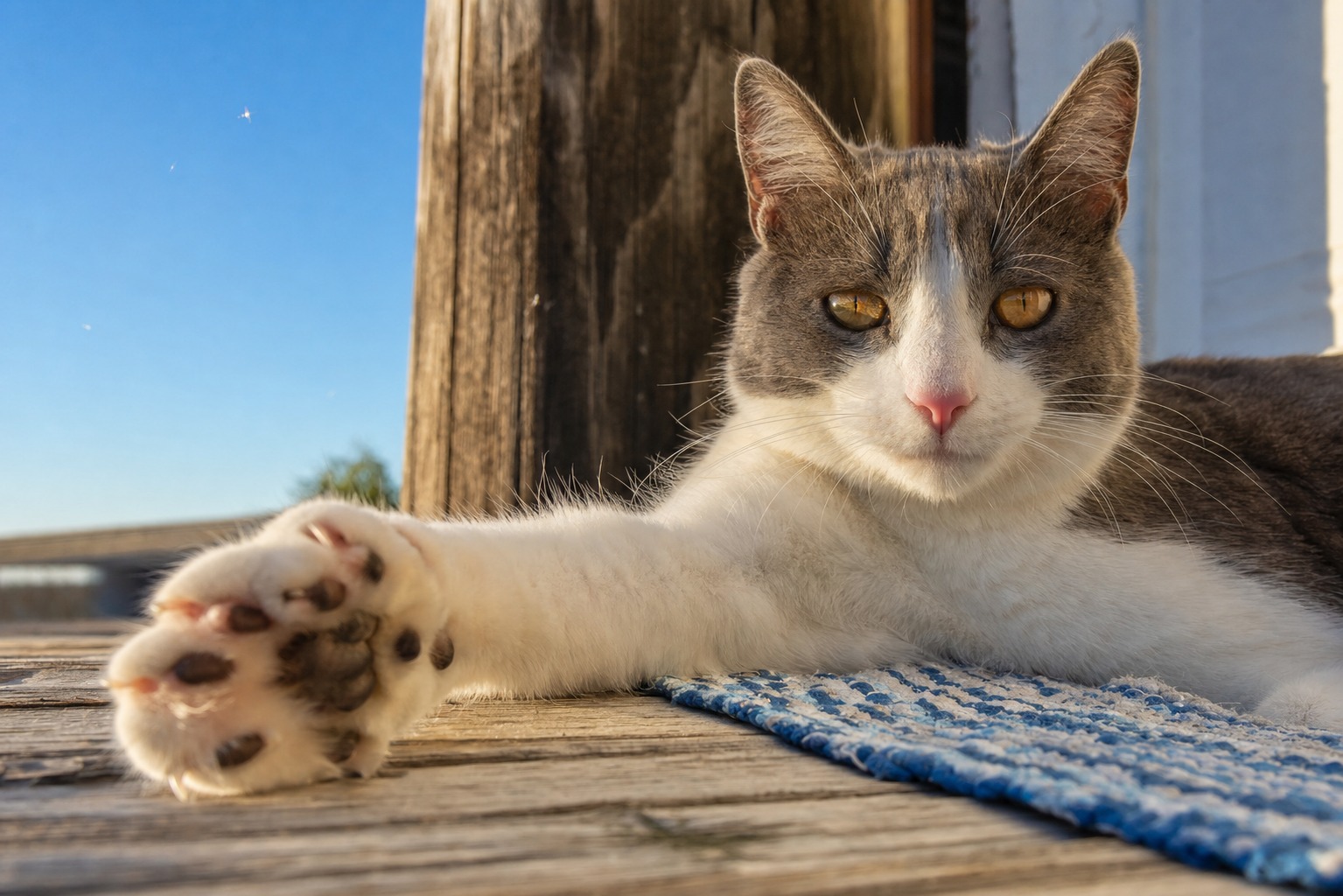
The paw pads (the “beans,” if you’re online) are the best part of a cat, and a polydactyl cat simply comes with more of them. Extra toes make these cats irresistible, and they’ve picked up a tangle of folklore over the centuries, including one confidently repeated “fact” about how the trait is inherited that happens to be flat wrong. Here’s the real story, extra digits and all.
1. They can have several extra toes, but there’s a limit
Most cats have 18 toes total: five on each front paw, four on each back. A polydactyl cat carries one or more extra toes on any or all of its paws, and the arrangement often isn’t symmetrical, so one paw may have a bonus toe while another doesn’t. The extras add up modestly in most cats. The extreme cases are the stuff of record books: a cat named Jake was recognized by Guinness World Records for a remarkable 28 toes, but a count like that is very much the exception, not the norm.
2. The genetics “fact” everyone repeats is wrong
Here’s the myth-buster. You’ll constantly read that polydactyly is caused by a recessive gene. It isn’t. In cats, the trait is inherited in an autosomal dominant pattern, meaning a single copy of the variant, from one parent, can pass it on. It also shows incomplete penetrance and variable expressivity, which is a scientist’s way of saying the gene doesn’t always show up, and when it does, the number and placement of extra toes varies.
The mechanism is genuinely cool. The extra toes trace to point mutations in a stretch of DNA called the ZRS, a distant regulatory switch that controls the Sonic hedgehog gene (yes, named after the video-game character) during limb development. Different mutations in that same switch produce polydactyly, and the versions found in Hemingway’s Key West cats and in North American cats differ slightly from the variants seen in British cats. So the next time someone calls it a recessive trait, you can gently correct them.
3. Any breed can be polydactyl, and breeding for it has a downside
Because the trait rides on a dominant gene that can surface in ordinary litters, extra toes turn up across breeds and in plain old mixed-breed cats. That said, deliberately overbreeding cats to maximize the trait can produce paw deformities that are painful and problematic, which is a good argument for admiring polydactyl cats without engineering them.
4. “Mitten cats” and “thumb cats” describe where the toes are
Not all extra toes sit in the same place. When the extras appear on the inner, thumb side of the paw, the cat looks like it’s wearing mittens or has opposable thumbs, and these are affectionately called mitten cats or thumb cats. Extra toes on the outer side look more like a widened paw. It’s a small distinction, but it’s why some polydactyl cats seem to be giving you a tiny handshake.
5. Maine Coons and the polydactyl connection
Here’s a fact the usual listicle skips. Polydactyly was historically common in Maine Coons, with old accounts putting the rate at a large share of the early breed population, likely because extra, snowshoe-like toes were an advantage for a working cat in snowy New England. Show-breed standards later pushed against it, but a dedicated community of breeders now works specifically to preserve polydactyl Maine Coons. The trait is embraced elsewhere too: the Pixiebob, a breed prized for its bobcat look, is one of the few that permits polydactyl paws in its standard.
6. The “Hemingway cat” nickname is literal
The famous nickname comes from author Ernest Hemingway, a Key West resident in the 1930s who was given a polydactyl cat named Snow White by a ship’s captain. “One cat just leads to another,” he reportedly wrote, and he wasn’t kidding. In Key West today, the Hemingway Home and Museum still cares for his cats’ descendants, keeping a colony of roughly 60 cats, about half of them polydactyl, all named after famous figures. They roam the walled property freely, and no, they are not for sale.
7. Sailors spread them on purpose
Polydactyl cats are especially common in the UK and along the North American East Coast, and there’s a nautical reason. British sailors considered these cats good luck and prized them as ship’s mousers: their larger paws helped them balance on pitching decks, and their extra claws made them formidable hunters. Ships carried them from port to port, seeding polydactyl populations along the Eastern seaboard, Key West included. (In parts of mainland Europe, by grim contrast, the same cats were once associated with witchcraft and killed.) The good-luck reputation reportedly appealed to Hemingway himself.
8. They’re healthy, with one thing to watch, and shelters have them
There are no major health risks tied to polydactylism itself. There is one bit of upkeep: those extra toes come with extra claws, and on some cats a claw can grow in a curl and eventually loop back into the paw pad if it isn’t trimmed.
“With a polydactyl cat I tell owners to actually count and check the claws, not just assume,” says Dr. Mara Chen. “The extra toes are usually perfectly fine, but a stray dewclaw-type nail can spiral into the pad and cause a nasty, avoidable infection. A regular trim and a quick look at every toe is all it takes.”
And if all this has you wanting one, you don’t need a breeder. Polydactyl cats show up in shelters all over the country. Call around, and you may find a mitten-pawed cat waiting for a home.
References
- Lettice LA et al. “Point mutations in a distant sonic hedgehog cis-regulator generate a variable regulatory output responsible for preaxial polydactyly.” Human Molecular Genetics, 2008.
- OMIA:000810-9685: Polydactyly in Felis catus (Online Mendelian Inheritance in Animals)
- Polydactyl cat (overview and history)
Sasha Ford is a certified cat behaviour consultant who has worked with shelters, catteries, and private clients across the country. They review all feline behaviour content at The Pet Times, with expertise in multi-cat households, indoor enrichment, and stress-related disorders.
Meet our experts ↗Keep reading
 LivingThe Shoulder-Cat Photo Everyone Tried to Copy. Here's Why Yours Won't Work.Sara Lim · 6 min
 LivingYour Cat Will Yowl for 3,000 Miles. Fix the Box, Not the Noise.Dr. Lena Park · 8 min
 LivingThe Cats in Her Art Aren't Decoration. They're the Coping Mechanism.Sasha Ford · 6 min
 TrainingThe Neck Bite Is Never the Problem. The Body Around It Is.Dr. Nina Kohl · 8 min
 LivingThe Tuxedo-Cat IQ Myth Is Really a Story About UsNina Vasquez · 7 min
 LivingThe World's "Most Expensive Cat" Was a Con. Here's What You're Actually Paying For.Sara Lim · 7 min