


From a Tennessee Backyard to a Brooklyn Walk-Up: Settling a Country Dog Into the City
Bringing a rural rescue into a small apartment, with existing pets and city noise, is its own specific challenge. Here is how we did it, and a practical playbook for any country-to-city transition.

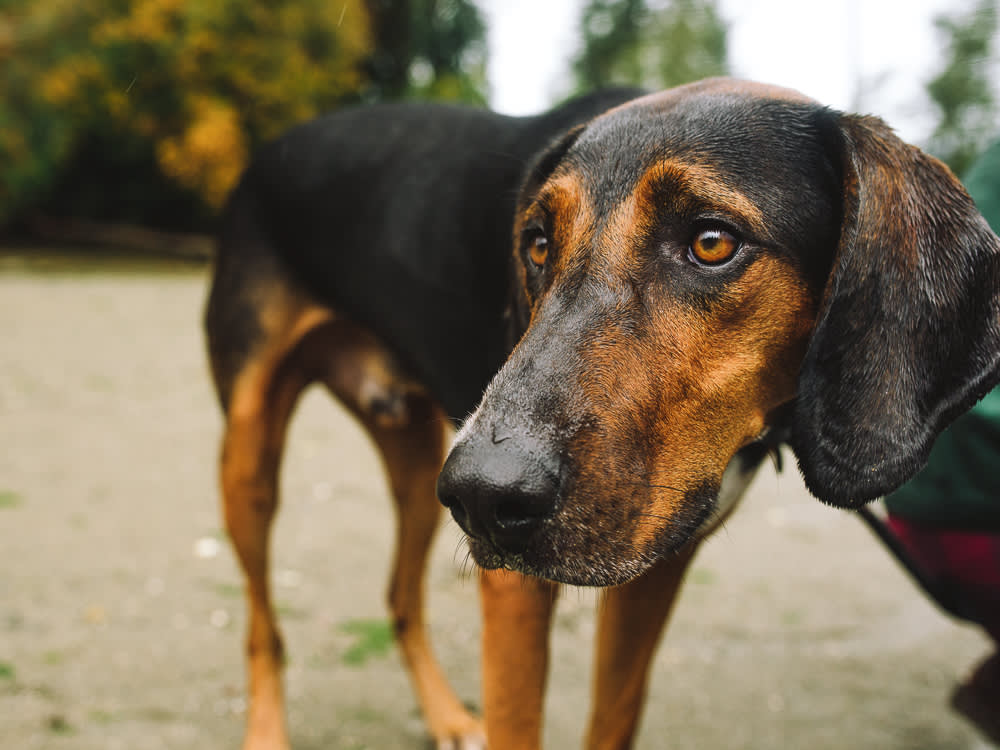
A pandemic pup was never in our plan. We already had a full house: Montie, a spunky elderly Terrier mix I adopted a decade ago, and Tiger, a supremely chill rescue cat my husband brought to the relationship. Getting those two to coexist had taken years and an embarrassing amount of money on a trainer who coached Montie through reining in her Terrier instincts. Peace in our Brooklyn apartment was hard-won, and we were not eager to disturb it.
Then, on an extended visit to Tennessee one summer, I downloaded PetFinder anyway. Practical? No. But something about a new place with an actual backyard let me talk myself into believing a second dog was doable, and pandemic puppies were far easier to come by in Tennessee than in New York, where early demand had emptied the shelters. We fell hard for Hopper, a 60-pound black-and-tan Hound being fostered by a local family, much bigger than Montie. We met the dogs at a park, they hit it off, and we brought Hopper home as a foster, with the safety net that he could return to his foster family if it did not work.
Here is the part the love-at-first-sight version of this story leaves out: a dog who has only ever known a fenced Tennessee yard does not automatically know how to be a New York City dog. The transition from country to city is its own specific project, and it is the part nobody warns you about. What follows is what actually worked, both for Hopper and, as I have since learned, for country-to-city dogs in general.
Why the country-to-city move is uniquely hard
A rural dog and a city dog live in completely different sensory worlds. In the country, a dog relieves themselves on grass whenever they like, rarely encounters crowds, and hears wind and birds. In the city, they are asked to potty on a leash on concrete, ride an elevator, walk past dozens of strangers and dogs, and tolerate sirens, garbage trucks, subway grates, and the constant percussion of a dense neighborhood. None of that is intuitive to a dog whose nervous system was calibrated for open space and quiet.
“The mistake people make is assuming a friendly, well-adjusted country dog will just absorb the city,” says Dr. Mara Chen, a veterinarian on our advisory roster. “What they are actually facing is sensory overload plus a whole new set of skills, leash manners, surface preferences, elevator rides, on a tight timeline. Go slower than feels necessary, and the dog catches up faster.”
The settle-in playbook
Start with a foster-to-adopt trial if you can
This was the smartest thing we did, and I recommend it for any uncertain match, especially one involving existing pets. Fostering first gave everyone an honest out and took the pressure off the introduction. It let us see how Hopper handled the apartment, the cat, and the neighborhood before anyone had to make a forever commitment. Many shelters and rescues offer this structure; ask.
Decompress before you do anything ambitious
A newly arrived dog needs a quiet stretch to simply exist before tackling city life. The widely used “3-3-3 rule” is a helpful frame: roughly three days to decompress, three weeks to start learning your routine, and three months to truly settle in. For the first few days, keep the world small. A calm room, a predictable feeding schedule, short low-key outings, and no big plans. Resist the urge to show your new dog off to the whole neighborhood at once.
Re-teach potty habits for concrete
A country dog may genuinely not understand that the sidewalk is the bathroom. Treat it like house-training from scratch: take them out on a consistent schedule, reward heavily the instant they go in the right place, and expect a few accidents while the new surface clicks. Some dogs hold it for a day or two out of sheer confusion, which is normal, not stubbornness.
Desensitize to noise and crowds gradually
This is where patience pays off most. Start walks in quieter areas and at quieter times, then slowly build up to busier streets as your dog’s confidence grows. Pair scary sounds, a passing bus, a sidewalk grate, with treats so the dog learns the city predicts good things. Never drag a frightened dog toward what scares them; let them watch from a comfortable distance and approach on their own terms.
Manage the introduction to resident pets carefully
We introduced Hopper and Montie on neutral ground, at a park, before he ever entered the apartment, which kept territory out of the equation. With a resident cat, go slower still: separate spaces at first, scent swapping, and supervised, gradual meetings, with the cat always able to retreat to a high or closed-off safe zone. Hard-won inter-pet peace, like ours, is worth protecting with a slow rollout.
Build a routine, then keep it boringly consistent
City dogs thrive on predictability because so much of their environment is chaotic. Regular walk times, meal times, and rest times give a disoriented country dog an anchor. The faster your dog can predict the rhythm of the day, the faster the city stops feeling threatening.
Drain mental energy, not just physical
A dog used to roaming a yard all day needs an outlet for that energy in a smaller space. Sniff walks, food puzzles, and short training games tire a dog out far more than apartment pacing, and a mentally satisfied dog is a calmer apartment-mate.
When to get help
Most country-to-city transitions smooth out within those first three months. But if your dog shows persistent, severe fear, can’t be walked without panic, or is genuinely not getting along with resident pets after weeks of careful work, loop in a professional. A certified trainer or a veterinary behaviorist can untangle whether you are looking at normal adjustment, a fixable management problem, or true anxiety that may benefit from a behavior plan. Asking for help early is not a failure; it is what kept Montie and Tiger living in harmony in the first place.
Hopper, for the record, became a New Yorker. The Hound who had never seen a sidewalk learned the route, made peace with the cat, and claimed his spot on the apartment floor as though he had always belonged there. The transition was easy-ish, in the sense that it took real work and a lot of patience, and then one day it was simply done.
Sara Lim leads our Product Picks coverage, testing and comparing the things pets and their owners actually use. From everyday essentials to home-and-style finds, she focuses on honest, useful recommendations rather than hype.
Meet our experts ↗Keep reading
 Living529 Days Alone on an Island. A T-Shirt Is What Finally Caught Her.Nina Vasquez · 5 min
 LivingThe Rescue That Stopped Taking the Dog AwayLeila Torres · 7 min
 Living"Hypoallergenic" Barely Holds Up. The Breeds That Come Closest for Allergy SufferersDr. Lena Park · 8 min
 Living12 Questions a Shelter Won't Volunteer, But Will AnswerDr. Priya Nair · 6 min
 LivingThe Screen Sells You the Dog. The Shelter Gets the Returns.Nina Vasquez · 6 min
 LivingA Pink Poodle Fell Into an Icy River. The Dye Job Saved Her.Marcus Webb · 6 min