


Hair vs. Fur Is the Same Protein. One Difference Still Decides How Much You Brush.
Under a microscope, hair and fur are identical. So why do we use two words, and does it matter for your dog? It does, but not where you'd think. The real difference is the growth cycle, and it drives your grooming and even your allergies.

You pet your dog’s hair. You also pet your dog’s fur. We swap the two words freely for the same warm covering, and most of the time nobody blinks. But there’s a real distinction hiding in there, and here’s the part that makes it worth knowing: the difference isn’t what hair and fur are made of, it’s how they grow, and that single fact quietly decides how often you’re reaching for a brush and how badly your allergies flare.
So this isn’t a trivia piece dressed up as advice. The biology points somewhere practical. Once you know which type your dog has, a lot of grooming guesswork turns into an actual answer.
They’re the same thing, chemically
Put a strand of hair and a strand of fur under a microscope and you’d struggle to tell them apart. Both are keratin. So is a fingernail. So is a feather, a cow’s horn, and the outermost sheet of your own skin. The wild range you see in keratin structures, the softness of a hair versus the hardness of a cow’s horn, comes down to how the keratin is arranged: softer structures like hair form a spiraling helix, harder ones like horn stack into sheets. At the cellular level, your dog’s “hair” and your dog’s “fur” are the identical material. Confusing, but true.
The difference that actually exists: the growth cycle
If they’re the same stuff, why two words? Because they behave differently, and the driver is the hair growth cycle, not the composition.
Dogs grow two kinds of strands. Some grow to a set length and stop, then shed, these are what we affectionately call fur. Others grow more or less continuously, and those are what we call hair. The technical version: predetermined-length strands (fur) spend a shorter stretch in the active growth phase before they’re released, while the continuously growing type (hair) stays in growth far longer. Some dogs have only the continuously growing type; some have both. Fur also tends to pack in more densely, thanks to a higher follicle count, which is why it often feels plusher.
Function follows from that. Hair is mostly about protection. Fur, being denser and shed-and-replaced on a schedule, is more about insulation, buffering the dog against both heat and cold.
Which dogs have which
- Dogs with fur: Double-coated breeds like Akitas, Huskies, and Border Collies carry fur. Most cats are in the fur column as well, and so is a long list of wild mammals: bears, foxes, raccoons, otters, rodents, and, improbably, seals.
- Dogs with hair: Humans (obviously), plus cows, horses, pigs, whales, and elephants. Among dogs, single-coated breeds like Poodles and Afghan Hounds have hair, as do Siamese cats.
Texture is a spectrum, not a rule
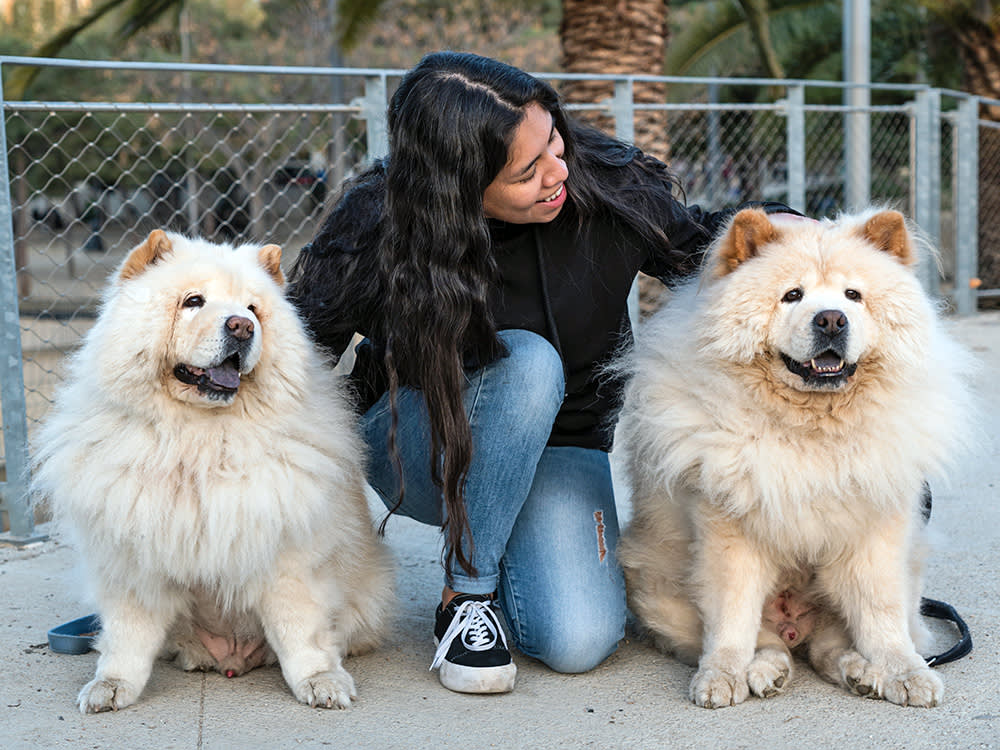
Keratin wears a lot of costumes. As a broad tendency, hair strands run coarser and longer while fur runs shorter and more densely packed, which reads as softer to the touch. But you’ll find every texture inside both categories. Think of the range in dog coats alone: the tight curls of a Poodle, the long waves of a Shih Tzu, the short sleekness of a Boxer, the thick bush of a Chow Chow. “Hair” and “fur” are useful buckets, not hard walls.
Where this pays off: grooming
Here’s the practical cash-out. Fur sheds on a regular cycle; hair tends to stick around longer. That one difference reshapes your grooming week.
A dense double coat sheds in earnest, especially during the spring and fall “coat blows,” so a thick-coated dog needs frequent brushing to pull out the loose fur before it carpets your house. A long, silky single coat sheds far less, so you’re brushing less often and doing more detangling and combing than heavy de-shedding. And the length rule flips too: fur-coated dogs rarely need trimming, while hair-coated dogs keep growing and often need regular clipping to keep the coat out of their eyes, mouth, and rear.
And where it shows up unexpectedly: your allergies
If dogs make you sneeze, the type of coat matters a little, though not the way most people assume. You’re not actually allergic to dog hair. You’re allergic to specific proteins in your dog’s skin cells, saliva, and urine. The skin cells flake off as dander, then hitch a ride on shed hair and spread through your home, delivering the itchy eyes and sneezing.
Every dog produces dander, hair or fur, so no coat is truly hypoallergenic. But the amount that gets flung around your house can differ. Because fur sheds more frequently, a heavily shedding, fur-coated dog can spread more dander simply through sheer volume, which can make allergies feel worse than they do around a low-shedding, hair-coated dog. That’s the kernel of truth behind “hypoallergenic” breeds, less shedding, less dander distribution, not zero allergens.
The word ‘hypoallergenic’ does a lot of damage in my exam room. People buy a low-shedding dog expecting to never react, then feel betrayed when they do. The realistic goal isn’t a dog that produces no allergens, it’s managing how much dander ends up in your air, and a lot of that is grooming, bathing, and vacuuming, not the label on the breed.
The bottom line
Hair and fur are two words for the same keratin structure growing out of your dog’s skin. The genuine difference is the type of growth cycle: one kind grows longer and lingers, the other grows to length and sheds on schedule. The shorter, thicker, denser type is what we call fur. Chemically identical, behaviorally very different, and knowing which your dog has takes a lot of the guesswork out of caring for their coat, and for your own itchy eyes.
Not a substitute for your vet. Our guidance is educational. For urgent symptoms, contact a vet or emergency clinic right away. Editorial standards
Dr. Solis is a board-certified veterinary dermatologist with over twelve years of clinical experience. She advises on skin conditions, allergies, and grooming practices that affect coat and skin health. All dermatology and allergy content at The Pet Times is reviewed by her team before publication.
Meet our experts ↗Keep reading
 LivingHe Lost 90% of His Business. Then He Groomed 1,461 Dogs for Free.Marcus Webb · 5 min
 LivingConan's Cohost Let Her Husband Cut the Dog's Hair. Once.Leila Torres · 8 min
 LivingA Pink Poodle Fell Into an Icy River. The Dye Job Saved Her.Marcus Webb · 6 min
 Health & WellnessNobody Licenses Your Dog's Groomer. Ask About the Dryer.Dr. Mara Chen · 7 min
 Product PicksThe At-Home Grooming Kit a Celebrity Dog Groomer Actually UsesSasha Ford · 5 min
 Health & WellnessThe 8-Week Puppy Bath Rule Has Nothing to Do With GermsDr. Mara Chen · 9 min