


'Organic' Doesn't Mean 'Pet-Safe.' 5 Ways to Fight Garden Pests Without Poisoning Your Dog or Cat
The scariest thing in a pet owner's garden isn't the aphids. It's the assumption that a 'natural' bug spray is automatically safe around animals. Here's what actually protects your plants, your pet, and the wildlife doing your pest control for free.

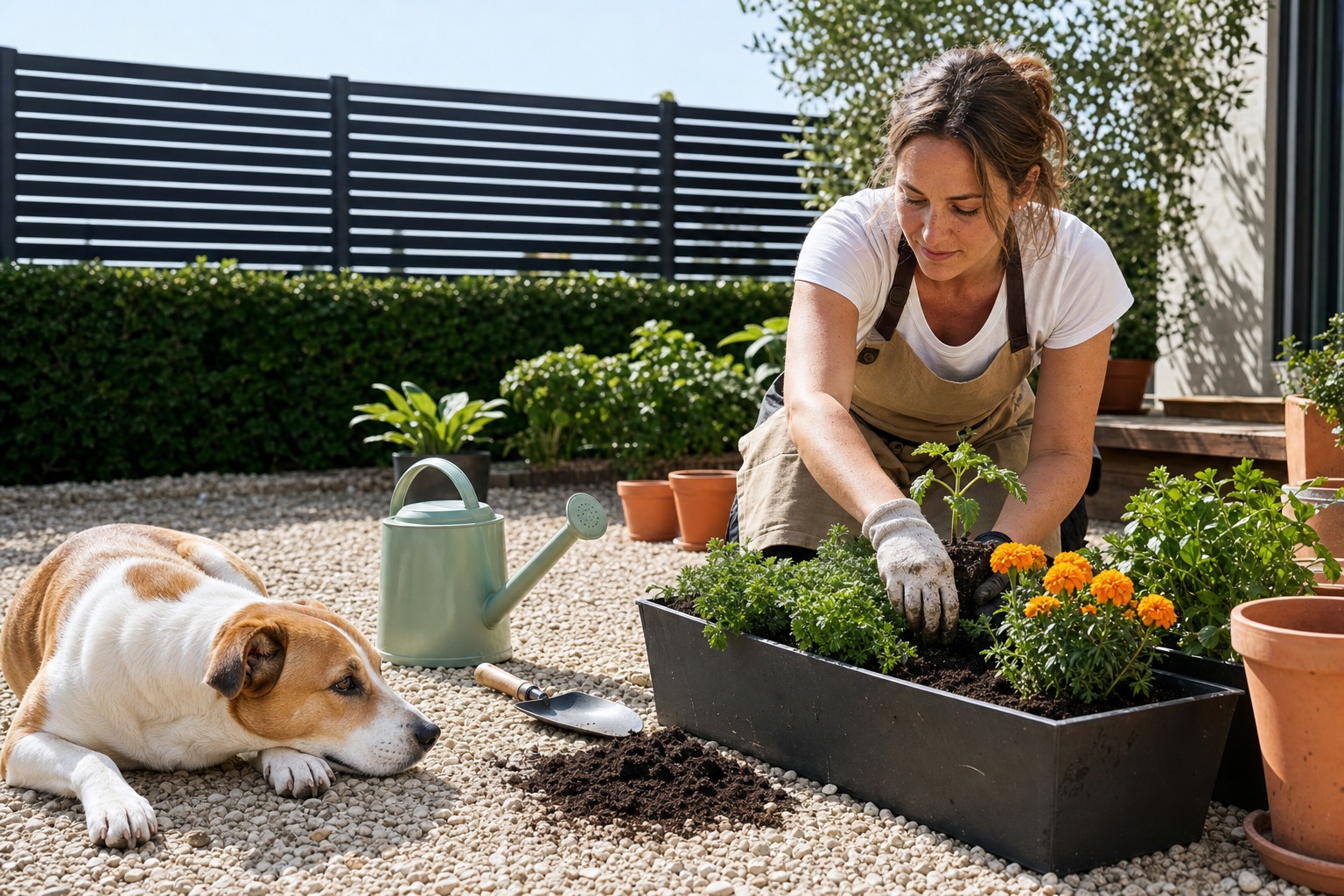
There is a moment every gardener knows: you spot the first cluster of aphids on your tomato stems, and your hand drifts toward the shelf of sprays at the garden center. Stop there for a second, especially if a dog naps in your flower beds or a cat patrols the fence line.
Here is the part most “pet-safe gardening” advice skips. The real hazard usually isn’t the pests. It’s the quiet belief that anything labeled organic, natural, or plant-derived is automatically fine to spray around animals. Some of the most dangerous garden products a pet owner can buy wear exactly those words on the front of the bottle.
So this is a guide to two things at once: keeping your harvest alive, and keeping the animals in your yard out of the emergency vet. The good news is that the same approach solves both.
Why the spray aisle is riskier than the bugs
When you soak a yard in pesticide and your pet spends time out there, exposure happens three ways at once. They breathe the mist. They walk across treated ground and then groom the residue off their paws and coat. And some compounds pass straight through skin. One study connected household chemical and lawn pesticide exposure to a higher rate of canine malignant lymphoma. Another found that pyrethroids, a chemical family in a huge share of insecticides, can trigger tremors, seizures, and in bad cases death.
Cats sit in a category of their own. Their livers are missing two of the metabolic tools (glucuronidation and ester hydrolysis) that other animals use to clear pyrethrins and pyrethroids from the body. So the chemical accumulates instead of leaving, which is why permethrin is one of the most common serious poisonings in cats worldwide. And here is the trap: pyrethrins are derived from chrysanthemum flowers, so they are marketed as the natural, gentle option. To a cat, natural pyrethrin is every bit as toxic as its synthetic cousins.
The word that gets cats hurt is ‘natural.’ People read it as a green light and spray a plant-based insecticide right where the cat sunbathes. If a product lists pyrethrin, permethrin, or anything ending in -thrin, treat it as off-limits for a cat and call us the moment you see drooling or twitching, because with cats that window matters.
There’s an ecological cost too. Broad pesticides, including many organic ones, kill more than their target. They wipe out the ladybugs, lacewings, birds, and soil life that quietly keep your garden in balance. Lose those, and you have signed up to be the pest control yourself, forever.
Start by gardening smarter, before you spray anything
The cheapest, safest pest control is the kind you build into the garden’s design. These techniques predate the spray bottle by centuries, and none of them can hurt your pet.
Invite the predators that eat your pests by planting things they love, like dill, cilantro, fava beans, and white clover, which draw in the beneficial insects that hunt aphids. Give pests a decoy by planting a trap crop such as sunflowers, which lure bugs away from the plants you care about. Rotate your vegetable families season to season so pests can’t settle in. And use companion planting to camouflage a crop, an old trick like tucking carrots in among onions so the carrot flies struggle to find them.
The goal is not a sterile, bug-free yard. A garden with zero pests also has nothing to feed the predators you want to move in. You’re aiming for balance, not eradication. If pests still get out of hand after all that, then it’s time for one of the gentle, pet-conscious options below.
1. Neem oil, used with a light hand
Neem oil is pressed from the seeds of the neem tree (Azadirachta indica), which has been used medicinally across the Indian subcontinent for thousands of years. Gardeners rely on it against mites, aphids, mealybugs, scale, whiteflies, and a couple hundred other leaf-wreckers. A big point in its favor: its active compound, azadirachtin, breaks down in soil in roughly three to 44 days, so it doesn’t linger.
Diluted and sprayed on foliage, neem is considered safe around pets, birds, fish, and bees. A simple homemade mix is a quart of water, a teaspoon of neem oil, and a quarter teaspoon of castile soap to help it emulsify. Test it on a small patch first, wait 24 hours, and check for leaf damage before doing the whole plant. Coat the tops and undersides of leaves, repeat every seven days while you have an active problem, or every 14 as prevention, and skip it on hot days. Keep pets from chewing treated leaves until they dry, and never let an animal drink the concentrate.
2. Food-grade diatomaceous earth
If you’ve ever fought roaches, you may already know diatomaceous earth (DE), the chalky white powder made from fossilized plankton. It kills insects by stripping the protective oils from their exoskeletons, which handles roaches, fleas, fungus gnats, and mites, and it discourages slugs and snails. It won’t foul your soil or water.
Two rules make it pet-safe. Buy only the “food grade” version, and keep the dust out of lungs, yours and your pet’s, because inhaled DE is an irritant. Sprinkle it on the soil around plants at the base where night-feeding bugs travel. You can dust the leaves too, but that can harm bees, so if you do, cover the plant with burlap for a day, then uncover and rinse.
3. Castile soap spray
Plain castile soap, usually made from olive oil, doubles as a mild insecticide. It’s effective on aphids, mealybugs, spider mites, and whiteflies, while leaving pets, ladybugs, butterflies, and wild birds alone. Dissolve a tablespoon of castile soap in a quart of warm, distilled water, transfer it to a spray bottle, patch-test a leaf, wait a day, and if the plant looks fine, mist the garden.
4. Physical barriers and hand-picking
The most under-rated method is also the most literal: put something between the pest and the plant. Floating row covers, copper tape around raised beds to stop slugs, and simply walking the garden at dusk to pluck caterpillars and snails by hand cost nothing and pose zero risk to an animal. For a yard where a curious dog treats every new object as a snack, a barrier you can see is safer than a chemical you can’t.
5. Skip the “pet-safe” products that aren’t
This is the item the original version of this advice always leaves out, and it may be the most important. Read the label of anything before it enters a pet’s yard, and walk past a few specific things no matter how green the packaging looks.
Avoid any insecticide listing pyrethrin, permethrin, or a -thrin compound, especially with cats around. Steer clear of metaldehyde slug and snail bait, which is intensely toxic to dogs and kills quickly. And be skeptical of essential-oil “natural pest sprays,” because concentrated oils like tea tree, citrus, and pennyroyal are toxic to cats and small dogs. A product being derived from a plant tells you nothing about whether it’s safe to spray where your animal breathes and grooms.
What newer research adds
The case for growing your own has only gotten stronger. Research in the journal Nature Food estimated that “food miles,” the transport leg of getting produce to your plate, account for a meaningful slice of global food-system greenhouse emissions, so a backyard tomato genuinely counts. And you don’t need acreage: a 2022 study in the Journal of Applied Ecology found that small urban gardens planted with native, pollinator-friendly species support wildlife just as effectively as large ones. A modest, chemical-free plot pulls real weight for the local ecosystem, and your dog will happily accept a share of the harvest.
References
- Household Chemical Exposures and the Risk of Canine Malignant Lymphoma (Environmental Research, 2012)
- Permethrin Toxicosis in Cats (Australian Veterinary Journal)
- Pyrethrin Toxicity in Cats (MSPCA-Angell)
- Global food-miles account for nearly 20% of total food-systems emissions (Nature Food, 2022)
- Turnover in floral composition explains species diversity in urban residential gardens (Journal of Applied Ecology, 2022)
This article covers pet safety around garden chemicals. If you think your pet has been exposed to a pesticide and is drooling, trembling, vomiting, or weak, contact your veterinarian or an animal poison control line right away.
Common questions
Is neem oil safe for dogs and cats?
Diluted neem oil sprayed on plants is considered low-risk around pets and pollinators, and it breaks down in soil within a few days to a few weeks. Never let a pet drink concentrated neem oil, and keep animals off a freshly sprayed plant until it dries.
What garden bug spray is toxic to cats specifically?
Anything containing pyrethrins or pyrethroids such as permethrin. These are marketed as 'natural' or plant-derived, but cats lack the liver enzymes to clear them and can develop life-threatening tremors. Keep cats away from treated areas entirely.
Dr. Nair is a veterinarian focused on diet and feeding. She covers everyday nutrition, treats, and the many "can they eat this?" questions owners ask, grounding each answer in what is actually safe and sensible for dogs and cats.
Meet our experts ↗Keep reading
 Living'Nobody's Around, It's Fine.' The 30-Second Decision You're Getting WrongTom Hadley · 6 min
 Product Picks'Natural' Pet Care Is a Word Nobody Checks. Read the Back of the Bottle.Dr. Amara Solis · 7 min
 Living6 Climate Wins That Make Eco-Friendly Pet Parenting EasierTom Hadley · 6 min
 LivingAdopting Is the Greenest Choice You'll Make About a Pet. The Bowl Is Where It Gets Complicated.Leila Torres · 6 min
 LivingYour Dog's Food Bag Isn't Recyclable. That Doesn't Mean It's Trash.Leila Torres · 5 min
 LivingYour Pet's Toy Pile Is Working Against YouNina Vasquez · 6 min