


The 8 Cues That Actually Make a Dog Easier to Live With
Skip the parade of tricks. These eight cues solve real daily friction at doors, on walks, and around guests, and the reward mechanics behind them matter more than the words you pick.
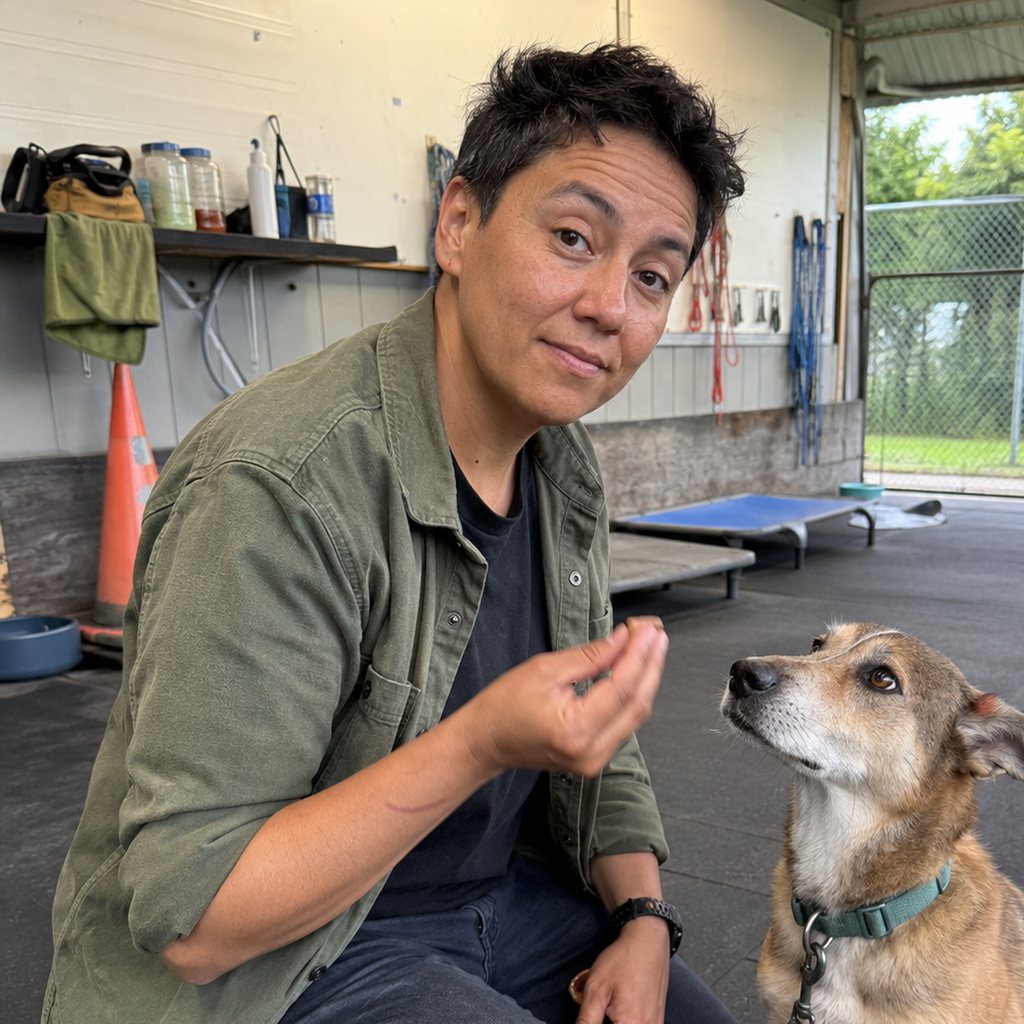
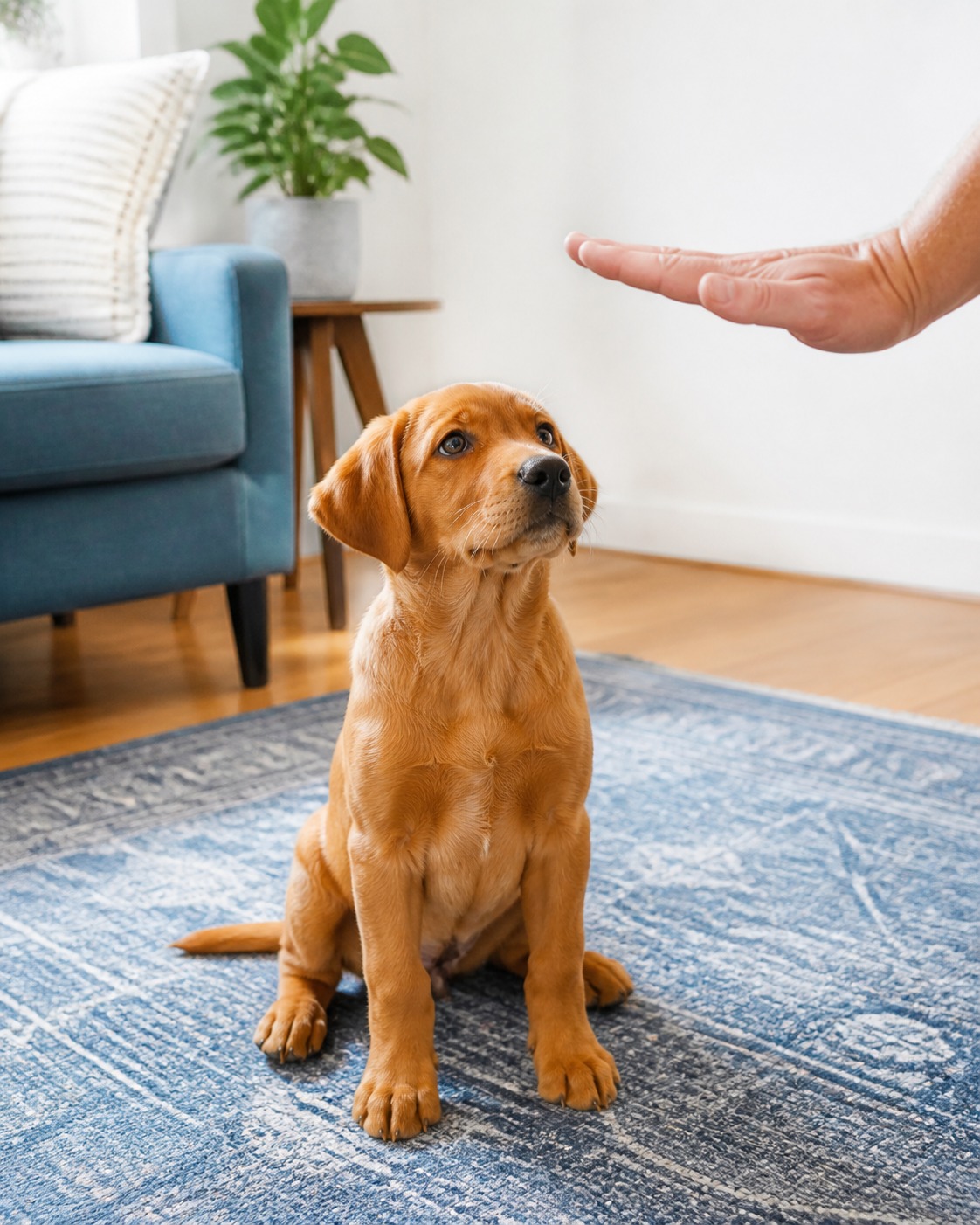
Most “basic cues” lists hand you a vocabulary and stop there. The problem is that a dog who knows the word “sit” the way a tourist knows a phrase from a guidebook is not actually trained. What makes a dog easy to live with is not how many words they recognize. It is whether the response holds up at a front door with a delivery driver on the other side, on a walk when a squirrel breaks cover, and in a kitchen full of guests who are not dog people.
So this is a list built around friction, not vocabulary. Every cue below earns its place by solving a specific, recurring headache of living with a dog, and we are going to spend as much time on the part nobody teaches, the mechanics that make any cue stick, as on the cues themselves. Get those mechanics right and you can teach a dog almost anything. Get them wrong and you will be repeating “sit, sit, SIT” at a dog who learned long ago that the word is optional.
The part that matters more than the cue
A cue is just a signal, a word or a gesture, that you and your dog have agreed means a particular behavior. The agreement is the hard part, and it rests on three things people routinely skip.
The first is a marker. This is a single, consistent sound, a clicker or a sharp “yes,” that you make the exact instant your dog does the right thing. Dogs live in the moment, and a reward that arrives three seconds late teaches them something other than what you intended. The marker bridges that gap. It tells your dog “that, the thing you just did, is what paid.”
The second is what you pay with, and how often. Early on, reward every correct rep with something your dog actually cares about. Plenty of dogs will work harder for a flung tennis ball or permission to go sniff a fence post than for a biscuit, so read your own dog.
The third is the order of operations, and it is the one most people get backwards. You teach the behavior first, then attach the word. If you say “down” at a dog who has no concept of what “down” means, all you are doing is teaching them that the word is background noise.
It is worth knowing that the broader research is decisively on the side of reward-based teaching, not just for results but for your dog’s emotional life. A judgment-bias study published in Scientific Reports found that dogs trained with two or more aversive methods, leash corrections, scolding, and the like, were measurably more pessimistic in a cognitive test than dogs trained with rewards. Earlier welfare research reached the same place: aversive methods do not train faster, and they cost you in stress and in your dog’s attachment to you. Reward-based teaching is simply the better tool, and it is what every cue below assumes.
The eight cues, ranked by how much daily friction they remove
Watch, because nothing else works without it
Look at my face. This goes first because it is the master key. You cannot ask a dog for anything if their attention is bolted to a passing dog or a dropped sandwich. “Watch” buys you that half-second of eye contact, and from there every other cue becomes possible. Teach it before you teach anything on this list.
Sit, the off-switch you will use ten times a day
Put your rear on the floor. Sit is the easiest behavior to teach and the most versatile to own, because a sitting dog cannot simultaneously jump, bolt, or shove through a door. It quietly defuses a dozen small situations a day, which is exactly why it earns a spot near the top.
Wait, the cheapest safety device you own
Hold here until I say otherwise. Wait at a threshold, a curb, an open car door, is the cue that keeps a dog from darting into traffic. It also makes the ordinary logistics of a dog, getting in and out of cars, through gates, down stairs, dramatically calmer. Of everything here, this is the one most likely to prevent a genuine emergency.
Stay, for the moments you need a dog to be furniture
Stay put until released. Where “wait” is a brief hold at a transition point, “stay” is a longer commitment to a spot. It is what you reach for when you have just shattered a glass on the kitchen floor, or when guests who do not love dogs have arrived. It also builds the impulse control that makes the rest of training easier.
Come, the cue you cannot afford to poison
Run to me, now, past the dead squirrel. A reliable recall is what lets a dog earn freedom. The one rule that makes or breaks it: coming to you must always, always be the best decision your dog ever made. Never call your dog to do something they dislike, a bath, a nail trim, the end of the park. If “come” sometimes means the fun stops, it stops working.
Release, the cue people forget exists
You are free now. A release word, “okay” or “free,” is the bookend to “wait” and “stay.” Without it, your dog is left guessing when a hold is over, and that guessing erodes the cue. A clean release tells them precisely when they can move, which is what makes the staying reliable in the first place.
Settle, the one the source lists never include
Switch off and relax. Here is the genuinely useful addition. Teaching a dog to actively settle, to go lie on a mat and decompress on cue, is the difference between a dog who is “trained” and a dog who is easy to live with. It is the cue that makes cafes, dinner parties, and slow Sunday mornings possible. Most cue lists skip it because it is not a flashy trick, but no single skill does more for everyday peace in a home.
A party trick, because it sells everything else
Show off. Last and least practical: teach one charming trick, a spin, a high-five, a bow. A reliable recall is genuinely harder than a high-five, but almost nobody knows that, so the trick is what makes people think your dog is brilliantly trained. More importantly, it keeps training feeling like a game for both of you, which keeps you doing it.
Keep sessions short and stack the wins
Two ground rules tie it all together. Keep sessions to five or ten minutes, especially at first, because a tired or bored dog learns badly. And always stop while your dog is still succeeding. Ending on a win is not sentimental, it is how you keep your dog wanting to play the training game tomorrow. No dog is too old to start, and a few good minutes a day will get you further than an hour of frustration ever will.
References
- Vieira de Castro, A. C., et al. “Does Training Method Matter? Evidence for the Negative Impact of Aversive-Based Methods on Companion Dog Welfare.” PLOS ONE, 2020. https://journals.plos.org/plosone/article?id=10.1371/journal.pone.0225023
- Casey, R. A., et al. “Dogs Are More Pessimistic if Their Owners Use Two or More Aversive Training Methods.” Scientific Reports, 2021. https://www.nature.com/articles/s41598-021-97743-0
- American Veterinary Society of Animal Behavior. “Position Statement on Humane Dog Training.” https://avsab.org/resources/position-statements/
Jordan Ellis is a certified professional dog trainer with a decade of experience working with rescue organisations and private clients. They specialise in anxiety, reactivity, and positive reinforcement methods, and review all training and behaviour content at The Pet Times.
Meet our experts ↗Keep reading
 First DaysYour Puppy Isn't Regressing. They're in a Fear PeriodJordan Ellis · 8 min
 TrainingTurn Your Living Room Into a Confidence Course: Indoor Agility for Cold DaysSasha Ford · 6 min
 LivingYou Raise the Puppy for a Year, Then Hand It Back. On Purpose.Jordan Ellis · 7 min
 TrainingA Deaf Dog Isn't Harder to Train. You Just Need a New LanguageDr. Mara Chen · 7 min
 TrainingYour Dog Pulls Because Pulling Works. Stop Paying for It.Dr. Mara Chen · 6 min
 Training7 Dog-Training Mistakes, and the 3 Root Causes Behind Almost All of ThemMarcus Webb · 6 min