


7 Dog-Training Mistakes, and the 3 Root Causes Behind Almost All of Them
Most training problems aren't random. They trace back to three root causes: bad timing, unclear criteria, and accidental reinforcement. Learn to spot the root, and you can diagnose your own mistakes.

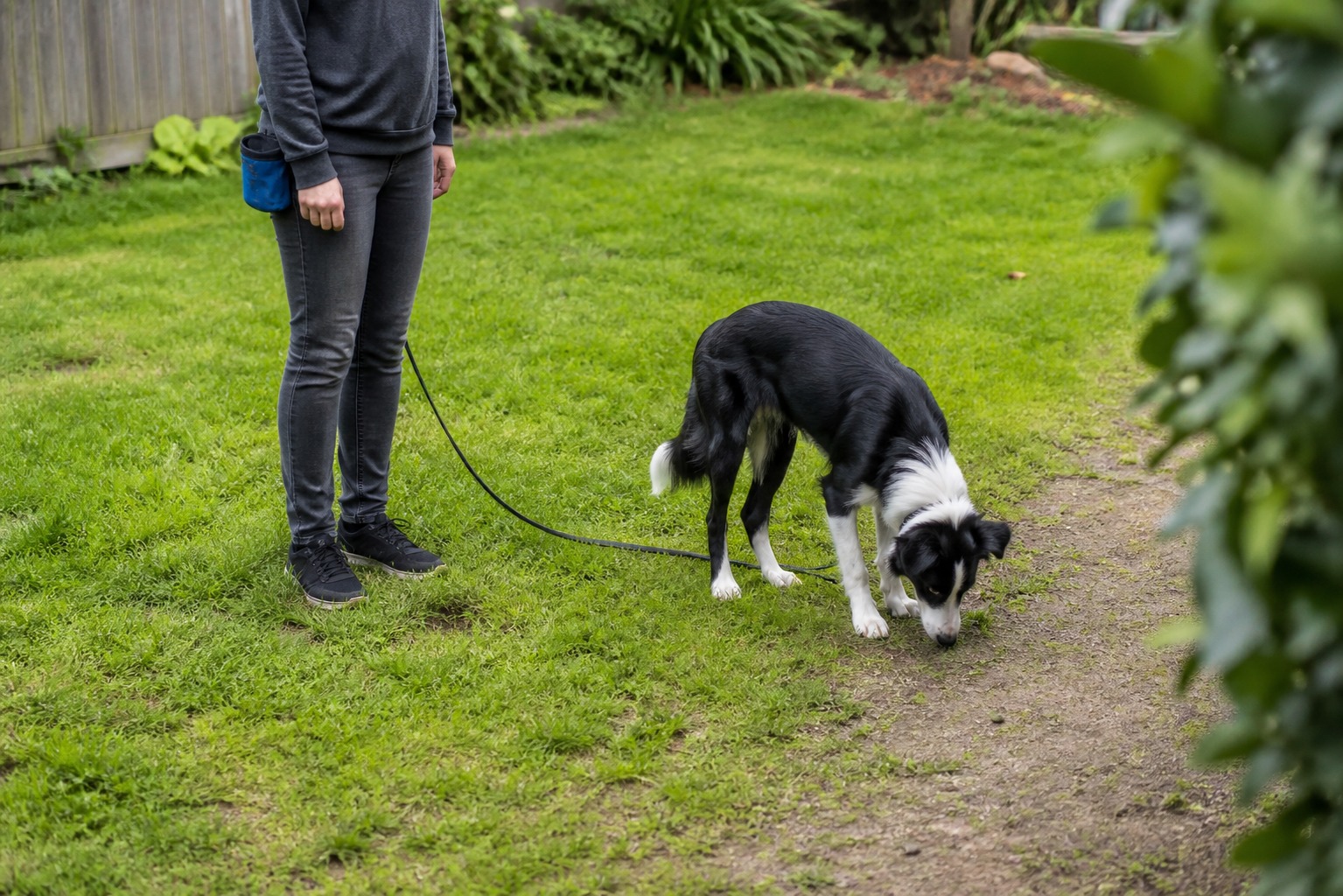
When a dog “won’t listen,” it rarely means the dog is stubborn or dim. It almost always means the human made one of a small number of predictable errors, and here is the useful part: those errors are not random. Nearly every common training mistake traces back to one of three root causes. Your timing was off. Your criteria were unclear. Or you accidentally rewarded the wrong thing. Learn to recognize the root cause, and you stop needing a checklist of mistakes to avoid, because you can diagnose your own the moment training stalls. Below are seven of the most common mistakes, grouped by the root cause they spring from.
Root cause 1: your timing is off
Dogs live in the split second. They connect a reward to whatever they were doing at the instant it arrived, not to what you meant to reward. Get the timing wrong and you teach the wrong lesson without ever noticing.
Mistake 1: Delivering the reward too slowly, or from the wrong place. You ask your dog to lie down, they do, but by the time the treat appears they are already springing back up toward your face. What did they just learn earned the treat? Jumping. Same trap if you call your dog, they trot over and sit, and you reward the sit while you were actually working on the recall. The fix is timing plus placement. Deliver the treat the instant your dog does the thing you want, before they can offer a second behavior, or use a marker, a clicker or a crisp “yes,” at the exact right moment to freeze the picture. And deliver where you want the dog to be: on the matching side while heeling so they never drift across your path and lose position, and a little below or behind the mouth at a station so they learn to hold their spot rather than lunge for the bag. Where the treat lands teaches the dog where to be.
Mistake 2: Making sessions too long. Several short sessions beat one marathon, but “short” is shorter than you think. A trainer’s idea of short is roughly half a minute to a minute and a half, nowhere near 20 minutes. That surprises people, because weekly classes run 45 to 60 minutes, but class length is about logistics, nobody drives to a training center several times a day, so instructors batch it into long blocks. What actually works is micro-sessions: tiny, frequent, and ended while your dog still wants more. Timing includes knowing when to stop.
Root cause 2: your criteria are unclear
Dogs are not being difficult when they “know it at home but not at the park.” They genuinely do not yet understand that the cue means the same thing everywhere. Clarity, in dog training, means being consistent and reasonable about exactly what you are asking, and where.
Mistake 3: Forgetting to teach generalization. “I don’t know why they won’t do it, I know they know it!” The behavior is almost always something common, sit, down, stay, come. But knowing a cue in the living room does not mean a dog can perform it on a walk or when guests arrive. Dogs do not automatically transfer skills to new places and higher distraction; they have to be taught to, location by location, distraction by distraction. A huge part of training is not teaching the behavior at all, it is teaching the dog to do it anywhere. Adjust your expectations to the situation as you build that fluency.
Mistake 4: Being inconsistent with cues. You are communicating across species, which is genuinely hard, and inconsistency makes it harder. If “come” is your recall cue, stick to that one word on every single repetition, never “c’mere” or “c’mon.” If your stay signal is an open palm facing the dog, do not expect them to read it when your hand is full of car keys. People muddy their cues constantly, then wonder why the dog looks confused. The dog is not confused about obedience; they are confused about what you are actually asking.
Mistake 5: Bribing instead of reinforcing. Reinforcement is a reward that follows a behavior and makes it more likely next time. Bribery is a reward dangled first to coax the behavior out. The classic version: you ask for a high-five, the dog does nothing, so you pull out a treat and ask again, and now they perform. You have just taught them to wait until they can see the payment. Unclear criteria again, the dog has learned the real cue is “treat is visible,” not “high-five was asked.” Keep rewards hidden until after the behavior, and the dog learns to work on the word alone.
Root cause 3: you rewarded the wrong thing
The subtlest root cause, because it usually happens with the best intentions. Consequences shape behavior whether or not you meant them to, and dogs are constantly learning from what pays off.
Mistake 6: Punishing the behavior you like. This is not about anyone using physical punishment. Even kind, positive-reinforcement trainers fall into it. Any time the consequence of a behavior is something a dog dislikes, that behavior gets rarer, technically “positive punishment.” The classic example: calling your dog to come, then doing something they hate, like a nail trim or a bath. Or patting a dog on the head as a “reward” when most dogs do not enjoy head pats. Worse, you can “poison” the cue, teaching the dog that “come” predicts something unpleasant, the same way many dogs learn “drop it” means losing something good. Make sure the behaviors you want to keep are always followed by something the dog genuinely enjoys.
Mistake 7: Reinforcing the behavior you don’t want. The flip side, and just as easy. Letting a dog pull on leash rewards the pulling, because it gets them where they want to go, faster, or closer to that cat. Giving attention in response to barking rewards the barking. Laughing at or petting a dog who jumps up makes jumping more likely. Do not let the behaviors you dislike work for your dog, or they will keep doing them, because from the dog’s side, they are working.
The fix that isn’t a fix: use more than treats
One overarching upgrade sits above all three root causes. Treats are wonderful because they are so motivating, and being generous with them makes for happy, productive sessions. But leaning only on treats limits both the effectiveness and the fun. Physical affection your dog enjoys, a new toy, a quick play session, or the chance to go outside can all expand your dog’s willingness to work, and they help in every category above.
Play, in particular, earns its own line, because recent canine-cognition research keeps reinforcing it. Studies have found that a short play session right after a learning task improves a dog’s memory of what they just learned. So treat a game of tug or fetch not as a break from training but as part of it. Ending a micro-session with play your dog loves does double duty: it rewards the work and helps it stick. Fix your timing, sharpen your criteria, guard what you reward, and end on a game, and the dog who “won’t listen” tends to disappear, replaced by one who finally understands what you were asking all along.
References
- Affenzeller, N., Palme, R., & Zulch, H. “Playful activity post-learning improves training performance in Labrador Retriever dogs.” Physiology & Behavior, 2017. doi.org/10.1016/j.physbeh.2016.10.014
- American Veterinary Society of Animal Behavior. “Position Statement on Humane Dog Training.” avsab.org
Marcus Webb writes about the gear, gadgets, and everyday choices that make life with a pet easier. His coverage runs from product picks to training and the causes worth paying attention to, always with an eye on what actually earns a place in your home.
Meet our experts ↗Keep reading
 TrainingYour Dog's Name Isn't a Label. It's a Promise You Can Break.Dr. Ravi Mehta · 6 min
 TrainingThat Bootie Wobble Isn't Funny. You Just Blindfolded Their Feet.Dr. Nina Kohl · 8 min
 TrainingNo, You Don't Need a Show Dog to Compete in ObedienceTom Hadley · 7 min
 TrainingYou're Probably Training Your Puppy Too Hard. Here's the 6-Month Plan That Works.Sasha Ford · 6 min
 TrainingYour Dog Isn't Being Bad. Your Christmas Tree Just Looks Like an Indoor Bush.Dr. Nina Kohl · 6 min
 TrainingYour Dog's Attention Is a Bank Account, Not a Personality TraitMarcus Webb · 6 min