


Your Dog Takes Their Bad Days to Bed
Brain-wave research shows a rough day costs dogs real deep sleep, and poor sleep loops back into more anxiety. The fix isn't a fancier bed. It's the 30 minutes before lights-out.

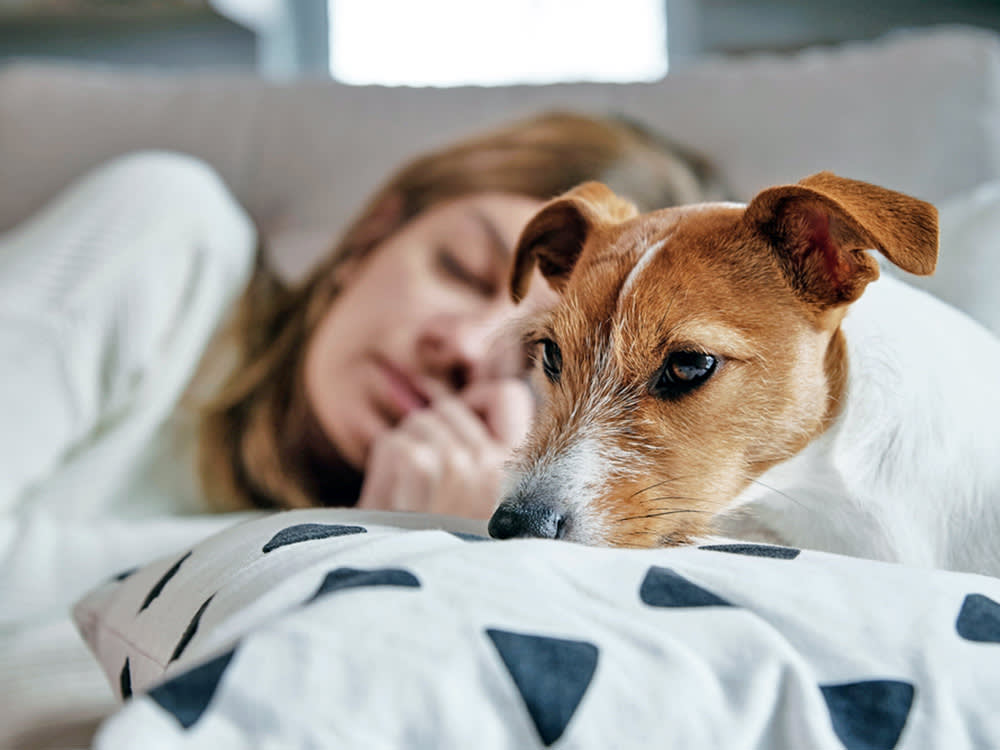
We tell each other to sleep on it, as if the night reliably files our worries away. It doesn’t always work for us, and it turns out it doesn’t reliably work for our dogs either. When a dog has a genuinely bad day, that stress follows them under the covers and costs them the deepest, most restorative part of their sleep. Worse, the lost sleep feeds back into the next day’s anxiety, so a single rough afternoon can start a small, quiet spiral. The reassuring part is that the same research pointing to the problem points straight at the fix, and it lives in the half hour before your dog closes their eyes.
What the brain-wave study found
The evidence comes from a 2017 study out of Hungary, where researchers recorded the sleeping brains of pet dogs. They worked with 16 dogs and gave each one two very different afternoons before a nap. In the good version, dogs got what dogs love: a game of fetch or tug and plenty of affection. In the bad version, they got the social cold shoulder, tied away and left alone, then approached by a person who ignored them or loomed in a mildly threatening way. Afterward, each dog was settled in a familiar room for a rest of up to three hours while gentle, non-invasive electrodes tracked their sleep.
The headline result: after a negative experience, dogs spent about 20 minutes less in deep sleep. Anyone who’s tossed and turned after a stressful day will recognize the pattern instantly.
But the study turned up a genuinely counterintuitive wrinkle. Dogs coming off a bad experience actually fell asleep faster than dogs coming off a good one, and they slept roughly 10 percent longer overall. On paper that sounds restorative. It wasn’t, because the extra time skewed shallow. They were logging more hours of worse sleep. Researchers read this as sleep doing double duty as a coping strategy, a way to check out of an unpleasant situation, more than a sign of genuine rest.
People see their stressed dog crash hard and assume they’re fine, sleeping like a log. But conking out fast after a bad experience can be avoidance, not recovery. The dog is escaping into sleep, and the quality of that sleep is exactly the part that suffers.
Sleep as a coping mechanism, and its cousins
That checking-out behavior has a name in the behavior world: it’s a displacement behavior, one of several odd little acts dogs perform to bleed off tension when they’re caught between conflicting feelings. Sleep is one. So are sudden bouts of intense sniffing, drinking more water than the moment calls for, or a fixation on licking or chewing. Spot your dog doing one of these right after something unsettling, a tense encounter, a vet trip, a thunderstorm, and you’re often watching them self-soothe, not relax.
Why the lost sleep matters more than it sounds
A dog’s sleep is not a luxury they can shortchange. Dogs need a lot of it, roughly 12 to 14 hours a day for an adult, with puppies and seniors needing even more to fuel growth and cushion aging. And that sleep is doing heavy work: it’s when a dog’s body repairs tissue, supports the immune system, and consolidates the day’s experiences into learning and memory.
Which is what makes the spiral dangerous. Quality sleep helps regulate mood and keep stress in check, so when stress steals deep sleep, the dog wakes up with less capacity to handle the next stressor, which costs them more sleep, and around it goes. Left unchecked, chronically poor sleep is linked to new behavior problems, a weakened immune system, and even a shorter life. A dog who sleeps well genuinely copes better.
Read the day, not just the night
You almost certainly don’t have an EEG rig at home, so you’re reading the day instead, watching for signs your dog is carrying stress that will follow them to bed. The signals are subtle and easy to miss:
- A tucked tail, flattened ears, or a stiff, braced posture
- Yawning when they aren’t tired, or panting when they aren’t hot
- “Whale eye,” where the whites show at the edges, or a wide, spatulate tongue
- Sweaty paw prints, pacing, or pointedly avoiding your gaze
- Extra shedding, more barking or whining than usual, or destructive chewing
None of these is proof of a crisis on its own, but a cluster of them after a hard afternoon is your cue to build in some recovery before sleep.
The fix is a wind-down, not a mattress
Because a bad day is the trigger, the most effective lever is the transition between day and night. Exercise is among the most reliable sleep aids a dog has, and mental work compounds it. Play, in particular, is a powerful antidote to fear and a reliable way to flip a dog out of a bad mood and into a good one. Layer in the low-key stress-busters, sniffing, licking, gentle chewing, and you help a wound-up nervous system stand down.
For a newly adopted or naturally anxious dog, the single highest-value move is giving them a consistent safe space they can retreat to, a spot that’s theirs, where nothing bad happens. Familiarity itself is calming: in the study, dogs relaxed in a room they already knew. Roll that out early, before the stressful nights, and you’re teaching your dog that home is a place their guard can come down. The step-by-step routine above turns all of this into a five-minute nightly habit.
What newer research adds
The 2017 brain-wave work has held up as a foundation piece, and the broader field has kept confirming its core message: dogs are far more like us in their sleep architecture than we assumed, moving through comparable sleep stages and paying a similar price when stress intrudes on them. The practical takeaway has only sharpened. Managing a dog’s sleep isn’t about buying a plusher bed. It’s about managing their day, and especially the wind-down before it ends, so the bad stuff doesn’t get a chance to follow them into the dark. As the researchers’ spirit of the work suggests, a dog who sleeps well is a dog who copes well.
References
- Kis, Anna, et al. “Sleep macrostructure is modulated by positive and negative social experience in adult pet dogs.” Proceedings of the Royal Society B: Biological Sciences, vol. 284, no. 1865, 2017, https://doi.org/10.1098/rspb.2017.1883.
- Bódizs, Róbert, et al. “The interrelated effect of sleep and learning in dogs (Canis familiaris); an EEG and behavioural study.” Scientific Reports, 2017, https://www.ncbi.nlm.nih.gov/pmc/articles/PMC5292958/.
Dr. Chen is a small-animal veterinarian who leads health and safety coverage at The Pet Times. She writes and reviews the bulk of our illness, condition, and safety content, translating clinical guidance into clear, practical advice owners can act on at home.
Meet our experts ↗Keep reading
 TrainingThat Hug You Love? Your Dog Is Probably Just Enduring It.Dr. Nina Kohl · 5 min
 TrainingYour Dog Isn't Lonely. Point a Camera at Them and Find Out.Dr. Nina Kohl · 8 min
 TrainingYour Dog Doesn't Need a Bad Memory to Be Terrified of the VacuumDr. Priya Nair · 9 min
 TrainingYour Dog Isn't Being Difficult. They Might Be Wired Differently.Dr. Nina Kohl · 8 min
 TrainingYour Dog's Favorite Toy Isn't a Toy. It's a Coping Tool, and You Can Use It.Dr. Amara Solis · 7 min
 TrainingExcited Isn't the Same as Happy. 8 Signs Your Dog Is Over Threshold.Dr. Nina Kohl · 8 min