


Your Dog Wants to Help You. Your Cat Ran the Numbers First.
A 2026 study put dogs, cats, and toddlers in the same test. Dogs and children pitched in for nothing. Cats helped only when there was something in it for them, and that's not the insult it sounds like.

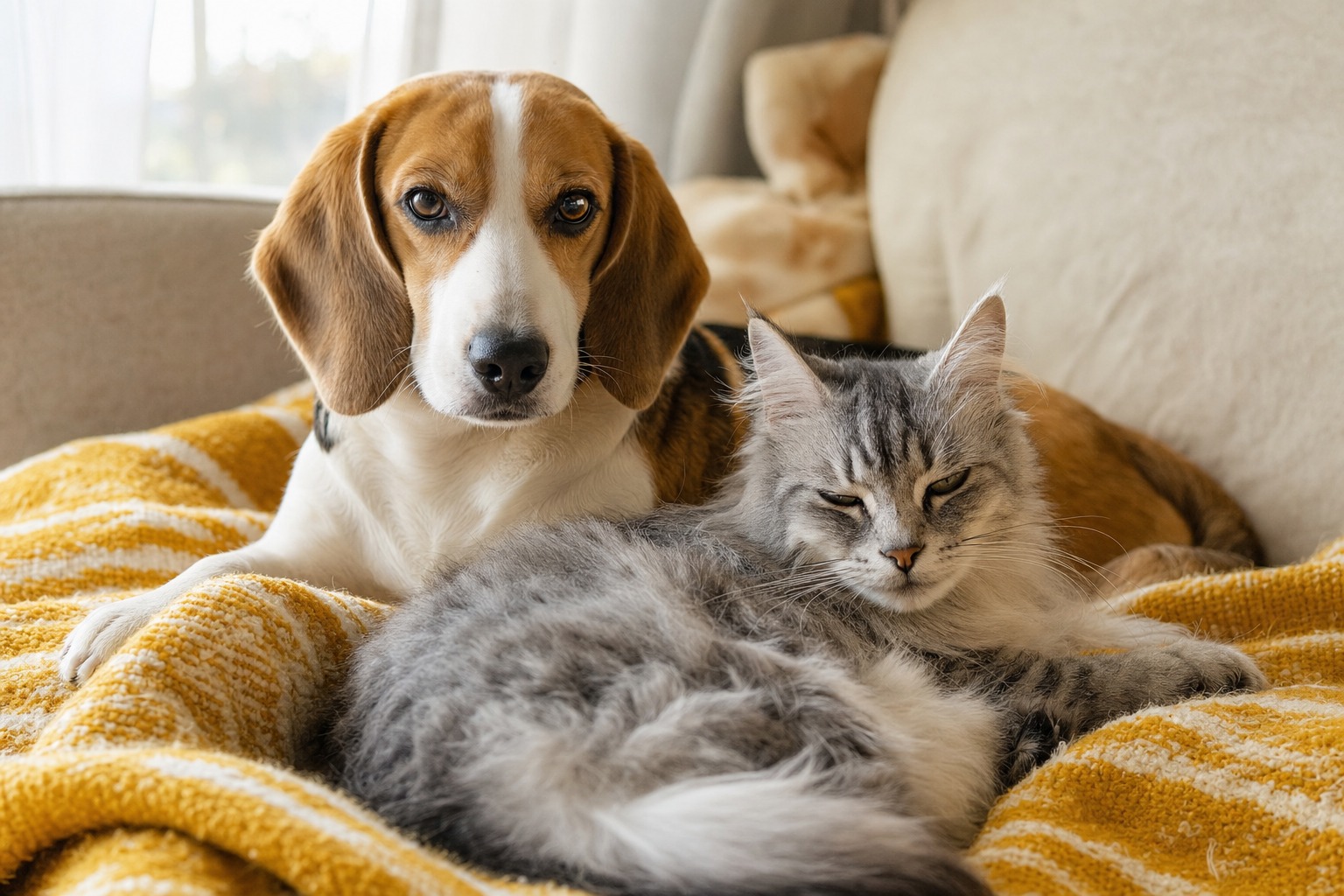
Picture yourself hunting around the house for something you dropped, getting visibly annoyed, and never asking for help. Would your dog step in? Would your cat? Researchers in Hungary set up almost exactly that scene, ran it past dogs, cats, and human toddlers, and got an answer clean enough to settle a few dinner-table arguments. Dogs behaved like the toddlers. Cats behaved like accountants.
The study, published in early 2026 in the journal Animal Behaviour by a team at Eötvös Loránd University and the HUN-REN–ELTE Comparative Ethology Research Group, is worth understanding for what it does not say as much as what it does. It does not say cats don’t care about you. It says cats decide whether helping is worth their while, and that turns out to be a more interesting finding than a simple “dogs win.”
What the researchers set up
The team tested 38 untrained pet dogs, 22 pet cats, and 19 toddlers between 16 and 24 months old. Crucially, every session happened in the animal’s or child’s own home, so nobody was reacting to a strange lab. Each subject watched a researcher hide an object, a household sponge. Then the subject’s own person searched for it, pretended to grow frustrated, and, importantly, never once asked for help.
That last detail is the whole design. The scientists weren’t measuring obedience or trained retrieval. They were watching for spontaneous helping: would the animal or child glance back and forth between the person and the hidden sponge, walk over to it, or go so far as to fetch it, entirely on their own initiative, for an object that meant nothing to them?
What happened
The toddlers did what toddlers in earlier studies do, hitting the helping milestones researchers expected. The surprise was on four legs. Dogs tracked the children almost move for move: more than three-quarters of the dogs and children either flagged the sponge’s location or brought it over, with no training, no reward, and no personal stake in a dishwashing sponge.
Cats mostly watched. They clearly tracked what was happening and would, now and then, glance toward the hidden object, but they rarely did anything about it. With one telling exception. In a control version of the test where the hidden item was something the cat actually wanted, a favorite toy or treat, cats pointed it out just as reliably as the dogs and toddlers did.
Read that twice, because it reframes everything. The cats were never incapable of helping. They understood the game and could play it perfectly. They simply declined to spend the effort on a payoff that was yours and not theirs.
This is the part people misread. A cat sitting out a task isn’t a cat that failed the test. It’s a cat that took the test and decided the reward didn’t justify the work. That’s not coldness, that’s a species that never evolved to earn its keep by pleasing us the way dogs did.
Why dogs and cats split here
The researchers were careful not to call cats “mean.” Their reading is that cats are wired for more independence and less reliance on human partners, which fits their history. Cats domesticated themselves alongside us on far looser terms than dogs did, living as capable solo hunters rather than cooperative workers. Senior author Márta Gácsi noted that living in our homes and forming close bonds with us clearly isn’t enough, on its own, to produce the eager helping dogs and children show. Something else in the dog lineage, tens of thousands of years of selection for working with people, seems to be doing that work.
The team also flagged a fair caveat: the cats might not have fully grasped that their person didn’t know where the sponge was, or might have needed more time to work out what was going on. And even where dogs and toddlers behaved alike, their motives may differ. The researchers suspect small children help out of budding empathy or a wish for approval, while dogs may be driven more by social bonding and a history of reinforcement. Same behavior on the surface, possibly different engines underneath.
What to take home
If you live with both species, this study is permission to stop grading them on the same curve. Your dog offering to help is your dog being a dog, tuned across millennia to read your state and pitch in. Your cat staying put on the warm cushion while you grumble is your cat being a cat, fully aware of what you’re doing and entirely unconvinced it’s their problem. Neither is a character flaw. They’re two different deals we struck with two different animals, and both, in their own accounting, are keeping their end.
References
- Dogs are more like toddlers than cats when it comes to helping humans — Phys.org
- Cats, unlike dogs and toddlers, help you only when it helps them — Scientific American
- Dogs are more like toddlers than cats when it comes to helping humans — EurekAlert!
- Csepregi et al., prosocial behaviour in dogs, cats, and children — Animal Behaviour
Dr. Chen is a small-animal veterinarian who leads health and safety coverage at The Pet Times. She writes and reviews the bulk of our illness, condition, and safety content, translating clinical guidance into clear, practical advice owners can act on at home.
Meet our experts ↗Keep reading
 LivingAn Animal Communicator Told Me My Dog Wanted a Cleaner Water Bowl. She Was Right.Claire Sutton · 7 min
 TrainingYour Pet Wears Their Stress on Their Face. Most Owners Miss It.Dr. Nina Kohl · 9 min
 TrainingYour Dog's 'Emotional Support' Pumpkin Is Real Psychology, Not Just a Cute VideoDr. Nina Kohl · 5 min
 TrainingWhen Your Kid Leaves for College, the Pet Falls Apart TooDr. Mara Chen · 5 min
 TrainingYour Dog Humping the Cat Isn't About What You ThinkDr. Ravi Mehta · 7 min
 First DaysYour Puppy Thinks the Cat Is a Toy. Fix That Before They Ever Meet.Dr. Mara Chen · 9 min