


Your Dog Humping the Cat Isn't About What You Think
It's rarely sexual and it's not really about being 'the boss.' Mounting is usually overflow, of excitement, stress, or learned attention-seeking. Here's how to read it and how to protect your cat while you fix it.

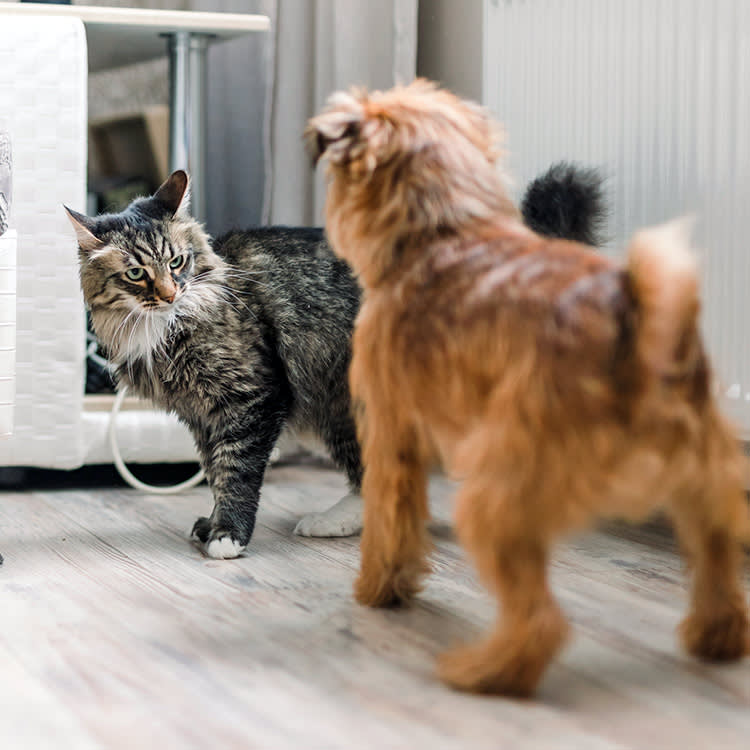
There is no elegant way to have this conversation, so let’s just have it: your dog keeps humping your cat, guests have noticed, and the cat has filed several formal complaints. Before embarrassment turns into a scolding, it helps to know what the behavior actually is, because almost everyone reads it wrong.
Here is the reframe: mounting is rarely about sex, and the popular “he’s showing the cat who’s boss” explanation doesn’t hold up well either. In most dogs, humping is overflow behavior, a pressure valve for excitement, stress, or big feelings with nowhere else to go. That matters practically, because you don’t fix an overflow problem with punishment. You fix it by finding what’s filling the tank.
One thing outranks the diagnosis, though: your cat’s safety. A dog of almost any size can injure a cat this way, and even a size-matched pair is racking up stress and eroding a relationship you want to succeed. So the plan is always two-track: protect the cat now, decode the dog in parallel.
“Mounting is one of the most misread behaviors I get asked about,” says Dr. Mara Chen. “People assume sex or status, but the honest answer is usually simpler: the dog is over threshold and this is where the energy went. Ask what wound them up, and you’re halfway to fixing it.”
First, is this normal?
Genuinely, yes. Mounting is standard-issue dog behavior. Puppies mount littermates in play long before hormones enter the picture, and plenty of adult dogs mount toys, cushions, legs, and, in multi-pet homes, the cat. Normal does not mean acceptable, though. It means your dog is not broken, and the behavior can be redirected the way any normal-but-unwanted behavior can.
The five real reasons behind it
1. Play that boiled over. Mounting sits on the standard puppy play menu, littermates practice it on each other constantly, and singleton puppies rehearse on toys or people. In a dog-cat household, a friendly wrestling session can escalate until the dog defaults to playing “like a dog,” and the cat becomes an unwilling littermate. Under-socialized dogs are especially prone to this, because they never got the peer feedback that teaches where the line is. Early, well-run socialization is the vaccine.
2. Stress leaking out sideways. Some dogs respond to anxiety with repetitive, self-soothing behaviors, and mounting is a common one. Watch the timing: does it spike when the doorbell rings, when the travel crate comes out, when a walk or meal runs late? That pattern is diagnostic gold. Left alone, stress-mounting can escalate into a compulsive loop that is much harder to unwind, so it is worth taking seriously early.
3. It works. Dogs are ruthless empiricists. If humping the cat reliably makes you drop your phone, leap off the couch, and give the dog your full attention, congratulations: you have been training your dog to hump the cat. Negative attention counts as attention. Skipped the morning greeting? No dog park lately? The cat becomes a lever your dog knows how to pull.
4. Friction over status and stuff. Households with multiple animals do sort out who defers to whom, and dogs and cats do not always land on the same answer. Mounting can show up amid that friction, alongside squabbles over beds, bowls, and prime windowsills. A note on the science: modern behaviorists have largely walked away from “dominance” as the master explanation for dog behavior, and the American Veterinary Society of Animal Behavior cautions against training built on it. Read this cluster less as “your dog wants a throne” and more as “your pets are competing over resources,” because the fix, more resources, less competition, is the same either way and doesn’t require a confrontation.
5. A body problem, not a behavior problem. An intact dog’s hormones can absolutely drive mounting, which is one more argument for the spay/neuter conversation. But so can urinary tract infections and skin irritation in the nether regions, either can produce humping as a response to discomfort. This is why a sudden, out-of-nowhere mounting habit warrants a vet visit before a training plan: you cannot train away a UTI.
The fix: manage first, train second
-
Log the pattern before you change anything. When does it happen, what kicked it off, what made it stop? A week of notes beats a month of guessing.
-
Flood the home with resources. Separate water bowls, separate beds, separate retreat spots, and then a spare of each. Competition fuels friction; abundance drains it. Give each animal daily one-on-one time with you, too.
-
Make the behavior stop paying. If the cat is not in danger, deny the payoff: leave the room without a word. No eye contact, no wrestling the dog off, no lecture. Attention-seeking behavior starves without an audience.
-
Install a better habit. Teach a rock-solid “sit” or “down” in calm moments, then use it as the interrupt when you see the wind-up. Skip treat-and-toy distractions in the moment, though, because a dog who gets a biscuit every time they start humping the cat will draw the obvious conclusion.
-
Never punish it. From your dog’s side, this is normal behavior. Punishment adds fear and confusion without teaching an alternative, and fear makes every behavior problem worse.
When to call in professionals
New, sudden mounting goes to the veterinarian first to rule out the medical drivers. If health checks out and your own consistency isn’t moving the needle, a qualified positive-reinforcement trainer or behaviorist is the right next call, not an admission of defeat. Meanwhile, keep managing the environment: baby gates, supervised time together, and guaranteed cat-only escape routes (high perches, gated rooms) protect the relationship while the training does its slower work.
What newer research adds
The dominance framing this behavior usually gets deserves its own correction, because the science moved. Position statements from the American Veterinary Society of Animal Behavior emphasize that most unwanted dog behavior stems from arousal, anxiety, learning history, or unmet needs rather than a drive for rank, and that confrontational corrections tend to increase aggression and stress rather than resolve them. For a humping dog, that translates directly: skip the alpha theatrics, manage the environment, reward the alternative behavior, and treat sudden changes as medical until proven otherwise.
For the cat’s side of the equation, feline behavior guidance from the American Association of Feline Practitioners consistently stresses vertical territory and predictable escape routes as the foundation of multi-species peace. A cat who can always get up and away from the dog is a cat whose stress, and retaliation risk, stays low while you work on the dog.
References
- UC Davis Veterinary Medicine, Clinical Animal Behavior Service: Inappropriate Mounting in Dogs
- Lindell, Ellen, Debra Horwitz, and Gary Landsberg. “Compulsive Disorders in Dogs.” VCA Animal Hospitals. vcahospitals.com/know-your-pet/compulsive-disorders-in-dogs
- “Mounting and Masturbation.” ASPCA
- American Veterinary Society of Animal Behavior: Position Statements (dominance and punishment)
- American Association of Feline Practitioners: Cat Friendly Homes, Multi-Pet Households
Common questions
Is it OK to let my dog hump my cat?
No. Even between size-matched pets it creates stress and conflict, and with a size gap your cat can genuinely get hurt. It's a behavior to interrupt and redirect, not one to wait out.
Is my dog trying to mate with my cat?
Almost certainly not. Mounting in dogs is usually driven by excitement, stress, or attention-seeking rather than sex, though an intact dog's hormones can contribute. A vet can help you sort out the driver.
Should I worry if the humping happens a lot?
Frequent mounting suggests your dog's stress or arousal has no better outlet, and it can harden into a compulsive habit. Tighten the daily routine, add one-on-one time and enrichment, and loop in your vet if it escalates or appeared suddenly.
Dr. Mehta is a board-certified veterinary nutritionist who evaluates pet food formulations, ingredient quality, and the science behind dietary trends. He writes and reviews all nutrition content at The Pet Times, including our food rankings and feeding guides.
Meet our experts ↗Keep reading
 TrainingYour Cat Screams at 3am Because You Never Let It Finish the HuntDr. Mara Chen · 8 min
 TrainingYour Dog Isn't Misbehaving. You're Asking the Wrong Question.Dr. Lena Park · 6 min
 TrainingYour Dog Isn't Being Rude. He's Cornered.Dr. Amara Solis · 8 min
 TrainingYour Puppy's Evening Meltdown Isn't Extra Energy. It's Exhaustion.Dr. Amara Solis · 5 min
 TrainingA Laser Pointer Isn't a Toy. It's a Job Your Dog Can Never Finish.Dr. Nina Kohl · 7 min
 TrainingYou Didn't Cause Your Dog's Leash Reactivity. Here's How to Manage ItDr. Amara Solis · 7 min