


Your Dog Isn't Colorblind. Their Eyes Made a Trade You'd Never Take.
The 'dogs see in black and white' myth gets it backwards. Your dog's eye gave up sharpness and full color to win something you don't have: motion detection and low-light vision. Here's what they actually see.

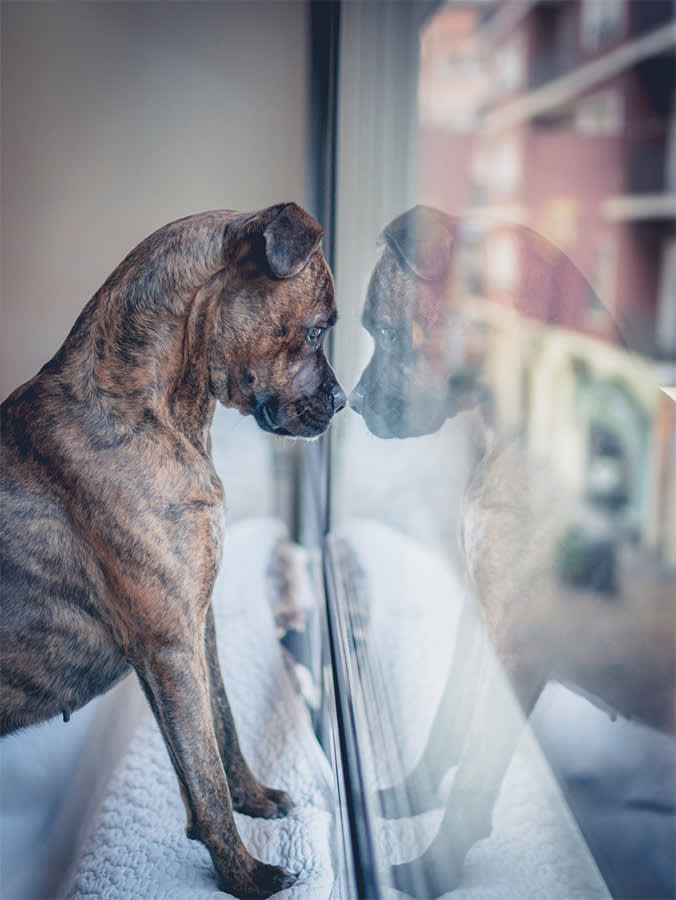
Everyone “knows” dogs are colorblind and see the world in black and white. It’s one of the most repeated facts about dogs, and it’s wrong, not just slightly wrong, but backwards in a way that misses something genuinely cool about how your dog experiences the world.
Here’s the reframe. Your dog’s eye isn’t a worse version of yours that lost its color. It’s a different instrument, tuned for a different job. Somewhere back in the evolutionary bargain, the canine eye gave up two things you have, rich color and sharp detail, and got two things you don’t, excellent motion detection and strong low-light vision. That’s not a deficiency. That’s a trade, the kind you’d never make as a primate who needs to spot ripe fruit and read fine print, but exactly the trade you’d want as an animal that hunts at dawn and dusk and needs to catch the faintest flicker of movement across a field. Once you see it as a trade rather than a loss, the whole “colorblind” myth falls apart, and what your dog actually sees gets a lot more interesting.
The eye behind the eyes
Start with the hardware, because the trade is built right into the anatomy. A dog’s eye is structurally a lot like ours, with a cornea, sclera, conjunctiva, iris, pupil, lens, and retina all doing roughly the jobs you’d expect: the cornea and lens focus light, the iris and pupil control how much gets in, and the retina turns light into signals the brain reads as vision. Notably, a dog’s eye color, however striking, doesn’t affect their vision at all.
The retina is where the trade lives. It’s paved with two kinds of photoreceptor cells: rods, which detect light and movement, and cones, which detect color. The balance of those cells is what defines an animal’s visual style, and dogs are built rod-heavy. More rods means more sensitivity to dim light and motion. Fewer cones means less color.
Then there are two features dogs have that we don’t. The first is a third eyelid, which acts like a windshield wiper, sweeping tears across the cornea and adding a layer of protection against injury. The second is the star of the low-light show: the tapetum lucidum, a reflective layer behind the retina. It bounces incoming light back through the retina a second time, effectively giving those light-detecting rods two chances to catch each photon. That second pass is what makes a dog’s vision hold up as the light drops, and it is also the reason a flashlight or a pair of headlights turns your dog’s eyes into two coins of green fire in the dark. The glow is just the mirror doing its job. (Not every dog has one; some blue-eyed Siberian Huskies are born without a tapetum entirely.)
What the color trade actually looks like
So dogs do see color, just less of it. Where humans are trichromatic, with three types of cones, dogs are dichromatic, with two. Practically, that means dogs see the world on a spectrum of blues and yellows and have real trouble distinguishing reds from greens. Their world isn’t gray. It’s colored, but in a more limited, blue-yellow palette, a bit like a person with red-green colorblindness.
This is genuinely useful information, not just trivia. If dogs see blues and yellows best and can’t really pick reds and greens out, then a bright red toy tossed onto green grass is, to your dog, two shades of the same muddy non-color, which is why they sometimes seem to lose a toy that’s sitting in plain sight. Choose blue and yellow instead, for toys, training targets, or gear, and you’re working with your dog’s eyes instead of against them.
The sharpness half of the trade
The other thing dogs gave up is acuity, the fine detail that makes edges crisp. Vision scientists measure this with the familiar 20/20 scale, where 20/20 is normal for people. Estimates put the typical dog nearer 20/75, and the arithmetic behind that fraction is worth unpacking: a detail you could resolve standing 75 feet back, your dog has to close to within 20 feet to make out at all. Everything past that distance arrives soft.
But look at what they bought with that softness. Because a dog’s eyes sit farther apart on the skull, each one covers more ground, which widens the total field of view and sharpens what they catch out of the corner. The bill for that comes due in depth perception: the two eyes share less of the same scene, and stereo vision needs overlap to work. Meanwhile their rod-rich, tapetum-backed retinas make them far better at detecting motion and seeing in low light. A dog might not read the fine print of a still scene, but a small movement at the edge of a dim yard? They’ll catch it long before you do.
There are some interesting edge cases in the day-vision department, too. Dogs actually see a bit better in dimmer light than in bright, and rarely, a genetic condition called hemeralopia, or day blindness, degrades the cones until bright sun becomes both hard to see through and visibly unpleasant to sit in. It stays rare, though vets have recorded it in a handful of breeds: Labrador Retrievers, German Shepherds, German Shorthaired Pointers, and Alaskan Malamutes among them.
The thing I wish more owners understood is that ‘colorblind’ makes it sound like your dog is missing out, when really their eye is just optimized for a different job than ours. They didn’t lose color vision so much as never needed much of it, and in exchange they got an eye that’s superb at catching movement and working in low light. When I explain it as a trade, people stop pitying their dog’s vision and start appreciating it, and they start picking blue toys.
When the trade breaks down: eye problems to watch
An eye this specialized still has plenty that can go wrong, and vision loss can come from the eye itself or from elsewhere in the body. Any dog whose eyes seem off should be checked promptly. The usual suspects sort roughly by speed. Some arrive all at once: a penetrating wound or a blunt blow; glaucoma, in which pressure builds inside the eye until it wrecks the retina and the optic nerve; or SARDS (sudden acquired retinal degeneration syndrome), which takes the retina apart in a matter of days to weeks for reasons nobody has pinned down. Others creep. A cataract clouds the lens so light can’t finish its trip to the retina, sometimes by inheritance and sometimes as fallout from another illness, and diabetes is a common upstream cause, which is why a diabetic dog can lose part or all of their sight. Progressive retinal atrophy (PRA) is the inherited slow burn, a retina that degrades year over year toward blindness. Inflammatory conditions like uveitis and optic neuritis round out the list.
Aging eyes, and how to protect them
Vision changes with age in dogs much as it does in people. A very common one is nuclear sclerosis, a gradual cloudiness of the lens that develops with age. Reassuringly, it isn’t painful and doesn’t cause blindness, and it’s frequently mistaken for a cataract. As the lens grows denser with age, though, both color vision and night vision do tend to diminish, and unlike nuclear sclerosis, true age-related lens changes can genuinely reduce sight.
Protecting a dog’s eyes across a lifetime is mostly unglamorous. Keep aerosols and cleaning chemicals away from their face, mind the dust, and trim back the fringe of fur that hangs into the eye and scrapes the surface all day. Then learn your own dog’s baseline, because that is what lets you register a change while it is still small. A dog who suddenly starts squinting deserves attention that day, not next week: a squint is often the opening move of a real injury. The same goes for a thick discharge, an eye gone red or cloudy, or any drop-off in what your dog can evidently see. Suspect the eyes if they start clipping doorframes and furniture, hesitating in rooms they know by heart, or hunting around for a bowl, a toy, or their own bed.
The eyes as a language
One last thing the trade didn’t cost dogs: the use of their eyes to communicate. Vision may not be a dog’s most important sense, but it’s a big part of how they read each other and us. A soft, loving gaze shows affection (or angles for a treat); a hard, determined stare directs attention or stands up to a perceived threat; and averted eyes signal fear or discomfort. Dogs also read visual cues from other dogs, raised hackles, a wagging tail, to understand what’s being communicated. So while your dog’s eyes may see a softer, bluer, more motion-tuned world than yours, they’re doing plenty of talking in it.
Understand the trade and the whole picture flips. Your dog isn’t peering at a gray, blurry version of your world and coming up short. They’re seeing a different world, one built for movement and dim light, with color and sharpness quietly traded away for skills you’ll never have. Not worse. Just tuned for a different life.
Eye health is individual and changes can move fast, so treat this as background and get any sudden change in your dog’s eyes or vision looked at promptly.
References
- Miller, Paul E., and Christopher J. Murphy. “Vision in Dogs.” Journal of the American Veterinary Medical Association, vol. 207, no. 12, 1995, pp. 1623–1634.
- Byosiere, Sarah-Elizabeth, et al. “What Do Dogs (Canis familiaris) See? A Review of Vision in Dogs and Implications for Cognition Research.” Psychonomic Bulletin & Review, vol. 25, 2018, pp. 1798–1813.
- Neitz, Jay, et al. “Color Vision in the Dog.” Visual Neuroscience, vol. 3, no. 2, 1989, pp. 119–125.
- “Achromatopsia (Day Blindness) in Dogs.” American College of Veterinary Ophthalmologists.
Common questions
Can dogs see in the dark?
Not in complete darkness, but far better than humans in dim light. Their eyes have larger pupils, a higher density of light-detecting rod cells, and a reflective layer called the tapetum lucidum that bounces light back through the retina, which is also why their eyes seem to glow at night.
How can I tell if my dog has poor eyesight?
Watch for bumping into walls or furniture, difficulty navigating familiar spaces, or trouble finding food, toys, or bedding. Sudden squinting, heavy discharge, redness, cloudiness, or an obvious change in vision all warrant a prompt vet visit.
Not a substitute for your vet. Our guidance is educational. For urgent symptoms, contact a vet or emergency clinic right away. Editorial standards
Dr. Kohl is a board-certified veterinary dentist with a particular interest in preventive oral care. She reviews all dental health content at The Pet Times and contributes practical guides on home dental routines, professional cleaning, and oral disease prevention.
Meet our experts ↗Keep reading
 Health & WellnessYour Dog Cried in Their Sleep. Here's When It's a Dream and When It's Not.Dr. Lena Park · 7 min
 Health & WellnessYou'd Expect Giant Breeds to Get the Most Cancer. A Big Study Says It's the Middle.Dr. Mara Chen · 6 min
 Health & WellnessA Dog Who Won't Drink Water Is a Clock, Not a QuirkDr. Lena Park · 7 min
 Health & WellnessChronic Kidney Disease in Dogs Is a Race Against Time. How to Win GroundDr. Lena Park · 7 min
 Health & WellnessMost Dog Coughs You Can Soothe at Home. A Few You Really Can't.Dr. Amara Solis · 9 min
 Health & WellnessMost Lumps on Your Dog's Back Are Fat. You Cannot Tell Which by Touching.Dr. Amara Solis · 7 min