


When Your Dog Stands on You, They're Asking a Question. Here's the Answer
A dog planting all four paws on you is making a request, not a power play. A behavior specialist breaks down the nine things they might be asking for and how to respond to each.

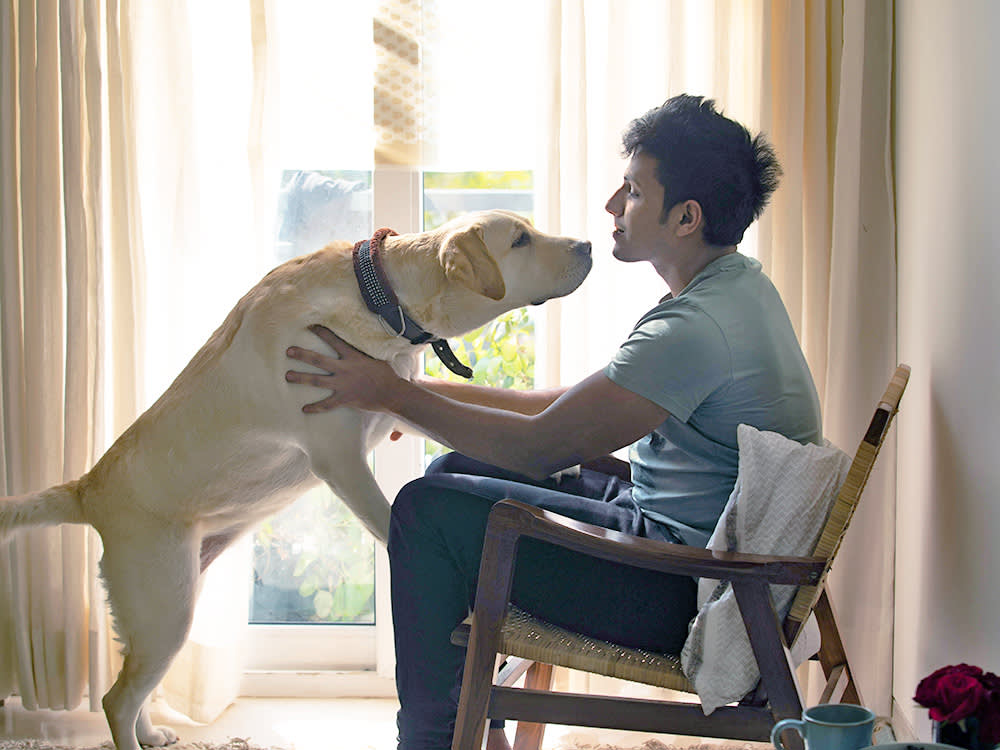
Every morning my neighbor’s Collie mix performs the same ritual: the bedroom door swings open, a feathery tail glides past the bed like a shark fin, and then forty pounds of dog is standing squarely on her chest, wagging. She scratches his ears, laughs, and gets up to let him out. What she does not realize is that she just answered a question, and her answer is why he asks it again tomorrow.
That is the key to this whole behavior. A dog standing on you is not making a statement about rank or ownership. They are making a request, and the request gets repeated for one simple reason: it works. According to behavior specialist Susan Nilson, almost any response, a pat, a laugh, even an annoyed “off,” reads to a dog as a payout. So the useful skill is not stopping the standing. It is learning to hear what your dog is actually asking for, because the right response depends entirely on the question.
“Good reaction or bad, your dog registers it all as attention, and attention was the goal the whole time,” Nilson says. “The behavior grows out of a need, comfort, closeness, or wanting something from you, never out of any desire to run the show.”
Here are the nine things your dog might be asking, and how to answer each one.
1. “Pay attention to me”
The most common request, and the one we accidentally train. If standing on you reliably earns a scratch, your dog files that away and does it again. The catch is that “negative” responses count too. Pushing your dog off or telling them to get down still delivers the eye contact and touch they wanted, so you reinforce the very thing you are trying to stop.
The answer: reward the behavior you do want. Teach your dog that lying or sitting beside you earns the attention, while standing on you earns nothing at all, no look, no words, no hands. Consistency is the whole game.
2. “I’m scared, anchor me”
Thunderstorms, fireworks, strange guests, or any sudden change can send a dog looking for a secure base, and you are it. Nilson points to research showing dogs use their owners much the way young children use a parent, as a safe anchor in a frightening moment. Standing on you, pressed in close, is a way to borrow your calm.
The answer: read the body. Ears down, tail tucked, a furrowed brow, these mean the request is fear, not fun. Do not shoo the dog off in that moment; address the fear itself with distance from the trigger, a calm voice, and over time some desensitization work.
3. “I love you and I want to be close”
Dogs are intensely social and often express affection through physical contact. Standing on you can be plain closeness-seeking, and there is real chemistry behind it: prolonged contact with you can spark a mutual release of oxytocin, the bonding hormone tied to feelings of trust and contentment. The good feeling is its own reward, which is exactly why the behavior sticks.
The answer: if you enjoy it, enjoy it. Just know you are reinforcing it, so do not be surprised when it becomes a daily habit.
4. “Stay near me, I’m watching out”
Certain dogs, by temperament or training, lean protective and instinctively watch over what they value most, their people included. Guardian breeds, German Shepherds and Dobermans among them, may feel a stronger pull to stay close. Standing on you can be a low-key version of that watchfulness.
The answer: harmless on its own. But if your dog stands on you while growling or snapping at someone else, that has crossed into over-protectiveness, which can escalate and is worth addressing with a vet or behaviorist before it becomes a bite.
5. “Please don’t leave”
Separation-related distress shows up in clingy, shadowing behavior even when you are home, and standing on you can be part of that pattern, alongside following you room to room or panicking when you step out of sight. It is worth knowing how common, and how variable, this is. A large study of nearly 14,000 dogs found that severe separation-related behavior was actually one of the less common anxiety traits, around 5 percent, even though noise sensitivity affected roughly a third. In other words, true separation anxiety is real but often over-diagnosed, so look at the whole picture before you label it.
The answer: if standing on you comes bundled with genuine distress at departures, treat the separation anxiety directly with a vet’s help, rather than just the paws.
6. “Let’s play”
Dogs invite each other into play with their bodies, the classic play bow with rear up, tail wagging, mouth loose and open. A playful dog may translate that into jumping up, planting their front paws against you, or clambering into your lap to get things started.
The answer: front paws plus a wagging tail and a bouncy posture usually means play. Channel it into an actual game or a fetch session rather than letting your lap be the launch pad.
7. “Something feels off, with you or with me”
Dogs are remarkable readers of human states, sometimes noticing we are unwell before we do. It is the same sensitivity that lets trained dogs detect the odor cancer cells leave on human breath. So a dog who suddenly leans on or stands over you when you are sick may be offering comfort or staying close protectively. It can also point inward: a dog who feels ill may either withdraw, hiding, slowing down, losing their appetite, or swing the other way into unusual clinginess.
The answer: if the standing is new and paired with other changes, in you or in them, take it as information. A sudden, out-of-character clingy phase is worth a vet conversation.
8. “I’m cold and you’re warm”
A simpler request that gets overlooked. Dogs seek body heat and contact pressure for comfort, especially small or thin-coated dogs and seniors, and a person is a warm, steady surface. Standing on or pressing into you can be straightforward thermoregulation and the soothing feel of close contact.
The answer: offer a cozy alternative, a warm bed or a blanket in their settle spot, so the warmth is available without your ribcage being the radiator.
9. Not a reason: “I’m dominating you”
This one belongs on the list precisely so you can cross it off. Like most modern behaviorists, Nilson considers dominance a debunked explanation for pet-dog behavior.
“The whole ‘dominance’ idea came from watching unrelated captive wolves and was then wrongly stamped onto pet dogs,” Nilson says. “It has been retired by behavioral science, even though the myth refuses to die. Your dog is not staging a coup. They want comfort, attention, or connection.”
The answer: drop the alpha framing entirely. It leads people toward confrontation that damages trust and never addresses the actual need.
How to answer without a power struggle
Once you know the question, the response is mostly the same gentle toolkit applied to the right need. If you would rather your dog not stand on you, move them off calmly with a quiet “off,” then immediately reward them for sitting or lying beside you, so the better choice becomes the one that pays. Build cues like “off,” “down,” and “leave it” so you have language to redirect with, and create inviting settle spots, a comfy bed near you, so closeness has a legal address that is not your torso.
And read the body language every time, because it tells you which question you are answering. Front paws and a wagging tail point to play. Persistent standing with a tucked tail, lowered ears, and a worried face point to fear, and that is a request for reassurance, not a habit to correct.
The bottom line
Your dog standing on you is a small, repeated question: pay attention to me, anchor me, stay close, let’s play, something’s off, I’m cold. It is never a bid for dominance. Figure out which need is behind the paws, answer that need a better way, and the behavior either fades or becomes a shared moment you both actually want. Either way, you stop fighting your dog and start understanding them.
Frequently asked questions
How do I get my dog to stop standing on me?
First figure out what they are asking for, then answer that need a better way. If it is attention, reward sitting or lying beside you instead and ignore the standing. If it is anxiety, address the fear rather than the paws. Redirect with positive reinforcement and stay consistent, since the behavior continues only as long as it keeps working.
Is my dog standing on me to show dominance?
No. Dominance as an explanation for everyday dog behavior has been debunked; it came from a flawed study of captive wolves and was wrongly applied to pet dogs. A dog standing on you is asking for attention, comfort, closeness, or play, not staging a power grab.
Will my dog start standing on other people too?
Possibly. A dog who learns that standing on you pays off may try it with family and guests, who may not welcome it or could be knocked off balance. If you cannot prevent it, give your dog a settle spot or move them to another room when company comes.
When should I call a vet about this behavior?
Reach out to a vet or behaviorist if your dog stands on you while growling or snapping at others, which signals over-protectiveness that can escalate, or if the behavior is new and paired with clinginess, hiding, or other signs your dog may be unwell.
Is it okay to let my dog stand on me?
If you enjoy it and nobody is bothered or at risk, it is completely fine. It only becomes a problem worth retraining when it is unwanted, unsafe, or rooted in anxiety you would rather resolve.
References
- Salonen, Milla, et al. “Prevalence, Comorbidity, and Breed Differences in Canine Anxiety in 13,700 Finnish Pet Dogs.” Scientific Reports, vol. 10, 2020, article 2962.
- Nagasawa, Miho, et al. “Oxytocin-Gaze Positive Loop and the Coevolution of Human-Dog Bonds.” Science, vol. 348, no. 6232, 2015, pp. 333-336.
- “Meet America’s Cancer-Sniffing Dogs.” American Kennel Club, 25 Mar. 2020, akc.org/expert-advice/news/meet-americas-cancer-sniffing-canines.
Tom Hadley writes about training and behavior, helping owners understand what their pets are trying to tell them. His work covers everyday manners, decoding common behaviors, and the small changes at home that make dogs and cats easier to live with.
Meet our experts ↗Keep reading
 TrainingYour Dog Isn't Being Rude. He's Cornered.Dr. Amara Solis · 8 min
 TrainingYour Dog's Joy Sends 86,000 People to the ER Every YearDr. Nina Kohl · 8 min
 TrainingYour Dog Paws at You Because It Works. You're the One Who Taught ThemDr. Mara Chen · 6 min
 TrainingYour Two Dogs Used to Be Best Friends. Here's Why That Cracked, and Why It Won't Just Pass.Dr. Mara Chen · 6 min
 TrainingNo Dog Is "Untrainable." Some People Just Quit.Dr. Nina Kohl · 8 min
 TrainingStop Punishing Your Puppy. It's Backfiring.Dr. Amara Solis · 9 min