


Stop Dog-Proofing Room by Room. Your Dog Doesn't Live in Rooms.
Dogs hunt by category: things to swallow, things to taste, places to squeeze into, doors to bolt through. Proof your house the way your dog actually works it.

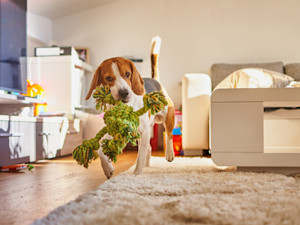
Every dog-proofing checklist walks you through the house the way a realtor would: kitchen, bathroom, living room, bedroom. The problem is that your dog does not tour your home, they work it, and they work it by category. There are things that fit in a mouth, things that smell like food, gaps that fit a body, and doors that sometimes open. A twist tie on the kitchen counter and a hair tie on the nightstand are, to a dog, the same object in two locations.
So here is the same territory organized the way your dog organizes it. Cover these four categories and you will have covered every room without thinking in rooms at all. This matters most right after adoption, when a new dog is mapping your house for the first time, and with puppies, who are less like babies and more like toddlers with a grudge against your baseboards.
Category one: things that fit in a mouth
This is the biggest category and the one that ends in surgery. Dogs swallow socks, underwear, hair ties, floss, twist ties, bread clips, sponges, laundry pods, corn cobs, and toy parts, and a surprising number of those objects do not pass on their own.
Your sweep list: keep counters clear of small objects, not just food. Close closet doors and keep laundry, especially socks, in a lidded hamper. In the bathroom, get floss, hair ties, and cotton products into drawers. In the bedroom, corral the loose change and earbuds on any dresser low enough to reach. In kids’ zones, small toys go in bins with lids.
Two structural fixes do a lot of the work: a covered trash can, ideally with a locking lid for the determined snoop, and the habit of keeping washer and dryer doors shut. An open dryer full of warm clothes reads as a bed to a dog, which is a problem you want to have exactly zero times.
Category two: things that taste like something
Food toxins are the ones most people already know: grapes and raisins, onions, garlic, chocolate, anything sweetened with xylitol, and macadamia nuts all belong permanently out of reach, in closed cabinets rather than on counters. But the tasting category is wider than food.
Medications, vitamins, and supplements poison more pets than any other household item, and human skin-care products have joined the list. Keep every pill bottle, yours and the dog’s, in a cabinet with a door, and take your own meds behind a closed door if you have a floor-scanner who materializes at the sound of a dropped pill.
Cleaning products, detergents, and fabric softener belong on high shelves or in latched cabinets. Toilet water is not a fatal hazard on its own, but with slow-release bowl cleaners it can be, so the lid stays down. Houseplants count here too: if a plant is toxic, height is not a plan for a dog who can reach a side table, so rehome the plant or hang it, and secure even the safe ones so they cannot be pulled over.
Category three: cords, gaps, and traps
The plastic coating on power cords apparently has a mouthfeel dogs appreciate, and a chewed live cord is a burn or worse. Cover cords, run them behind furniture, or box them in cord organizers, especially anywhere a bored dog waits out your workday.
Then look for the places a body can get into but not out of: behind the water heater, under the recliner (check before you rock it), inside an open dishwasher, the gap behind the couch. Get on the floor, at actual dog height, and look. This sounds silly and works better than any checklist, because your house has hazards no list can predict. You are looking for anything loose, dangling, wobbly, or gap-shaped.
Category four: exits
Window screens are not dog-proof. A dog who spots a squirrel will go through a screen, and second-story screens are no more dog-proof than first-story ones. Close windows when you leave, or open them from the top. Watch door-dashing pinch points, especially the path from the front door to the street, and consider a baby gate as an airlock if your dog treats every delivery as a starting gun.
The mindset that replaces the checklist
You cannot make a house adversary-proof against a creature with unlimited free time and a nose that works at parts per trillion. What you can do is make the easy wins boring: nothing swallowable at floor level, nothing edible at counter level, nothing chewable carrying current, and no exit that opens by accident. A crate-trained dog with good chew toys and enough exercise will meet you more than halfway. Dog-proofing is not about defeating your dog. It is about making sure their curiosity never costs more than a chewed slipper.
What’s new since this was written
The ASPCA’s Animal Poison Control Center published its 2025 numbers, and they read like a ranked map of exactly this article. The center handled more than 376,000 exposure cases in 2025. Over-the-counter medications and supplements were the number-one culprit at 16.9 percent of calls, boosted by the boom in skin-care creams and masks that dogs lick off nightstands and bathroom counters. Food and drink came second at 16.4 percent, led by grapes, raisins, xylitol gum, onions, and garlic. Human prescription meds held third.
Two newer trends worth knowing: recreational drugs cracked the top ten again, and calls about kratom, an herbal stimulant sold in gas stations and smoke shops, jumped 400 percent in a single year. If anyone in your household uses either, treat them like medications: behind a door, never in a bag on the floor.
References
Dr. Kohl is a board-certified veterinary dentist with a particular interest in preventive oral care. She reviews all dental health content at The Pet Times and contributes practical guides on home dental routines, professional cleaning, and oral disease prevention.
Meet our experts ↗Keep reading
 LivingShelters Say the Same Thing About Lost Dogs: Nobody Has a Usable PhotoMarcus Webb · 8 min
 Health & WellnessYour Dog Can Love Winter. You're Just Sending Them Out Wrong.Dr. Ravi Mehta · 7 min
 LivingThe 'Dog Days of Summer' Were Never About DogsNina Vasquez · 7 min
 LivingBefore You Bring Your Dog to the Cookout, Answer 8 Honest QuestionsTom Hadley · 9 min
 LivingYour Dog Doesn't Hate Fall. It Hates Your Calendar.Dr. Mara Chen · 8 min
 Health & WellnessThe Hot Car Isn't What Gets Most Dogs. The Walk Is.Dr. Priya Nair · 9 min