


Your Dog Isn't Being 'Bad' During Play. Their Brain Is Overloaded.
When play tips from goofy to unhinged, that's not disobedience, it's an overloaded nervous system. A trainer-informed guide to the six signs your dog is getting overstimulated during play, why high-arousal games trigger it, and how to bring your dog back down before things get frantic.

Affiliate disclosure. This article contains affiliate links. We may earn a small commission if you buy through a link, at no extra cost to you. How we handle recommendations.
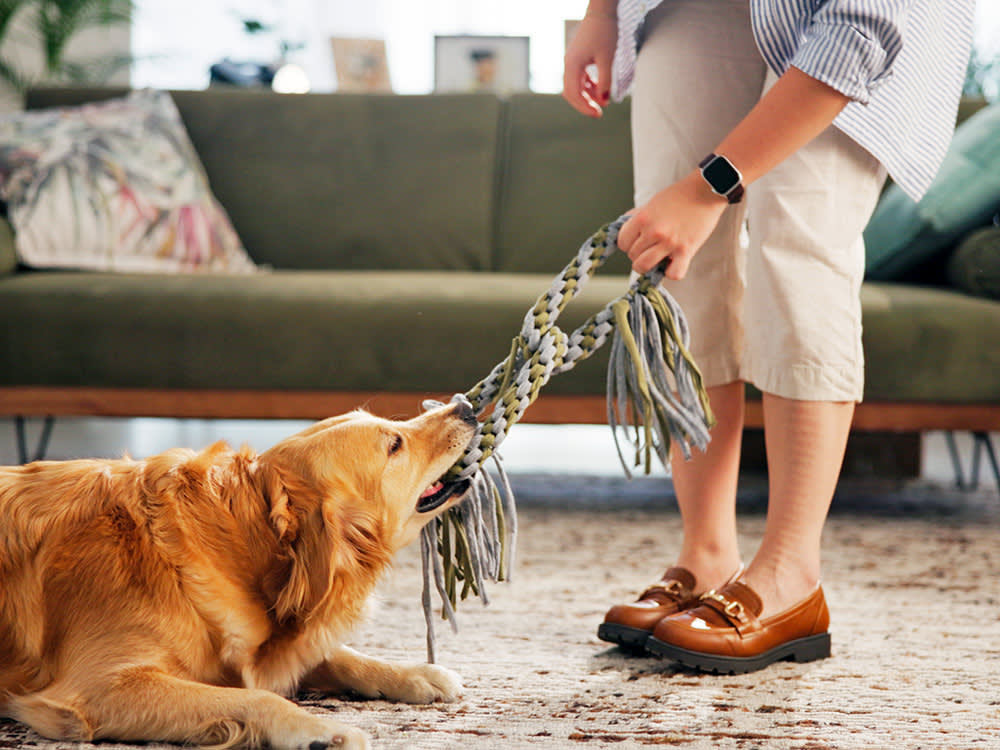
If you’ve ever watched your dog go from happily goofy to completely unhinged in about two seconds flat, you weren’t imagining it. Dogs get overstimulated during play, and when they cross that line, their excitement stops being fun and becomes a state where they can’t think clearly anymore.
The key thing to understand is what’s happening under the hood, because it changes how you respond. Overstimulation isn’t your dog being naughty. It’s arousal, in the physiological sense, spiking past what their nervous system can manage. When that happens, the thinking part of the brain gets crowded out by the fight-or-flight machinery, and a dog in that state is far more prone to overreacting, biting down too hard, or exploding into frantic zoomies. The threshold varies enormously from dog to dog. Some tolerate a lot of noise and motion; others tip early. It’s a bit like people and crowded clubs, the volume, the bodies, the lights, thrill some and overwhelm others.
The good news is that overstimulation announces itself before it peaks, if you know what to watch for. Catch the early signs and you can step in while play is still safe and fun.
I want people to stop reading overstimulation as disobedience, because that framing leads to punishment, and punishment pours fuel on an already flooded nervous system. Think of arousal like a rising thermometer. Your job isn’t to correct the dog at the top; it’s to notice the temperature climbing and cool things down a few degrees before they boil over.
Six signs your dog is tipping over the edge
Some of these look like ordinary “hyper” play. Others are quiet shifts that reveal your dog is creeping up on their threshold.
1. Their bites start landing on your hands instead of the toy. This is an early, easy-to-miss signal that arousal is climbing too high. Sometimes it’s made worse by handler pressure, an owner playfully shoving at the dog to get them to engage, which can push a dog into an interaction they didn’t actually want.
2. Zoomies and other displacement behaviors show up. Zoomies aren’t always joy. They can be a displacement or avoidance behavior, a way for a dog to discharge overwhelming stimulation. On their own they’re harmless, but alongside other frantic signals they suggest your dog has left a genuinely playful headspace. The same goes for sudden ground-sniffing, looking away, or pausing mid-play, all coping mechanisms that say “this is becoming too much.”
3. Rough mouthing or “sharking.” When arousal floods in, dogs lose precision. “Sharking” is that frantic, imprecise snapping at hands instead of toys that happens when a dog is too worked up to aim their mouth. It isn’t aggression; their brain is simply moving faster than their self-control.
4. Mounting or humping mid-play. Often misread as dominance, this is commonly just a displacement behavior. When arousal climbs too high, a dog’s body may default to it as a way to cope with the excess excitement or stress.
5. High-dopamine games escalate fast. Play styles like tug, fetch, and chase tip dogs into overdrive quickly because they trigger big dopamine spikes. That doesn’t mean you should ban them. It means being mindful of your expectations and watching the intensity.
6. They can’t stop themselves. Some dogs simply won’t quit, chasing, mouthing, or badgering you to keep going with no natural pause. Certain breeds were built for high-arousal work, Belgian Malinois, Border Collies, German Shepherds, and they get worked up easily. It’s like owning a sports car versus a sedan: buy the Lamborghini and you’d better know how to drive it.
How to bring your dog back down
Spot any of these, and it’s your cue to gently step in. The behavior is manageable as long as you interrupt early, before your dog is fully over threshold. The full sequence lives in the how-to box above, but the core idea is simple: swap high-arousal chasing for low-arousal sniffing and chewing.
Scattering food on the ground activates the seeking-and-sniffing system and tells the brain it’s safe to settle down. “Up-down” games, a burst of tug, then a hunt for treats in the grass, then more tug, always ending low, teach a dog to regulate their own arousal. Quick pause behaviors between rounds build impulse control without killing the fun, and cues like “drop it” and “take it” put you, not the dog, in charge of when the game starts and stops. When you’re winding down for good, a chew or a food-stuffed frozen toy does a lot of the work; steady, focused chewing is one of the most reliable ways to calm a revved-up dog. A classic stuffable rubber toy like the Kong Classic, packed and frozen, is a cheap, near-universal cool-down tool.
What newer research adds
Trainers increasingly talk about “trigger stacking,” the way multiple exciting or stressful inputs pile up faster than a dog can recover from any one of them, which is exactly why a dog can seem fine and then suddenly isn’t. There’s also growing evidence for why the sniffing-based resets above work so well. Research on scent work has found that letting dogs use their noses is associated with a more relaxed, “optimistic” emotional state, which is part of why scatter feeding and food-in-the-grass games calm an over-aroused dog rather than just distracting them.
The takeaway is worth holding onto: overstimulation isn’t bad behavior, it’s a nervous system getting overwhelmed. Learn your own dog’s early tells, interrupt arousal before it crests, and build in plenty of enrichment and cool-down time. A little awareness keeps play safe, sharpens your communication, and lets your dog enjoy high-energy fun without tumbling over the edge.
References
Dr. Kohl is a board-certified veterinary dentist with a particular interest in preventive oral care. She reviews all dental health content at The Pet Times and contributes practical guides on home dental routines, professional cleaning, and oral disease prevention.
Meet our experts ↗Keep reading
 TrainingYour Dog Nibbles You Like Corn on the Cob. Two Experts Disagree About What to Do.Dr. Nina Kohl · 8 min
 TrainingYour Dog Isn't Wrecking the Yard. They're Doing a Job. Name It.Dr. Mara Chen · 8 min
 TrainingYes, Dogs Get Tired of Barking. Waiting Them Out Still Won't Work.Dr. Nina Kohl · 6 min
 TrainingToy Theft Is Normal. What Happens in the Next Two Seconds Isn't Always.Dr. Amara Solis · 6 min
 TrainingYour Dog Digs Up Your Sheets. The Timing Tells You Whether to Worry.Dr. Nina Kohl · 7 min
 TrainingYour Dog Isn't Peeing on His Friend. He's Peeing on the Message Underneath Him.Dr. Amara Solis · 8 min