


The Four-Paw Bounce, Decoded (and the One Version That Isn't Cute)
That gazelle leap through tall grass, 'stotting,' is almost always pure joy. But one look-alike move, the mid-run back-leg lift, can point at a knee problem. Here's how to tell delight from discomfort.

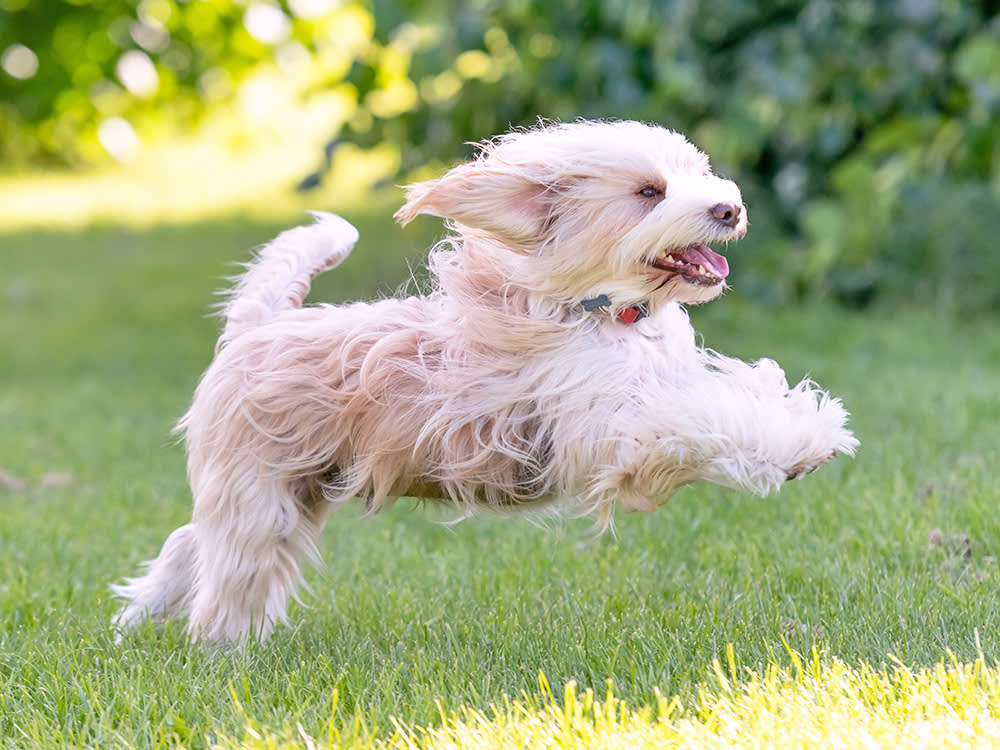
Somewhere in your phone there is probably a blurry video of it: your dog crossing a field in a series of springy, all-four-paws-airborne leaps, ears flying, looking less like a canine and more like a gazelle who has made some interesting life choices. The internet calls it the bunny hop. Ethologists borrowed older words for it: “stotting,” from a Northern English and Scots verb, or “pronking,” from Afrikaans, both originally coined for the bouncing gait of deer and antelope.
Some dogs never do it. Others treat it as a core personality trait. And because the move looks so theatrical, people wonder whether it means something, an instinct, a signal, a problem. The short version: the classic leap is one of the clearest joy behaviors a dog owns. The longer version is worth reading, because one look-alike variation deserves a closer look at the vet.
Why gazelles do it, and why your dog probably doesn’t share the reason
In actual gazelles, stotting has a serious proposed job. Many researchers read it as an honest advertisement aimed at predators: leaping straight up mid-escape burns energy a weaker animal cannot spare, effectively saying, “I am fit, fast, and not worth the chase.” It is antelope trash talk, backed by cardio receipts.
Do dogs inherit that? Behaviorists are skeptical, and the logic is simple: a house dog whose meals arrive on schedule and whose most dangerous predator is the vacuum has little use for anti-predator signaling. When trainers and behaviorists watch stotting dogs, the context is nearly always play, greeting, or open-field excitement, not vigilance. The gazelle gave the move its name; the dog runs it purely for the feeling.
“When a dog throws all four paws off the ground in an open field, I read it as an exclamation point,” says Dr. Lena Park. “The body has more excitement than a normal stride can carry, so the extra comes out as air.”
The physics of overflowing joy
The best model for the bounce is arousal overflow: excitement builds past what walking or running can express, and the surplus becomes vertical. It clusters exactly where you would predict, at leash pickup, at reunions, at the first step onto grass, right before a sprint. Think of a sprinter bouncing behind the starting blocks or a tennis player windmilling their racket before a match: the energy needs somewhere to go before the main event. Many dogs run the same discharge pattern before their signature full-body shake-off.
Notably, the leap is not a play bow. A bow is a genuine social invitation, an ask directed at another party. The bounce is more like a culmination, a toddler so excited they flap their hands, energy escaping through the nearest exit. Your dog is not necessarily requesting anything. They are just full.
It also lives in the same neighborhood as a behavior science actually has a name for: FRAPs, or frenetic random activity periods, the technical term for zoomies. Veterinary behavior resources, including Cornell’s Riney Canine Health Center, describe these sudden bursts of charging, spinning, and leaping as normal energy release, most common in puppies and young dogs, and often triggered by transitions, an owner coming home, the end of a bath, the release of a long day’s tension. A stotting run and a zoomie session are cousins: both are healthy pressure valves, not glitches.
The pogo-stick variant
Related but distinct: the dog who jumps straight up and down in place like a piston. Same engine, excitement, anticipation, greetings, with one twist: it is often a learned attention play. Bouncing gets eyes on the dog, and a behavior that reliably earns attention gets repeated. You will see the vertical bounce most in young, small, athletic, and herding dogs, but no breed has a monopoly; trainers report it in everything from Collies and Miniature Pinschers to Boxers and pit-bull-type dogs.
Two practical notes. First, if you would rather not be greeted by a pogo dog, make sure the bounce stops paying: attention arrives when four feet are on the floor, not mid-launch. Second, volume matters. Repeated high-impact jumping, especially on hard surfaces, adds up in joints, and can contribute to injuries like cruciate ligament tears and, long-term, arthritis. An occasional launch is living; a hundred reps a day off the back porch is a workload worth managing.
The one version to watch: the back-leg lift
Here is where decoding matters. A dog who intermittently lifts one back leg mid-run, skipping a beat every few strides, may not be doing a happy dance at all. That hitch is a classic presentation of a luxating patella, a kneecap that slides out of its groove. The dog lifts the leg to dodge the discomfort, then carries on, often still looking cheerful, because dogs are gifted at masking pain and will keep moving fast while quietly avoiding the movement that hurts.
Brief lifts of both back legs during hard turns or bursts of speed can be perfectly normal athletics. Lower back trouble can also masquerade in this space. What separates fine from not-fine is context and consistency: an occasional, symmetrical hop during wild play is one thing. The same hitch showing up on calm walks, favoring the same leg, or growing more frequent over weeks is a pattern, and patterns get exams.
“A skipped stride your dog repeats is not a quirk, it’s data,” says Dr. Priya Nair. “Kneecaps that slip don’t announce themselves with crying. They announce themselves with exactly that little hop, and the earlier we look, the more options we have.”
When to book the vet
Get a professional set of eyes on the bouncing if you notice:
- Limping, before or after the acrobatics
- Stiffness, or trouble standing up
- Reluctance to run or jump in a dog who used to love it
- Visible discomfort when you touch the back or hind legs
- Muscle loss in a hind leg
- Swelling anywhere in the leg
- The same leg lifted repeatedly, or a hitch that worsens over time
The reassuring flip side: brief, balanced, symmetrical leaping that only shows up in moments of high excitement, in a dog who moves normally the rest of the day, is almost always exactly what it looks like. Joy, expressed at altitude.
What newer research adds
The zoomies finally got scientific respectability. Veterinary behavior literature now treats FRAPs as a normal, healthy behavior rather than a mystery, with Cornell’s canine health resources noting they are most frequent in young dogs and often triggered by transitions like post-bath release or an owner’s return. The practical takeaway for the stotting question: sudden bursts of exuberant, athletic movement are a feature of canine emotional life, not a bug, and the veterinary consensus is to let them happen in safe spaces with decent footing.
The orthopedic side has also sharpened. Patellar luxation remains one of the most common orthopedic conditions in small-breed dogs, with published prevalence estimates around 1.3 percent of the general dog population and far higher rates in predisposed toy breeds, and veterinary orthopedists grade it on a four-point scale that guides whether monitoring, physio, or surgery makes sense. Early detection genuinely changes the menu, which is one more reason the “cute skip” deserves one good vet exam.
References
- Cornell University College of Veterinary Medicine, Riney Canine Health Center: What Are Zoomies?
- O’Neill, D. G., et al. “The Epidemiology of Patellar Luxation in Dogs Attending Primary-Care Veterinary Practices in England.” Canine Genetics and Epidemiology, vol. 3, no. 4, 2016. doi:10.1186/s40575-016-0034-0
- Caro, T. M. “The Functions of Stotting in Thomson’s Gazelles: Some Tests of the Predictions.” Animal Behaviour, vol. 34, no. 3, 1986, pp. 663-684. doi:10.1016/S0003-3472(86)80052-5
Dr. Chen is a small-animal veterinarian who leads health and safety coverage at The Pet Times. She writes and reviews the bulk of our illness, condition, and safety content, translating clinical guidance into clear, practical advice owners can act on at home.
Meet our experts ↗Keep reading
 Health & WellnessDog Saliva Doesn't Heal Wounds. It Delivers Bacteria.Dr. Priya Nair · 8 min
 Health & WellnessYour 'Hyper' Dog Might Just Be Exhausted. 7 Signs You're Reading It Wrong.Dr. Lena Park · 6 min
 TrainingYes, Dogs Wake Up Grumpy. The Morning Growl Is Information, Not Attitude.Dr. Ravi Mehta · 6 min
 Health & WellnessYour Dog Licking Your Feet Is Harmless. The Cream on Your Skin Isn't.Dr. Ravi Mehta · 6 min
 TrainingYour Dog Didn't Shred the Bed to Punish You. They Ran Out of Ideas.Dr. Nina Kohl · 8 min
 Health & WellnessDo Dogs Really Cry Happy Tears? The Truth Is MessierDr. Mara Chen · 5 min