


Your Dog Can't Have Down Syndrome. What You're Seeing Is Still Real.
Down syndrome doesn't exist in dogs, and the biology is airtight. But the puppy that made you ask almost certainly has something, and most of the real answers are treatable if you chase the diagnosis instead of the label.

Somebody, somewhere, has looked at your dog, or a dog online, and said the words “Down syndrome dog.” Maybe it was the wide-set eyes, the flat little face, the puppy who was slower to walk and slower to learn than its littermates. The instinct behind the phrase is understandable. We reach for human conditions to name what we see in our pets.
But the label is a dead end, and staying stuck on it can cost your dog the thing that actually helps: a real diagnosis. So let’s do two things at once. Let’s be clear and final about why dogs cannot have Down syndrome. And then let’s spend most of our time on the part that matters, the real, often treatable conditions that make a dog look the way that word is trying to describe.
Why the answer is a firm no
Down syndrome is a specific event: a third copy of chromosome 21 in a human being. That’s it. The condition is defined by that one chromosome, in one species.
Dogs are not built from the same blueprint. A dog has 78 chromosomes; a human has 46. They aren’t the same chromosomes in a different quantity, they’re a different set, organized differently, running different developmental programs. There is no canine chromosome 21 that maps onto the human one, so canine trisomy 21, the literal thing Down syndrome is, cannot exist. And it isn’t just theory: there are no verified, peer-reviewed reports of a dog with a condition biologically equivalent to human Down syndrome. On the rare occasions a dog does carry a major chromosomal abnormality, it usually affects many body systems at once and tends to be fatal very early, which is part of why you don’t see dogs living with something Down-syndrome-like.
So the door is closed on the label. Good. Now walk through the more useful one.
The real conditions hiding behind the word
Here’s the reframe this whole article is built on: the features people call “Down syndrome” in a dog are real, and they have real names. When a puppy shows a broad or domed skull, wide-set eyes, a body noticeably smaller than its littermates, floppy low muscle tone, slow learning, or trouble with coordination, a veterinarian isn’t looking for a syndrome that doesn’t exist. They’re working through a short list of conditions that do.
Congenital hypothyroidism is often the first suspect, and it’s the one you most want to catch, because it’s so treatable. A thyroid gland that isn’t pulling its weight from birth can cause slow growth, low muscle tone, lethargy, delayed teeth, and a dull coat, a cluster that looks a lot like the popular image of the condition. It’s diagnosed with blood tests and usually managed with a daily medication.
Congenital heart disease covers defects a puppy is born with, like a patent ductus arteriosus, a ventricular septal defect, or pulmonic stenosis. These can slow growth, sap stamina, and cause coughing or fainting. A vet often catches the first hint with a stethoscope, then confirms with chest X-rays and an echocardiogram. Some are surgically correctable; others are managed with medication.
Hydrocephalus, an excess of fluid on the brain, can produce the domed skull and wide-set eyes that most strongly evoke the “Down syndrome” impression, along with circling or seizures. It’s suspected most in toy and flat-faced breeds and confirmed with advanced imaging like an MRI or CT.
Pituitary dwarfism is the classic one in German Shepherds and related lines: stunted growth, a retained puppy coat, hair loss, sometimes other hormone problems layered on top. It’s diagnosed with hormone testing and managed with hormone therapy and supportive care.
Round it out with craniofacial anomalies like a cleft palate, which changes the face and complicates feeding, and the occasional true chromosomal abnormality, rare in practice and usually serious. And one honest caveat that saves a lot of worry: sometimes there’s nothing wrong at all. A flat-faced, snorting, easily-tired Bulldog or Pug isn’t sick, it’s shaped like its breed. (Though genuine breathing trouble in those breeds is its own real issue, not to be waved off.)
Owners come in convinced they need me to confirm ‘Down syndrome,’ and I have to gently move them off the word, because the word is the one thing I can’t help with. What I can do is find out whether this is a thyroid problem I can treat tomorrow or a heart defect we need to watch. That’s the difference between a label and a plan.
How a vet actually gets to the answer
There’s no “test for Down syndrome” in dogs, because there’s no Down syndrome to test for. What a good workup does instead is narrow the field, ruling out the treatable things first.
Expect it to start with a thorough history, including how the pregnancy went, whether the mother was exposed to anything, and how this puppy grew and hit its milestones compared with its siblings. Then a careful physical and neurologic exam: growth measurements, the shape of the face and skull, muscle tone, heart and lung sounds, reflexes, and gait, all documented so there’s a baseline to compare against later. Baseline lab work, a complete blood count, chemistry, and urinalysis, comes early, with thyroid testing added when the picture calls for it. Imaging fills in the rest: chest X-rays and an echocardiogram for suspected heart disease, and an MRI or CT if the brain or skull looks involved. In complex cases, breed-specific DNA tests exist, and a referral to a cardiologist, neurologist, or veterinary geneticist may be the way to a full answer.
Most workups land in one of three places: a specific, treatable condition; a recognized syndrome with a defined care path; or an undefined pattern that gets managed supportively. All three beat a label.
Treatment follows the diagnosis, not the myth
Because there’s no single condition, there’s no single treatment, and that’s actually the encouraging part. Care is matched to what’s really going on.
If it’s hypothyroidism, the fix is often as simple as a daily pill. If it’s a heart defect, the path might be surgery or medication. Neurological issues can call for medication, surgery, or physical therapy. Craniofacial problems like a cleft palate may need surgical repair. Puppies who struggle to grow may need calorie-dense diets or help with feeding. And a lot of the day-to-day work is environmental: non-slip flooring, ramps, padded bedding, steady routines, and patient, positive-reinforcement training in short sessions to match the dog’s pace. The consistent thread is that early identification and targeted care, especially for hypothyroidism and certain heart defects, frequently change the outcome for the better.
Can you prevent it?
You can’t prevent a condition that doesn’t exist, so “preventing Down syndrome in dogs” is a non-question. But you can lower the odds of the congenital and genetic problems that are real. That work happens before a puppy is even born: responsible breeding, genetic testing where it’s available, good prenatal care, and honest buyer education. None of it eliminates risk, but it meaningfully reduces how often, and how severely, these problems show up.
What newer research adds
The scientific consensus here has only hardened. Recent veterinary writing continues to state plainly that dogs cannot have Down syndrome, and to redirect the conversation toward the conditions that mimic it, congenital hypothyroidism, dwarfism, hydrocephalus, and heart defects, precisely because those are the ones a family can act on. If anything, the newer framing leans harder on early detection, since the most treatable look-alike, congenital hypothyroidism, responds so well to simple daily therapy. The practical message hasn’t changed: if a puppy seems off, the useful move is a vet visit and a workup, not a search for a diagnosis that isn’t in the species.
Bottom line
Dogs don’t get Down syndrome, and the biology leaves no room for it. But the puppy that prompted the question is not imaginary, and neither are its needs. The features people call “Down syndrome” usually trace back to congenital hypothyroidism, a heart defect, hydrocephalus, pituitary dwarfism, or a craniofacial issue, and a good number of those are treatable or manageable, especially caught early. Chase the diagnosis, not the label. If your dog is showing any of these signs, that starts with a call to your veterinarian.
References
Common questions
Then why does my dog look like it has Down syndrome?
Because several real canine conditions produce overlapping features: a broad or domed skull, wide-set eyes, low muscle tone, slow growth, or developmental delays. The look is genuine. It just points to a different, nameable cause, most often congenital hypothyroidism, a heart defect, hydrocephalus, or pituitary dwarfism.
Are any of these conditions treatable?
Many are, which is the whole reason to get a real diagnosis. Congenital hypothyroidism is often managed with a daily thyroid medication. Some heart defects are surgically correctable or controlled with medication. Others are managed supportively. Early identification tends to improve the outcome.
How does a vet figure out what's actually going on?
By ruling things in and out: a full history and physical, baseline blood work, thyroid testing, and imaging like chest X-rays, an echocardiogram, or an MRI or CT when a brain or skull issue is suspected. There's no single test, because there's no single condition.
Not a substitute for your vet. Our guidance is educational. For urgent symptoms, contact a vet or emergency clinic right away. Editorial standards
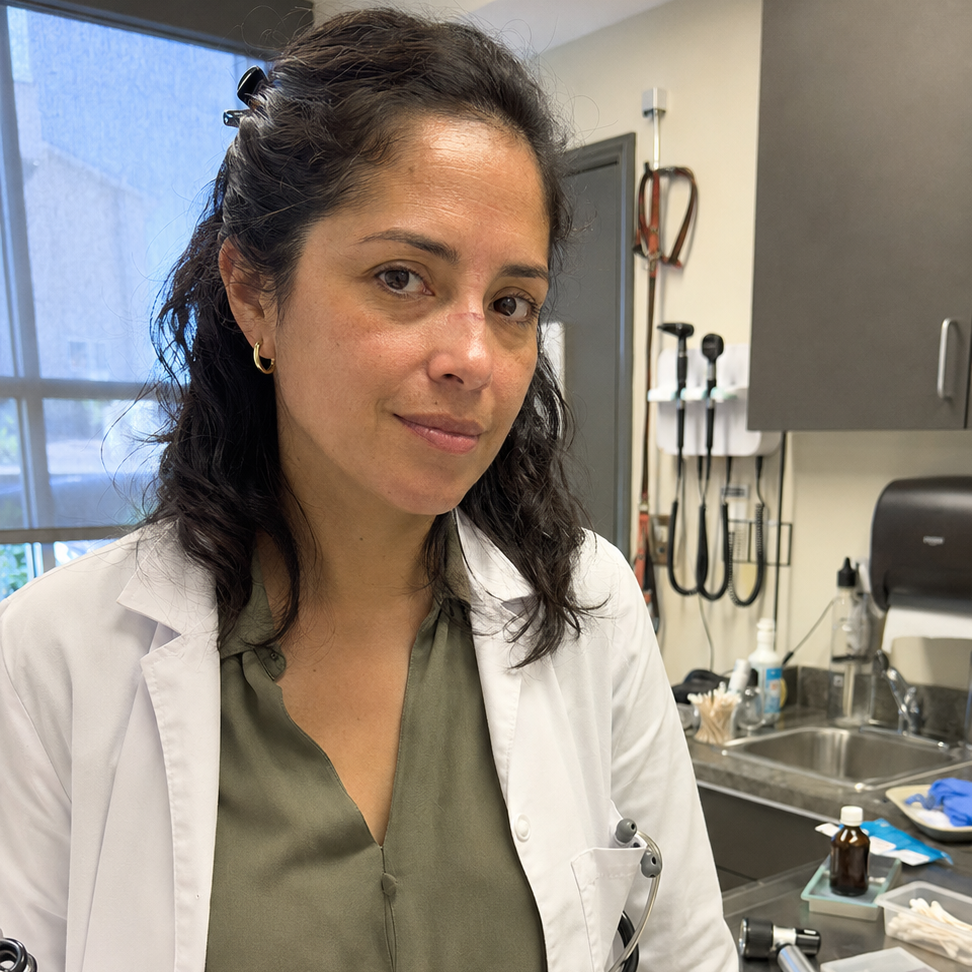
Dr. Solis is a board-certified veterinary dermatologist with over twelve years of clinical experience. She advises on skin conditions, allergies, and grooming practices that affect coat and skin health. All dermatology and allergy content at The Pet Times is reviewed by her team before publication.
Meet our experts ↗Keep reading
 Health & WellnessMost Post-Water Coughs Are Nothing. Here's the Short List That Isn't.Dr. Priya Nair · 7 min
 Health & WellnessThe Scary Part of Roundworms Isn't in Your Dog. It's in Your Yard.Dr. Mara Chen · 6 min
 Health & WellnessThat New Lump Feels Like Nothing. That's Exactly the Problem.Dr. Mara Chen · 7 min
 Health & WellnessThe Thyroid Test That Puts Healthy Dogs on Lifelong MedicationDr. Lena Park · 9 min
 Health & WellnessLeptospirosis Used to Be a Country-Dog Problem. Now It's Hunting City Dogs.Dr. Ravi Mehta · 8 min
 Health & WellnessHer Dog Collapsed on the Sidewalk. What Looked Like a Stroke Usually Isn't.Dr. Ravi Mehta · 8 min