


Your Dog Isn't Bad, They're Bored: Reading the Signs and Matching the Fix
Boredom in dogs is an enrichment deficit, and the destruction, the pacing, the day-long naps are symptoms of it. Here's how to tell boredom from a medical problem, and how to match the right outlet to your dog's hardwired drive.

There is a pandemic-era meme that still makes me laugh: a dog perched on top of the kitchen cabinets, captioned, “No, I’m not coming down! We’ve been on 20 walks today. Leave me alone.” Most of us have the opposite problem now. We are back to commuting, the house is empty for nine hours, and the dog who once got too much is getting too little. But here is the reframe that actually helps, because “give your dog more attention” is not a plan: a bored dog is not a badly behaved dog, they are a dog with an unmet drive. The chewed couch, the 3 p.m. howling, the dog who sleeps the day into a coma, these are not personality flaws. They are an enrichment deficit, and an enrichment deficit has a specific fix that depends on which drive is going unfed. Get that diagnosis right and the symptoms tend to dissolve on their own.
Before anything else: boredom is a diagnosis of exclusion
The single most important thing to understand about boredom is that it is the explanation you reach for after you have ruled out the others, not before. The behaviors boredom produces, barking, destruction, accidents, withdrawal, are the exact same behaviors produced by pain, illness, and separation anxiety. Treating a medical problem as boredom wastes time a sick dog does not have.
A behavior shift is usually the first symptom you can see from across the room. Owners tell me their dog seems ‘off’ weeks before a limp or an appetite dip ever shows. And some serious issues, separation anxiety in particular, mimic boredom almost perfectly: the vocalizing, the destruction, the neediness. So the order matters. Vet first to clear out a medical cause. Then ask whether it only happens when the dog is alone, because that points somewhere very different from boredom and needs a real behavior plan, not a new puzzle toy.
So the sequence is: vet visit, then the alone-time question, then boredom. With that guardrail in place, the rest of this is about reading the signs and matching the fix.
The signs, and what each one is really telling you
Boredom does not look like one thing. It tends to take whichever shape your individual dog’s energy defaults to, which is itself a clue about the drive underneath.
Chewing and shredding. Chewing is self-soothing. A dog with pent-up energy and no legal chew target will manufacture one out of your pillow or your baseboard. This is one of the loudest signals that the dog needs a chewing outlet specifically, not just “more exercise.”
Overeating or raiding the trash. A bored dog with access to food may eat well past fullness or go dumpster diving in the kitchen bin. Dogs do not portion-control or eat from emotion the way we do; food-seeking is usually a hunt for something, anything, to do. The behavior points at a foraging drive with nowhere to go.
Sudden indoor accidents. When a reliably house-trained dog starts having accidents, it is a classic boredom flag, and a classic medical flag, especially in older dogs, which is exactly why the vet step is non-negotiable. Some dogs also do it as a protest at being left too long.
Nonstop attention-seeking. The pawing, the barking, the whining, the following you from room to room. Dogs are social, and this is the social drive announcing itself. It is loudest in puppies and adolescents.
Sleeping the day away. Dogs sleep a lot, especially puppies and seniors. But a dog who sleeps far more than usual, ignores toys, and shows no interest in walks may be bored to the point of low mood. Like us, a dog with nothing to do often just shuts down and naps the hours away.
Repetitive barking, digging, and pacing. Demand barking and digging get a reaction, which from the dog’s side is the whole point. If boredom is the root, these respond beautifully to the right outlet, because they are drives leaking out sideways.
Notice the pattern: each sign maps to a drive. That is the diagnostic. Watch what your dog reaches for when left to their own devices, and you will know which outlet to build.
Match the outlet to the drive
Most boredom advice hands you a generic list of activities. The better move is to feed the specific drive your dog is showing, because a chaser does not want a chew and a sniffer does not want a tug toy. Here are the outlets, organized by the drive they satisfy.
For the sniffer: enrichment that uses the nose
Scent is a dog’s dominant sense, and using it is real cognitive labor, which is why it tires dogs out so efficiently. The most underrated tool here costs nothing: let the walk be a “sniffari,” not a route march.
“Judge a walk by nose-time, not mileage. Ten minutes spent working over one fascinating hedge can do more for a dog than a brisk hour of heeling past everything interesting,” Dr. Kohl says. “Lack of access to breed-typical behaviors, sniffing, dissecting, scavenging, chewing, chasing, is one of the surest paths to a frustrated dog and a frustrated owner.”
Beyond walks, scatter-feed a meal across the grass, hide treats around a room for a scavenger hunt, or graduate to formal nose work and barn hunts. A snuffle mat turns dinner into a ten-minute foraging puzzle.
For the forager and problem-solver: food puzzles
For the dog whose boredom shows up around food, make the food itself the project. Interactive food-stuffing toys like a Kong or West Paw’s Toppl turn a meal into work. In hot weather, freeze a stuffed Kong with wet food or broth-soaked vegetables and a single feeder can occupy a dog for an hour. Puzzle boards from makers like Nina Ottosson and Outward Hound add a thinking layer; smear a little peanut butter inside to raise the appeal. The trick is difficulty calibration: start easy so your dog wins fast, then increase the challenge, because a puzzle that is too hard too soon produces frustration, which is the opposite of enrichment.
For the chewer: a legal target, sized right
If chewing is the symptom, give the chewing somewhere to go. The hazard rules matter more than the brand: pick a size your dog cannot lodge in their throat, check for parts that can break off into choking or blockage hazards, supervise the first sessions with anything new, and retire toys as they wear. A correctly sized durable chew or a frozen feeder redirects the drive away from your furniture and onto something you actually bought for the purpose.
For the chaser and athlete: a sport or a job
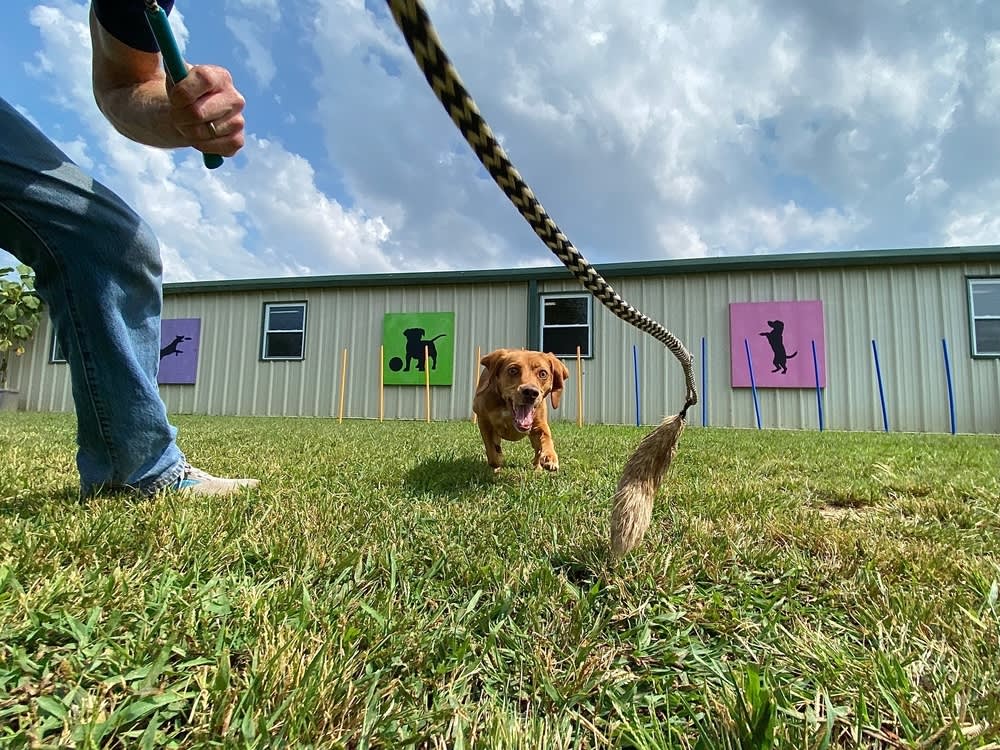
Some dogs are not asking for a puzzle, they are asking for a job. Channel a chase drive into a flirt pole, fetch, or a structured sport. Flyball, dock diving, agility, lure coursing, and rally all give a high-drive dog a legitimate outlet and the bonus of working alongside you. Even a few minutes of trick training a day satisfies the dog who wants to do something with you.
For the social dog: time with their people and their kind
For the dog whose boredom is loneliness, the fix is contact. Arrange playdates with compatible dogs, build dog-friendly errands into your day, and let sidewalk greetings happen. Social interaction is not a luxury for these dogs; it is the missing nutrient.
The everyday baseline: passive enrichment for busy days
You will not run an agility course every day, and you do not have to. Build a low-effort floor. Rotate the toy bin so old toys feel new. Leave a frozen feeder for a long workday. DOGTV and dog-oriented playlists genuinely settle some dogs, and research has found classical music lowers stress and encourages rest, though dogs hear far more acutely than we do and need quiet breaks too. Try a little, watch how your dog responds, and keep what works.
The bottom line
A bored dog is a dog whose hardwired drives have nowhere to go, and the destruction or the apathy is that energy escaping through the nearest crack. The fix is not “more,” it is “matched”: rule out medical and separation causes first, watch your dog to learn which drive is loudest, and feed that drive directly, with a nose game for the sniffer, a food puzzle for the forager, a chew for the chewer, a sport for the athlete, and company for the social one. Do that and the cabinet-climbing, couch-shredding, day-sleeping dog usually turns back into the calm one you knew was in there.
References
- Bowman, A., et al. “The Effect of Different Genres of Music on the Stress Levels of Kennelled Dogs.” Physiology & Behavior, vol. 171, 2017, pp. 207-215.
- “Canine Enrichment,” American Veterinary Medical Association.
- Youngerman, Claire. “Abnormal Eating Habits in Dogs.” UC Davis School of Veterinary Medicine, Animal Health Topics.
- “Destructive Chewing,” ASPCA.
Common questions
How do I tell boredom from a medical problem or separation anxiety?
You can't, not on your own, and that's the point. Boredom, pain, and separation anxiety can all look identical from the outside: barking, destruction, house soiling, or lethargy. Rule out a medical cause with your vet first. If a dog only falls apart when left alone, suspect separation anxiety and involve a qualified behavior consultant rather than assuming boredom.
How much extra activity does a bored dog actually need?
Less than you'd think. Adding just 10 minutes of intentional activity a day, a sniffing walk, a game, a short training session, measurably changes behavior. The quality of the outlet matters more than the quantity.
Why does sniffing tire a dog out more than a long walk?
Scent is a dog's dominant sense, and processing smells is genuine cognitive work. A 20-minute walk where your dog is allowed to investigate every scent post drains more mental energy than a brisk 40-minute march to nowhere. Enrichment that engages the brain outlasts plain exercise.
Dr. Kohl is a board-certified veterinary dentist with a particular interest in preventive oral care. She reviews all dental health content at The Pet Times and contributes practical guides on home dental routines, professional cleaning, and oral disease prevention.
Meet our experts ↗Keep reading
 TrainingYou Taught Your Dog to Paw at You. Here's How to Untrain It.Dr. Amara Solis · 7 min
 TrainingThat Friendly On-Leash Hello Is Teaching Your Dog to Melt DownDr. Amara Solis · 6 min
 TrainingYour Puppy's Evening Meltdown Isn't Extra Energy. It's Exhaustion.Dr. Amara Solis · 5 min
 TrainingYou Can't Out-Command Your Dog's Nose. Here's What Actually WorksDr. Ravi Mehta · 6 min
 TrainingStop Letting Your Dog 'Say Hi' on the LeashDr. Priya Nair · 5 min
 TrainingYour Dog Digs Up Your Sheets. The Timing Tells You Whether to Worry.Dr. Nina Kohl · 7 min