


Do Calming Pheromones Actually Work? An Honest Look at DAP for Anxious Dogs
Dog-appeasing pheromones are marketed as a near-magic fix for canine anxiety. The real evidence is more interesting and more useful: solid for some situations, weak for others, and never a substitute for a plan. Here's where DAP helps, how to choose a format, and when to stop relying on it.

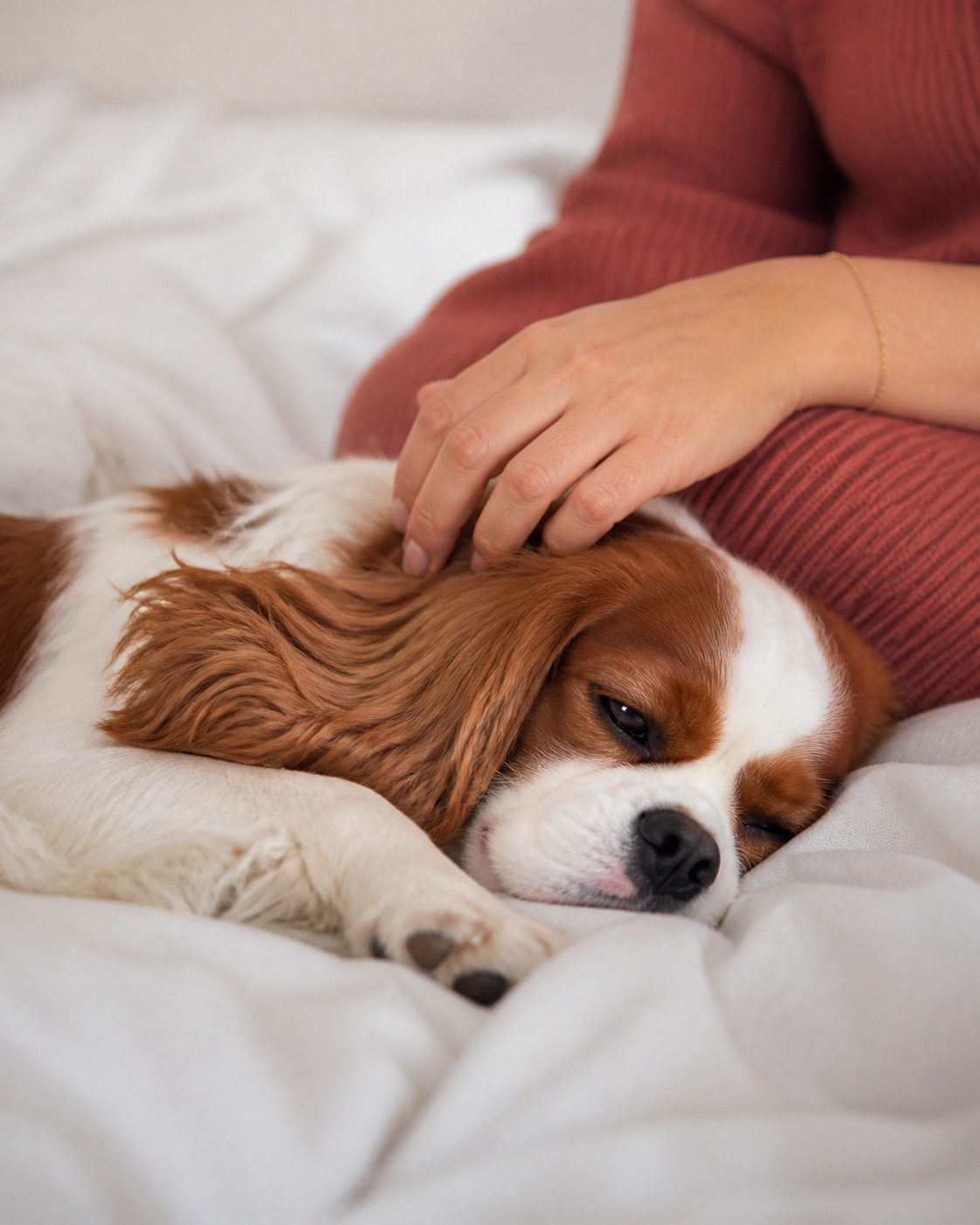
If you have ever been told to “just calm down” mid-panic, you already understand the central problem with marketing a calming product: stress does not have an off switch. Dog-appeasing pheromones, sold under names like Adaptil and usually shortened to DAP, are often pitched as exactly that kind of switch, a plug-in or a collar that melts your dog’s anxiety away. They are not that. But they are also not nothing. The honest, more useful version of the story is that DAP is a low-risk tool with genuinely mixed evidence, one that helps in some specific situations, does little in others, and only ever works as part of a larger plan. Here is how to use it intelligently.
What DAP actually is
DAP is a synthetic copy of a natural pheromone, a chemical signal, that a nursing mother dog releases from glands near her mammary area. In puppies, that signal produces a sense of safety and calm. The synthetic version aims to send adult dogs that same “you are safe” message. Because it is a chemical signal a dog detects rather than a drug it absorbs, DAP has no meaningful downside: it will not sedate your dog, will not interact with medications, and is very unlikely to cause harm. That safety profile is the strongest, least disputed thing about it, and it is the reason it is so easy to add to a behavior plan.
What the evidence really says (the part the box won’t tell you)
Here is where an honest article diverges from the product copy. When researchers have pooled the studies on DAP, the picture is genuinely mixed, and being clear about that helps you set the right expectations.
The evidence is strongest, reaching moderate quality, for reducing some fear behaviors tied to thunderstorm noise. There is weaker but real evidence that DAP can ease some non-specific stress behaviors in dogs in stressful settings like a veterinary hospital, and mild evidence it can reduce barking and increase relaxation in shelter dogs and newly adopted puppies adjusting to a new home. But for general, everyday anxiety in adult dogs over about six months old, the evidence remains weak, and reviewers caution that a clear clinical benefit there is still undetermined.
I tell owners to think of DAP as a gentle nudge, not a treatment. For a thunder-phobic dog or a puppy settling into a new home, it’s a sensible, low-risk thing to try. For a dog with serious separation anxiety, expecting a diffuser to fix it on its own will only cost you time the dog doesn’t have. It belongs alongside training, and sometimes alongside medication, never instead of them.
One more finding worth knowing before you shop: no study has shown any one format, spray, diffuser, or collar, to be more effective than the others. So choose the format by your situation, not by a claim that one works better.
Choosing the right format for the right trigger
Since the formats are roughly equivalent in effect, the practical question is simply where and when your dog gets anxious. Match the delivery method to the trigger.
The diffuser, for a fixed location. A plug-in covers a room continuously for about 30 days. It is the right choice for anxiety that happens at home in a predictable place, the dog who hides in the bedroom during fireworks, the new puppy settling into the house, the dog stressed by being home alone. Plug it in where your dog actually retreats, not in a hallway they pass through.
The collar, for anxiety that travels with the dog. A collar provides continuous pheromone support for about four weeks and goes wherever the dog goes, which makes it the format for triggers outside the home: reactivity on walks, startle at sudden street noise, or a stay at a boarding facility or veterinary hospital. Body heat helps disperse it, so it should sit reasonably snug against the skin.
The spray, for targeted, on-demand use. A spray lets you treat a specific spot: a few spritzes on a favorite bed or a hiding place before a storm, or inside a travel crate before a car trip. Spray it 15 minutes before you need it and let it dry; never spray it directly on your dog.
Realistic expectations and how to tell if it’s helping
Set the bar where it belongs. DAP, when it works, produces a subtle reduction in anxiety, not a transformation. Some owners notice a change quickly; others only realize it was helping when a diffuser or collar runs out and the old behavior creeps back, which is itself useful information. Give a format a fair trial of at least two to four weeks before deciding, keep everything else (routine, training) consistent so you can actually attribute any change, and watch for small wins: a dog that settles a little faster, barks a little less, recovers from a scare a little sooner.
If you see nothing after a full trial, that is a real result too. DAP simply does not work for every dog, and continuing to buy refills for a dog it is not helping is money better spent elsewhere.
When to skip the diffuser and call your vet
DAP is a reasonable first thing to try for mild, situational anxiety. It is the wrong thing to lean on in these cases:
- The anxiety is severe or escalating: a dog who panics, injures themselves, destroys things, or cannot be left alone at all needs a real behavior plan and likely a veterinary behaviorist, not a plug-in.
- The behavior is new or sudden. A previously calm dog who becomes anxious, clingy, or reactive may have an underlying medical problem (pain, thyroid issues, cognitive decline in seniors). See your vet to rule that out first.
- There is any aggression. Aggression is a safety issue that needs professional guidance, not an over-the-counter product.
- DAP alone is not enough. For separation anxiety and serious noise phobias, current veterinary guidance favors a structured behavior-modification plan, and for many dogs, anti-anxiety medication prescribed by a vet, with DAP as a supporting player at most.
Used with clear eyes, DAP is a fine, safe thing to add to the toolbox, especially for storms, vet visits, and new-home adjustment. Just buy it for what the evidence actually supports, pair it with the training the problem really needs, and treat your veterinarian, not the packaging, as the source of the plan.
This article is informational and not a substitute for veterinary advice. Persistent or severe anxiety warrants a veterinary exam.
References
- Frank, D., Beauchamp, G., & Palestrini, C. “Systematic review of the use of pheromones for treatment of undesirable behavior in cats and dogs.” Journal of the American Veterinary Medical Association, 2010. https://avmajournals.avma.org/view/journals/javma/236/12/javma.236.12.1308.xml
- “Can dog appeasing pheromone ameliorate stress behaviours associated with anxiety in mature domestic dogs?” Veterinary Evidence, 2021. https://veterinaryevidence.org/index.php/ve/article/view/421
- Tod, E., Brander, D., & Waran, N. “Efficacy of dog appeasing pheromone in reducing stress and fear related behaviour in shelter dogs.” Applied Animal Behaviour Science. https://pubmed.ncbi.nlm.nih.gov/20839989/
- “Fears, Phobias, and Anxieties in Dogs.” American College of Veterinary Behaviorists. https://www.dacvb.org/
Not a substitute for your vet. Our guidance is educational. For urgent symptoms, contact a vet or emergency clinic right away. Editorial standards
Dr. Nair is a veterinarian focused on diet and feeding. She covers everyday nutrition, treats, and the many "can they eat this?" questions owners ask, grounding each answer in what is actually safe and sensible for dogs and cats.
Meet our experts ↗Keep reading
 Health & WellnessThe Dog CBD Study Everyone Cites Validated a Protocol, Not a ProductDr. Lena Park · 5 min
 Health & WellnessThe 'Vagus Nerve Reset' for Anxious Dogs Is a Myth. The Nerve Is Not.Dr. Lena Park · 6 min
 Health & WellnessSound Baths for Dogs Sound Like Woo. The Research Isn't.Dr. Lena Park · 6 min
 Health & WellnessYour Dog's Anxiety Might Start in the Gut, Not the BrainDr. Mara Chen · 5 min
 Health & WellnessCBD Oil and Canine Cancer: What the Research Actually ShowsDr. Ravi Mehta · 7 min
 Health & WellnessOf All the Pet CBD Claims, Arthritis Is the One With Real ScienceDr. Amara Solis · 7 min