


CBD Oil and Canine Cancer: What the Research Actually Shows
CBD will not cure your dog's cancer, but a growing body of research suggests it may ease pain, calm nausea, and support a vet-approved treatment plan. Here is what to know.

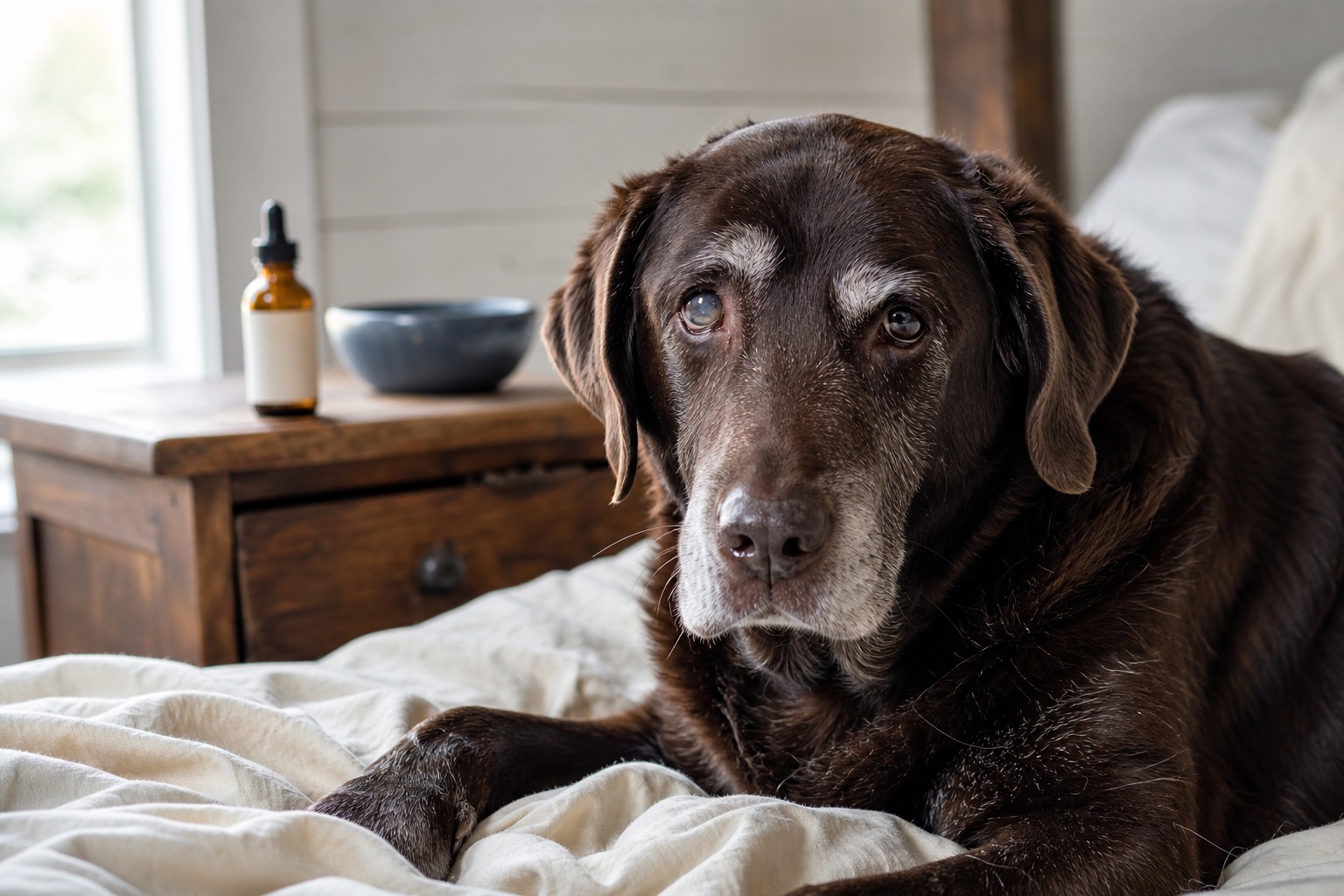
A cancer diagnosis is one of the hardest things any dog parent can hear. And it is far from rare. Roughly 1 in 4 dogs will be diagnosed with cancer at some point, and it is the leading cause of death in dogs over the age of 10, according to the Veterinary Cancer Society.
The better news is that a diagnosis is not automatically a death sentence. Some cancers respond very well to treatment, and research into prevention and care keeps moving forward. One area drawing real attention from veterinarians is cannabidiol, better known as CBD.
Let me be clear up front, because this matters. CBD is not a cure. But there is a growing pile of research suggesting it may make your dog more comfortable during treatment, and in some cases may even help the treatments themselves work better. As with anything you add to a sick dog’s routine, the first step is a conversation with your vet.
I tell my clients to think of CBD as a teammate, not a treatment. It will not beat the cancer on its own, but for the right dog, at the right dose, it can take the edge off pain and nausea so they actually feel like themselves while we do the real work.
Where CBD fits into a cancer plan
How a vet treats canine cancer depends on the type and the stage. The toolkit can include surgery to remove tumors, chemotherapy to shrink them, radiation, and a range of medications to manage the side effects of all of the above. Increasingly, some vets fold natural supplements like CBD into that broader plan as supportive care.
Here is what the evidence suggests it may do.
Easing pain without piling on side effects
Pain shows up in cancer care from two directions. It can be a symptom of the disease itself, and it can be a side effect of treatment. Managing it is almost always part of the picture.
The trouble is that the standard pain options carry baggage. Opioids come with tolerance and overdose risk. NSAIDs have drawn growing scrutiny for serious side effects in some dogs, including GI bleeding, and liver and kidney problems, with the most severe risks falling on senior and immune-compromised dogs, exactly the population fighting cancer.
CBD’s ability to dial down both pain and inflammation is well documented. It may also boost the effect of other pain drugs, which can let a vet prescribe a lower dose without leaving the dog uncomfortable. And so far the safety data in dogs looks reassuring, with fewer harsh side effects than many of the usual prescriptions.
Supporting anti-tumor treatments
This is the area people get most excited about, and also where the most caution is warranted, because much of the research is still in humans and lab models. CBD has shown anti-tumor effects across several human cancers, including breast cancer, leukemia, lung cancer, colon cancer, and brain and spine tumors.
Some studies suggest CBD may enhance the tumor-shrinking power of radiation, potentially allowing a lower radiation dose to do the same job. In one striking animal study, mice with pancreatic cancer treated with CBD alongside the chemotherapy drug gemcitabine had a threefold increase in survival compared to gemcitabine alone.
The reason this is even plausible comes down to a system you may not know your dog has: the endocannabinoid system. This signaling network, woven through the nervous system, turns out to be closely tied to how cancer develops and how the body responds to it. Cannabinoids like CBD interact with that system directly.
Calming nausea and protecting appetite
Two of the most common and most distressing side effects of cancer treatment are nausea and a fading appetite. Left unchecked, they can spiral into anorexia. On top of that, some cancers trigger cachexia, a metabolic condition where the body wastes away muscle and fat. Cachexia is severe, and is blamed for as many as 20 percent of cancer deaths.
This is a big reason oncologists are interested in cannabis-based medicine. Cannabinoids have a track record of stimulating appetite and quieting nausea. The gut is also packed with endocannabinoid receptors, and CBD appears to help keep that environment friendly to healthy gut flora, which ties back to overall well-being.
Supporting the immune system
The endocannabinoid system and the immune system are so intertwined that some researchers half-jokingly call the overlap the “immunocannabinoid system.” CBD has been studied for its ability to reduce oxidative stress, a process that helps the body fight off invaders without damaging its own healthy tissue along the way. Cannabinoids also help regulate gut function, which is itself linked to immune health.
Helping with sleep
This one is murkier. Researchers know the endocannabinoid system plays a role in sleep, but the details are still being worked out. THC and CBD seem to act in opposite directions, with CBD behaving more like a daytime wake agent. The thinking is that by promoting alertness during the day, CBD may help a dog sleep more soundly at night. Results in the lab have been mixed, so in practice many vets use a little trial and error to find what timing works for a given dog.
Talk to your vet first, every time
CBD is sold over the counter without a prescription, which can make it feel casual. It is not, especially for a dog already on other medications.
CBD has real, documented drug interactions. Sometimes that works in your favor, letting your vet trim back other drugs. Other times your vet will simply want to stagger the timing so the supplement does not interfere with another medication. Either way, your vet needs to be in the loop.
Not every vet is equally enthusiastic about CBD, and that is fine. If yours is skeptical and you want to explore it, look for a holistic or integrative veterinarian in your area for a consultation. Whoever you work with, insist on a high-quality, lab-tested, full-spectrum CBD oil made for pets. Quality control in this market is all over the place, and a cheap mystery bottle is not worth the risk for a dog who is already fighting hard.
The bottom line has not changed. CBD will not cure your dog’s cancer. But for many dogs, it may be a meaningful add-on that makes the fight a little more bearable.
What the newest dog-specific studies show
For years the honest caveat on CBD and cancer was that almost none of the encouraging data came from actual dogs. That is finally starting to change, and it is worth knowing exactly what the canine research does and does not say, so you can weigh it without the hype.
The most useful recent development is not a cure headline, it is a safety signal. A controlled trial published in 2025 gave a CBD and CBDA-rich hemp oil to dogs with lymphoma who were also going through standard CHOP chemotherapy. The supplement was well tolerated and did not interfere with the chemotherapy drugs, which is precisely the question a worried owner needs answered before adding anything to an active treatment plan. It is a small study, and it was designed to test safety rather than to prove the CBD shrank anything, but “it did not make the real treatment worse” is genuinely valuable information.
That fits a broader pattern in the canine work. A 2024 systematic review of CBD in dog oncology concluded that laboratory and cell-line results are promising but that the field still lacks the standardized doses and formulations needed to run convincing clinical trials in living dogs. In plainer terms: the test-tube science is interesting, the patient science is early, and anyone selling you certainty is ahead of the evidence.
The one consistent, real-world finding across canine CBD studies is mundane and reassuring at the same time. The most common side effect is a temporary, harmless rise in a liver enzyme called ALP on bloodwork. It usually means nothing, but it is a concrete reason your vet may want to check labs periodically while your dog is on CBD, especially a dog whose liver is already working hard.
The other shift is regulatory. The FDA still has not approved any CBD product for pets, and it continues to warn that quality and labeling vary enormously between brands. Independent testing has repeatedly found products that contain more or less CBD than the label claims, and some that contain none at all. Until oversight catches up, a current certificate of analysis from the manufacturer, the document showing an independent lab measured the CBD and screened for THC, pesticides, and heavy metals, is your single best protection.
What has not changed is the core message from the cancer research itself: the strongest evidence is for comfort and quality of life, not for shrinking tumors. Treat any product promising the latter with real skepticism.
References
- Veterinary Cancer Society. “Cancer in Pets.” https://vetcancersociety.org/pet-owners/
- National Cancer Institute. “Cannabis and Cannabinoids (PDQ) — Health Professional Version.” https://www.cancer.gov/about-cancer/treatment/cam/hp/cannabis-pdq
- Kulpa, J., et al. “Safety and tolerability of escalating cannabinoid doses in healthy dogs.” Journal of the American Holistic Veterinary Medical Association, 2021. https://pubmed.ncbi.nlm.nih.gov/34904907/
- “Safety, efficacy, and doxorubicin pharmacokinetics during cannabidiol/cannabidiolic-acid-rich hemp oil use in dogs with lymphoma undergoing CHOP chemotherapy.” PMC, 2025. https://pmc.ncbi.nlm.nih.gov/articles/PMC12232875/
- “Potential antitumor effect of cannabidiol (CBD) in canine oncology: a systematic review.” PubMed, 2024. https://pubmed.ncbi.nlm.nih.gov/42254894/
- U.S. Food and Drug Administration. “FDA and Cannabis: Research and Drug Approval Process.” https://www.fda.gov/news-events/public-health-focus/fda-regulation-cannabis-and-cannabis-derived-products-including-cannabidiol-cbd
Common questions
Do I need to tell my vet before giving my dog CBD?
Yes, always. CBD has known interactions with other medications. Your vet may adjust doses or stagger timing so the supplement does not interfere with your dog's other drugs.
Is CBD safe for dogs?
Research so far suggests a strong safety profile in dogs, with fewer and milder side effects than many common pain medications. Still, quality varies widely, so choose a lab-tested product made for pets and talk to your vet about dosing.
Not a substitute for your vet. Our guidance is educational. For urgent symptoms, contact a vet or emergency clinic right away. Editorial standards
Dr. Mehta is a board-certified veterinary nutritionist who evaluates pet food formulations, ingredient quality, and the science behind dietary trends. He writes and reviews all nutrition content at The Pet Times, including our food rankings and feeding guides.
Meet our experts ↗Keep reading
 Health & WellnessYour Dog Isn't Licking His Leg Raw Out of Boredom. X-Ray What's Under It.Dr. Nina Kohl · 8 min
 Health & WellnessYour Senior Dog Isn't 'Just Slowing Down.' They're in Pain.Dr. Ravi Mehta · 7 min
 Health & WellnessThe Best Thing You Can Do for an Arthritic Dog Isn't a SupplementDr. Ravi Mehta · 8 min
 Health & WellnessThe Vet Laser Isn't Magic. But It Isn't a Gimmick Either.Dr. Ravi Mehta · 8 min
 Health & WellnessYour Dog's Cancer Pill Was Built for Humans First. That's Exactly the Point.Dr. Ravi Mehta · 6 min
 Health & Wellness'Natural' Won't Cure Your Dog's Seizures. But These Add-Ons Actually Help.Dr. Lena Park · 9 min