


"Air Jail" Isn't Training. It's a Mute Button
Scooping your pet up to stop a behavior feels like discipline. A behavior consultant explains why it teaches the wrong lesson, and what to do with your hands instead.

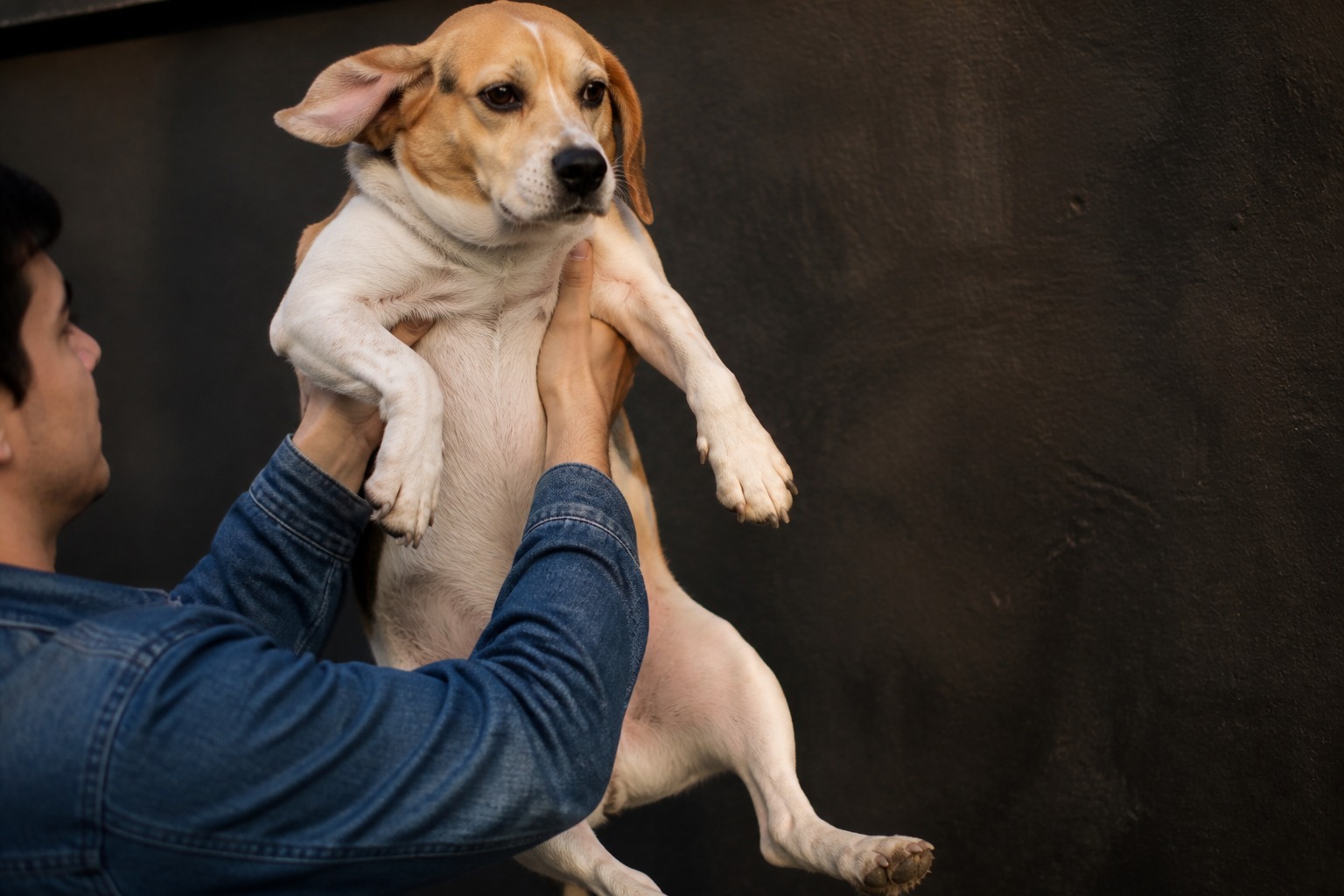
Here is the thing nobody tells you about scooping your dog off the ground mid-misbehavior: it works, and that is exactly the problem. The chewing stops. The humping stops. The lunging at the other dog stops. You get instant, satisfying silence, and your brain files the move away as “discipline that works.” But the behavior you actually paused and the lesson your pet actually learned are two completely different things. The internet has a name for the move, “air jail,” and the gap between what it looks like it does and what it really does is where pet parents get into trouble.
“Air jail” is just grabbing your pet and holding them up off the floor to interrupt them. As one well-traveled Reddit thread proves, there is no size limit, people hoist 80-pound dogs the same way they hoist a kitten. It feels harmless. It even feels kind of loving. So let’s be clear about what it teaches, because that is the part that matters.
What you think air jail teaches versus what it actually teaches
In your head, the lesson is “don’t do that thing.” In your pet’s head, the lesson is “when I do that thing, hands come down from the sky and the fun ends.” Those are not the same lesson, and the second one does not generalize the way you want.
“What owners actually want is for the behavior to be gone next week, and lifting the animal buys you ten seconds at most,” says Dr. Mara Chen, a veterinary behaviorist. “It interrupts. It does not instruct. You have hit mute on the symptom without touching the cause, so the moment your hands are not there, the behavior is right back.”
“A dog cannot learn what to do instead while they are dangling in the air. You have taken away every option except being held. That is not a teaching moment, it is a pause button, and pause buttons do not change behavior.”
The deeper issue is what your hands start to mean. If being picked up reliably signals “the good part is over,” your pet starts to dread the pickup itself. Dr. Chen says this is how a perfectly friendly dog slowly becomes hard to handle: hiding when you reach for them, ducking the collar grab, stiffening, and in the worst cases growling or snapping when hands approach. You did not set out to teach your dog that your hands are bad news. You taught it by accident, one scoop at a time.
The geometry problem most owners miss
There is a specific, physical danger to air jail that has nothing to do with training philosophy, and it comes up most often in the exact scenario that makes people reach for it: another dog charging over.
When a loose dog runs at you and you snatch your dog up to “protect” them, you have not removed your dog from the conflict. You have raised it to chest height. “You have turned your dog into the high prize,” Dr. Chen explains. “The loose dog starts climbing you to reach what you are holding, and any scuffle that breaks out now happens against your chest instead of down at ground level.” A scuffle that would have happened at ankle level is now happening at eye level, with your hands trapped holding a panicking animal. In an actual emergency, picking your dog up can absolutely be the right call, but reflexively hoisting them at every approaching dog can manufacture the danger it was meant to prevent.
Small dogs catch the worst of this, simply because they are easy to grab. Lift a little dog every time the world gets stressful and you teach them that they have no agency, that their own four feet are never the answer, and that the solution is always to be swept up and away. Over time, some of them start to resent it, and a dog who resents being handled is a dog who has lost a tool you genuinely need.
When picking your pet up is actually fine
None of this means you should never lift your dog. A true emergency, a dog about to bolt into traffic, a real threat you can physically remove them from, is exactly when you should. The distinction is honesty about the situation. Are you lifting because there is a genuine hazard, or because you are embarrassed, anxious, or want the moment to be over? Dogs read that difference instantly. The twitchier and more reactive you are on the way to the grab, the more your dog learns that the world is full of things worth panicking about.
What cats think of all this
Air jail is mostly a dog phenomenon, but plenty of cat owners try it, usually with worse results. Cats tolerate being restrained far less than dogs do, and holding a cat aloft is closer to a wrestling match than a correction.
“It may look harmless to us, but for most cats that position is neither safe nor comfortable,” says Dr. Lena Park, a feline-focused veterinarian. “Every cat is its own animal, and sure, the odd easygoing one will put up with it, but with most you are burning trust that is slow to rebuild, and collecting scratches while you do.” With cats especially, the move costs more than it ever delivers.
What to do with your hands instead
The fix is not “have better reflexes.” It is to give your pet a job they can do on their own four feet, so you do not need your hands at all.
The single most useful skill, Dr. Chen says, is a trained “let’s go” or “find it” cue that turns your pet away from the trigger and creates distance without any physical contact. “You want them to move themselves out of the situation so their brain can drop out of survival mode and back into a state where learning is even possible,” she says. A dog who has practiced peeling away from exciting or scary things on cue does not need to be carried away from them.
Build it before you need it. Pattern games, simple, repeatable sequences like tossing a treat between your feet and then off to the side, give an anxious dog something predictable to do when everything else feels unpredictable. For the dog-greeting situations that tempt the scoop, teach actual greeting manners in low-stakes settings first. And if you have a dog you legitimately do need to lift sometimes, at the vet, on a hike, into the car, teach them to opt into being picked up on a cue, rehearsed when everyone is calm, so the lift becomes a partnership instead of an ambush.
Your dog may seem to tolerate air jail just fine. Tolerating it is not the same as learning from it. Trade the scoop for a skill, and you stop fighting the same battle every single day.
References
- Volpe, Maria Azzurra. “Cat Owner Claps Back at Criticism of How He Holds Orange Boy: ‘Air Jail.’” Newsweek, 14 Oct. 2024, newsweek.com.
- American Veterinary Society of Animal Behavior. “Position Statement on Humane Dog Training.” avsab.org.
- Ziv, Gal. “The Effects of Using Aversive Training Methods in Dogs: A Review.” Journal of Veterinary Behavior, vol. 19, 2017, pp. 50–60, sciencedirect.com.
Nina Vasquez writes about life at home with pets and the relationships at the heart of it. Her work covers day-to-day living, people-and-pet stories, and the products that fit into a real household, with a warm, grounded take on everyday pet ownership.
Meet our experts ↗Keep reading
 TrainingWhether You Call It PTSD Doesn't Matter. How Fast You Act on It DoesDr. Nina Kohl · 7 min
 TrainingThe 'Let Them' Theory Works on Pets. Because It's Just Management With Better PR.Dr. Priya Nair · 7 min
 TrainingFace Bites Are Almost Always Our Fault, Not the Dog'sDr. Amara Solis · 5 min
 Training"My Dog Only Listens When I Have a Treat." Here's the Fix You Skipped.Dr. Nina Kohl · 6 min
 TrainingYour Dog's Behavior Problem Probably Isn't Your FaultDr. Nina Kohl · 6 min
 TrainingYour Two Dogs Used to Be Best Friends. Here's Why That Cracked, and Why It Won't Just Pass.Dr. Mara Chen · 6 min