


'Will My Dog Ever Love Me?' Is the Wrong Question. Watch What They Choose.
Every sign people scan for (the licking, the following, the leaning) is ambiguous. There's one piece of evidence that isn't, and it's the only one worth watching.

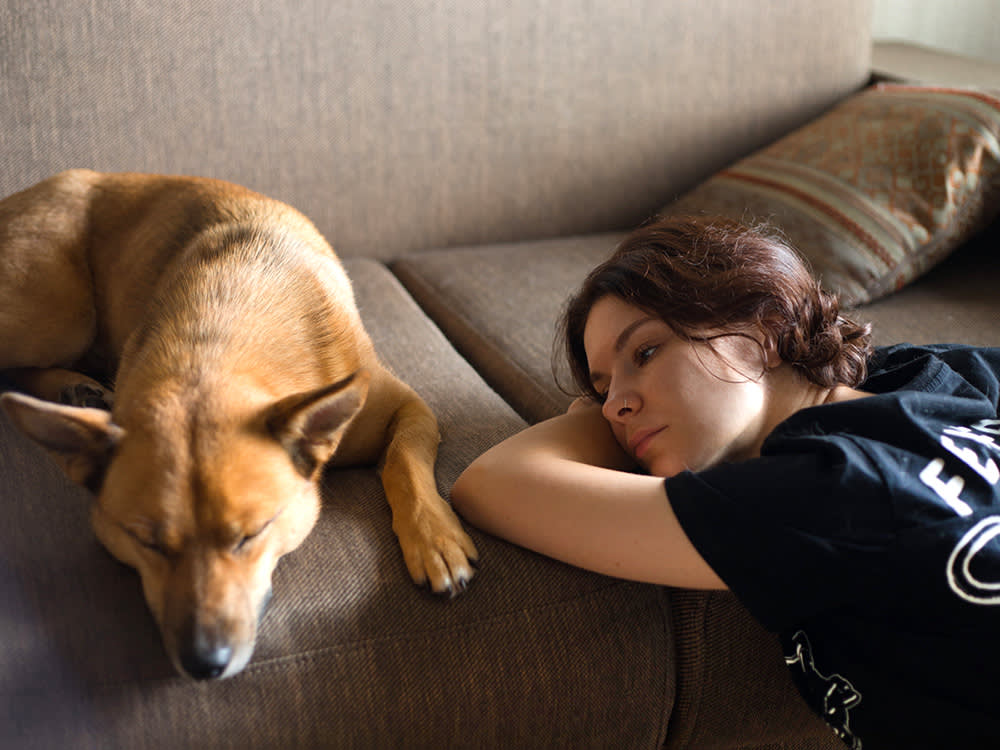
There’s a specific ache that brings people to this question, and it isn’t idle curiosity. It’s the person three weeks into a rescue adoption, sitting on the floor at the far end of a room from a dog who won’t come near them, wondering if they’ve made a mistake.
So let’s answer the real question rather than the polite one.
The honest answer is that you are asking for a verdict, and there isn’t one. Love in dogs isn’t a switch that flips once they decide you’re worthy. It’s an attachment system that gets built out of a thousand boring, predictable moments, most of which you’re already doing. And every single sign you’ve been scanning for (the licking, the leaning, the tail, the following) is ambiguous.
There’s one piece of evidence that isn’t. Skip to it if you like. But the ambiguity matters, because it’s the reason you feel unloved by a dog who is probably already attached to you.
Everything you’re watching for is ambiguous
Here’s the standard list of “signs your dog loves you,” and here’s what each one actually tells you.
Tail wagging. Not all wags are happiness. A stiff, high, fast wag can mean arousal or tension. What’s meaningful is the loose, whole-body wag that starts at the shoulders, the one where the dog can’t keep their back end still. That one is real. But a wagging tail on its own proves nothing.
Relaxed body language. A dog who is loose and easy around you is comfortable with you, and comfort is a real thing worth having. But a dog can be tense at the vet, tense with a stranger, tense at a coyote in the yard, and adore you completely. Tension in specific contexts says nothing about the relationship.
Rolling over to show the belly. Genuinely ambiguous. It can be an invitation, an itch, an attempt to cool off, or an appeasement gesture from a dog who is unsure of you. Reading a nervous dog’s appeasement roll as a request for belly rubs is one of the most common misreadings there is.
Leaning on you. Trust and affection, often. Also, sometimes, a nervous dog seeking a wall.
Lying on you. Warmth, contact, comfort. Also warmth, contact, and comfort.
Following you around. Attachment, yes. Also, in some dogs, anxiety. A dog who cannot let you out of their sight is not necessarily more in love than a dog who naps in the other room. They may be less secure.
Pawing at you. Attention-seeking. Some dogs do it to everyone alive.
Licking you. Affection, greeting, information-gathering, appeasement, or a taste of the salt on your arm. Take your pick.
Bringing you a toy. Now we’re getting somewhere. This one’s closer to real evidence than most of the list.
Do you see the problem? Nearly every item on the classic list can be produced by a stressed, insecure dog. Which means a person who is anxious about whether their dog loves them will find plenty of behaviors to reassure themselves with, and plenty to torture themselves with, and none of it settles anything.
The evidence that isn’t ambiguous: what they choose
Watch what your dog does when they have options and nothing is being asked of them.
Not what they do when you call. Not what they do when you have food. What they do in the dead time.
- You move to a different room for no reason. Do they, over the next few minutes, get up and drift after you? Not urgently. Just, eventually, to be where you are.
- Something startles them. Where do they go?
- They’ve got the whole house, three beds, a sunbeam, and a sofa. Where do they lie down?
- They’re mid-nap and half-awake. When they resettle, do they resettle toward you?
This is the behavior scientists call the secure base effect, and it’s the same thing measured in human infants: an attached individual uses their person as the fixed point they orient to and explore from. Adaptations of Ainsworth’s Strange Situation test to dogs have shown exactly this pattern. Dogs explore more, and play more confidently, when their person is in the room. Not because they’re being called. Because their person’s presence changes what feels possible.
That is unambiguous, and it’s a much better test than a tail. It also can’t be faked, and it can’t be produced by nerves. A frightened dog seeks proximity to whoever is safest. A secure dog seeks proximity to whoever they love, and then goes off and does something else, and then comes back.
Choice, under freedom, with no incentive. That’s the tell.
What’s actually happening underneath
The bond runs on the same equipment we do.
Oxytocin, the hormone behind the bonds between romantic partners and between parents and babies, is at the center of it. A landmark 2015 study in Science found that mutual gaze between dogs and their owners raises oxytocin in both species, in a loop: the dog looks, the human’s oxytocin rises, the human responds, the dog’s oxytocin rises. Researchers have argued this is precisely how dogs got in: they hijacked a bonding system that was already running.
(One caution: this applies to your own dog, in a relaxed moment. Never hold eye contact with a dog you don’t know, or with any dog with a bite history. To an unfamiliar dog, a stare is a threat.)
Oxytocin has also been shown to promote social bonding in dogs directly, and dogs carry oxytocin and opioid receptor gene variants associated with how enthusiastically they greet their people. Some dogs are simply built to show it more loudly than others. Your undemonstrative dog is not a less loving dog. They may just have a different volume knob.
“People come in convinced their dog doesn’t love them, and then the dog spends the whole consult lying against their foot,” says Dr. Mara Chen. “Attachment doesn’t always look like enthusiasm. In an anxious dog it often looks like nothing at all for the first few months, and then one day they follow you to the kitchen for no reason. That’s the moment. It’s just very quiet.”
The bonding timeline nobody wants to hear
If you adopted a dog recently, you’ve been given the 3-3-3 rule: three days to decompress, three weeks to settle, three months to feel at home.
It’s a nice shape and it has no research behind it. It’s a piece of shelter folklore that got repeated until it sounded like a finding. The three-day part may loosely track the fact that stress hormones can take a couple of days to come down, but the rest is invention.
What the actual picture looks like is messier and slower. Decompression from a shelter environment commonly takes somewhere between six weeks and three months. Full emotional security, in a dog who arrived with a hard history, often takes six months or more. And plenty of dogs blow straight through all of it and are on your lap by day four.
The reason this matters is that people use 3-3-3 as a deadline. They hit month three, the dog is still wary, and they conclude the dog doesn’t like them, or that they’ve failed. Neither is true. You’ve hit an arbitrary number invented by nobody in particular.
Stop counting. Watch what they choose instead.
How to build it, rather than wait for it
None of the following is a trick to make a dog love you. It’s how attachment is actually constructed, and it works on the same principle every time: be the reliable source of predictable good things.
Make the world predictable. Feed at consistent times. Walk at consistent times. Dogs build security out of routine, and security is the soil the bond grows in. A chaotic house produces a watchful dog, not a devoted one.
Play, consistently. Across the animal kingdom, individuals who play together have closer relationships than those who don’t. Play is not a bonus round after the important stuff. For your relationship, it is the important stuff.
Touch, on their terms. Petting and grooming affect brain chemistry in both of you. The condition is that the dog must be enjoying it, which means you have to be willing to notice when they aren’t. Pet for three seconds, take your hands away, and see if they ask for more.
Be the source of good things. Treats and reward-based training are the most efficient bond-builders available, because they combine attention, cooperation, success, and food in one activity. A dog learning something new with you is a dog building a relationship with you.
Do nothing, next to them. Underrated. Sit on the floor, don’t look at them, don’t reach for them, read a book. For a fearful dog especially, being ignored by a calm person is the fastest route to being approached by one.
Let them come to you. This is the whole thing, really. The dog who is given the choice will eventually make it. The dog who is pursued will keep backing up.
The short version
Your dog probably already loves you. You’ve been looking for it in the wrong evidence.
Stop auditing the tail. Stop counting the days against a rule someone made up. Sit still, be predictable, and watch where they choose to be when nothing is asked of them.
That’s your answer, and it’s been walking past you all week.
References
- Nagasawa, M., et al. “Oxytocin-gaze positive loop and the coevolution of human-dog bonds.” Science, 348(6232), 2015. science.org
- Romero, T., et al. “Oxytocin promotes social bonding in dogs.” PNAS, 111(25), 2014. pnas.org
- Prato-Previde, E., et al. “Is the dog-human relationship an attachment bond? An observational study using Ainsworth’s Strange Situation.” Behaviour, 140(2), 2003. jstor.org
- Payne, E., et al. “Current perspectives on attachment and bonding in the dog-human dyad.” Psychology Research and Behavior Management, 8, 2015. tandfonline.com
- Kubinyi, E., et al. “Oxytocin and Opioid Receptor Gene Polymorphisms Associated with Greeting Behavior in Dogs.” Frontiers in Psychology, 8, 2017. pubmed.ncbi.nlm.nih.gov
- “Pet Adjustment Periods: The 3 Days - 3 Weeks - 3 Months Guide.” ASPCApro. aspcapro.org
Common questions
Do dogs actually feel love, or are we projecting?
The bond runs on the same machinery as human attachment. Oxytocin, the hormone behind parent-infant and romantic bonding, rises in both dog and human during mutual gaze, and dogs show the classic secure-base behavior of an attached individual: they explore more confidently when their person is present. Whether you call that 'love' is a language question. The attachment is not in dispute.
How long does it take a rescue dog to bond?
Longer than the internet says, and it varies enormously. The popular 3-3-3 rule (3 days, 3 weeks, 3 months) has no research behind it. Decompression from a shelter often takes six weeks to three months, and full security can take six months or more. Some dogs attach in days.
My dog seems more bonded to someone else in the house. Did I do something wrong?
Almost certainly not. Dogs tend to bond hardest to whoever is the most reliable source of good, predictable things, and that's often just the person with the schedule that lines up. It's fixable, and it's fixed by becoming that person, not by demanding affection.
Does staring into my dog's eyes strengthen our bond?
With your own dog, in a relaxed moment, mutual soft gaze does raise oxytocin in both of you. Never do it with a dog you don't know or a dog with any history of aggression. To an unfamiliar dog, a hard stare is a threat, not a love letter.
Dr. Nair is a veterinarian focused on diet and feeding. She covers everyday nutrition, treats, and the many "can they eat this?" questions owners ask, grounding each answer in what is actually safe and sensible for dogs and cats.
Meet our experts ↗Keep reading
 LivingThe Shelter Dog Everyone Called 'Aggressive' Just Needed a PlaygroundDr. Mara Chen · 8 min
 First DaysThe 3-3-3 Rule Is Two-Thirds Made UpDr. Mara Chen · 10 min
 LivingThe Dire Wolf Fantasy Is Filling Shelters With Real HuskiesMarcus Webb · 6 min
 LivingShelter Temperament Tests Are Barely Better Than a Coin Flip. Good Dogs Die for It.Dr. Ravi Mehta · 7 min
 LivingA 160-Pound Ranch Dog Found a Lost Toddler. His Breed Was Built for Exactly This.Dr. Nina Kohl · 6 min
 Training'Imprinting' Is the Wrong Word for What Your Dog FeelsDr. Ravi Mehta · 8 min