


Where Dahlias Actually Rank on the Garden-Danger Scale for Dogs
Dahlias are toxic to dogs, but only mildly, and most reactions pass within a day. The real risk in your yard is the handful of plants that can kill. Here's how to tell them apart.

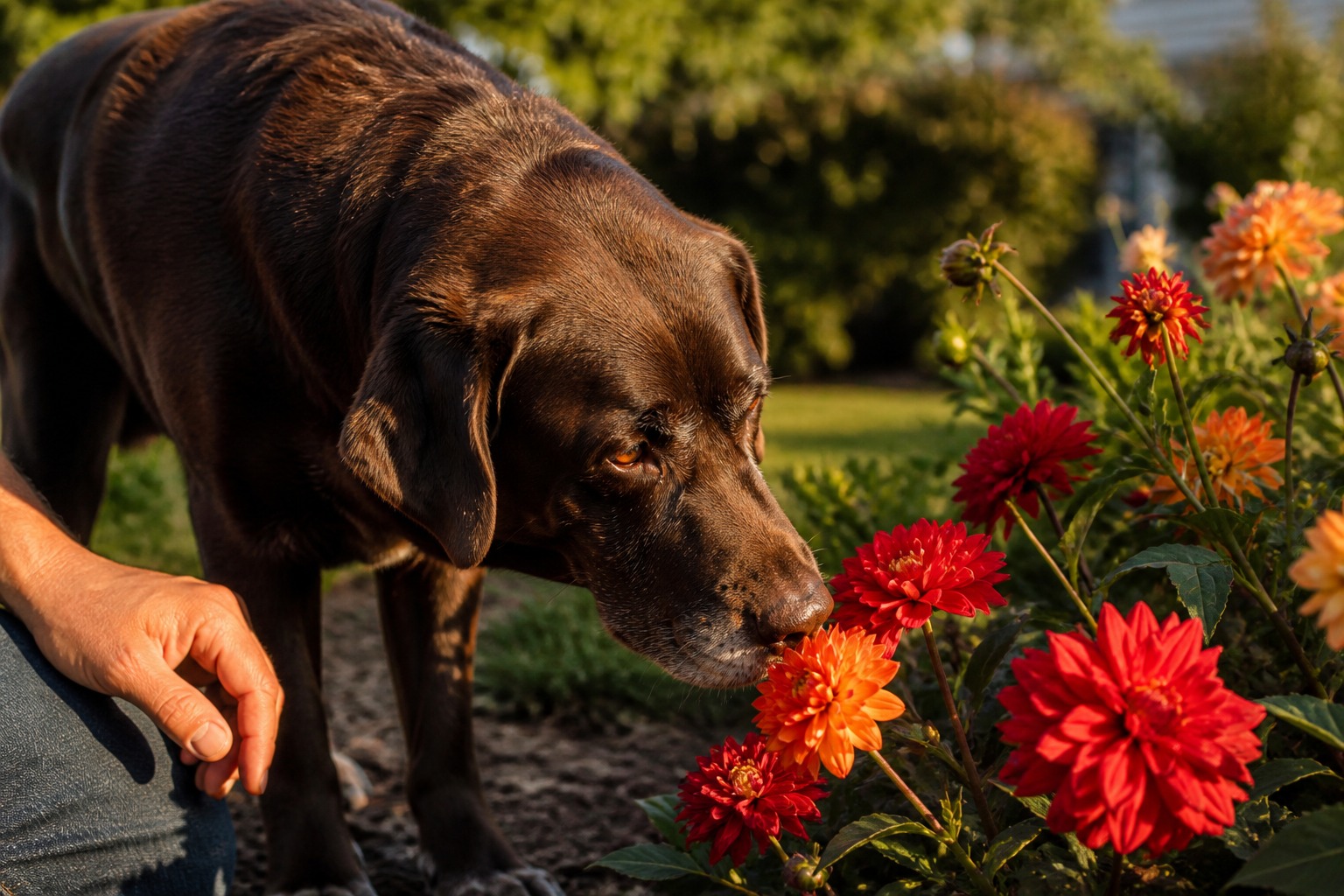
Here is the thing almost every dahlia-and-dogs article gets backwards: it treats a mild, self-limiting tummy upset like a poisoning emergency, then leaves the genuinely deadly plants growing two feet away without a word. Dahlias are toxic to dogs. They are also near the bottom of the danger scale. If you are going to worry about something in your garden, the dahlias are not it.
So let’s do the opposite of the usual warning. We’ll size the actual dahlia risk honestly, then spend most of our time on the plants that send dogs into liver failure, because that is the distinction that protects your dog.
How toxic is a dahlia, really?
The American Society for the Prevention of Cruelty to Animals lists dahlias as toxic to dogs, cats, and horses, with the expected clinical signs being mild gastrointestinal upset and mild dermatitis. The toxic compound has never been identified, which itself tells you something: a plant that regularly hospitalized dogs would have a well-studied toxin by now.
In practice, a dog who chews a dahlia is looking at some combination of drooling, nausea, vomiting, loose stool, and a brief loss of appetite. A dog who brushes against the foliage might get mild contact dermatitis, occasionally a short-lived rash or a blister. Most of it resolves within about 24 hours on its own.
Dahlias land in the same bucket as eating too much grass or a strange snack off the sidewalk. In a healthy adult dog I expect a rough evening, not a crisis. What I do not want is for an owner to panic over dahlias while a sago palm sits in the same flower bed.
That is the whole point. Knowing a plant is “toxic” is not enough. You need to know how toxic, because the response is completely different.
The garden-danger scale, from nuisance to deadly
Plant toxicity runs on a spectrum, and lumping everything into one “toxic” pile is what gets dogs hurt. Here is where the common ones actually sit.
| Plant | Risk tier | What it does | What to do |
|---|---|---|---|
| Dahlia | Mild | GI upset, mild skin irritation, usually gone in a day | Monitor at home; call if signs are severe or persist |
| Tulip, hyacinth (bulbs) | Moderate | Drooling, vomiting; bulbs are the worst part | Vet call, especially if a bulb was dug up and eaten |
| Azalea, rhododendron | Serious | Vomiting, weakness, abnormal heart rhythm | Vet now |
| Oleander | Severe | Heart-rhythm disruption, can be fatal | Emergency vet |
| Autumn crocus | Severe | Contains colchicine; organ damage, bleeding, can be fatal | Emergency vet |
| Sago palm | Life-threatening | Liver failure, seizures; roughly 50% fatal even with treatment | Emergency vet immediately |
| Lily (Lilium, Hemerocallis) | Deadly to cats | Kidney failure in cats from tiny exposures | Emergency, cats especially |
A dahlia and a sago palm are both “toxic plants,” and they are not remotely the same problem. The sago palm kills about half the dogs who eat it even with aggressive treatment. Autumn crocus carries colchicine, the same compound that makes it dangerous to humans. These are the plants worth redesigning a yard around.
What to actually do if your dog eats a dahlia
Because the risk is mild, the response is mostly calm observation, not a scramble.
First, take the plant away and see how much is gone. A single chewed petal is different from a dog who dug up and ate a tuber. Then watch for the expected signs: vomiting, diarrhea, drooling, or skin irritation where the plant made contact. Offer water, hold off on the next meal for an hour or two if your dog seems queasy, and let a mild upset run its course.
Call your veterinarian, or the ASPCA Animal Poison Control Center at (888) 426-4435, if any of these are true:
- Vomiting or diarrhea is severe, bloody, or still going after about 24 hours
- Your dog seems lethargic, wobbly, or won’t drink
- The dog is a puppy, a senior, very small, pregnant, or has an existing health condition
- You are not certain it was a dahlia and not one of the dangerous plants above
For a healthy adult dog and a confirmed dahlia, most vets will have you monitor at home. The diagnostics older articles describe, full blood panels, serum chemistry, urinalysis, induced vomiting, activated charcoal, IV fluids, are real tools your vet has, but they are reserved for the severe or uncertain cases, not the standard dahlia nibble. Reaching for them by default overstates a mild exposure.
Can you keep dahlias if you have a dog?
Yes, with ordinary sense. Plenty of dog owners grow dahlias without incident, because most dogs are not interested in eating ornamental flowers and the consequence of a stray bite is mild. The tubers are the part worth protecting, both because dogs sometimes dig and because a swallowed tuber is more material than a petal. Plant them where your dog doesn’t dig, lift and store tubers out of reach over winter, and you have managed essentially the whole risk.
If you have a dog who eats everything, or you simply do not want to deal with it, skip them. But “skip dahlias entirely” as blanket advice, while a sago palm or oleander stays in the bed, gets the priorities exactly wrong.
Build the bed around the real hazards
The useful version of plant-proofing is not memorizing every mildly toxic flower. It is keeping the life-threatening ones out of reach and learning to recognize them.
Worth keeping far from dogs: sago palm, oleander, autumn crocus, foxglove, azalea and rhododendron, castor bean, and lily-of-the-valley. If you also have cats, treat true lilies (Lilium and Hemerocallis) as a hard no, since even pollen can cause fatal kidney failure in cats.
Reliably dog-safe choices for color: sunflowers, snapdragons, asters, garden marigolds (Calendula), and roses (mind the thorns). These let you plant freely without scanning every bloom.
The bottom line
Dahlias are mildly toxic to dogs, the kind of thing that ruins an evening, not a life. Keep them out of a digging dog’s reach, watch for a day of GI upset if your dog samples one, and spend your real vigilance on the sago palms, oleanders, and autumn crocuses that actually land dogs in the emergency room. Sorting the mild from the deadly is the skill that keeps a dog safe in a garden, and it is the part the standard warning leaves out.
References
- “Dahlia.” ASPCA Toxic and Non-Toxic Plants, www.aspca.org/pet-care/aspca-poison-control/toxic-and-non-toxic-plants/dahlia.
- “Do You Know Which Flowers and Plants Are Toxic to Pets? Our Experts Explain.” ASPCA, www.aspca.org/news/do-you-know-which-flowers-and-plants-are-toxic-pets-our-experts-explain.
- “Toxic and Non-Toxic Plant List — Dogs.” ASPCA Animal Poison Control, www.aspca.org/pet-care/animal-poison-control/dogs-plant-list.
- “Poisonous Plants for Dogs.” American Kennel Club, www.akc.org/expert-advice/home-living/poisonous-plants-for-dogs.
Common questions
What happens if my dog eats a dahlia?
Usually a bout of drooling, nausea, vomiting, or loose stool, and sometimes mild skin irritation where the plant touched. It is uncomfortable, not an emergency, in a healthy adult dog. Call your vet or ASPCA Poison Control at (888) 426-4435 if signs are severe, persist past a day, or your dog is very small, very old, or already sick.
Which common garden plants are actually dangerous to dogs?
Sago palm, autumn crocus, oleander, foxglove, azalea and rhododendron, and lily-of-the-valley are the ones that can cause organ failure or death. Lilies in the Lilium and Hemerocallis families are deadly to cats specifically. These belong in a different risk tier than dahlias.
Not a substitute for your vet. Our guidance is educational. For urgent symptoms, contact a vet or emergency clinic right away. Editorial standards
Dr. Nair is a veterinarian focused on diet and feeding. She covers everyday nutrition, treats, and the many "can they eat this?" questions owners ask, grounding each answer in what is actually safe and sensible for dogs and cats.
Meet our experts ↗Keep reading
 LivingThe Kayak Isn't What Hurts Dogs. The Water Is.Dr. Ravi Mehta · 8 min
 Health & WellnessAre Essential Oils Safe for Your Dog? You Can't Actually Know.Dr. Mara Chen · 7 min
 LivingDon't Teach Your Dog to Swim. Teach Them to Get Out.Dr. Priya Nair · 8 min
 Health & WellnessThe Fleas on Your Dog Are 5% of the Problem. The Rest Is in Your CarpetDr. Ravi Mehta · 10 min
 LivingA Pink Poodle Fell Into an Icy River. The Dye Job Saved Her.Marcus Webb · 6 min
 Health & WellnessEvery Second You Spend on Snakebite First Aid Is a Second Your Dog Is DyingDr. Ravi Mehta · 8 min