


Dog Poop Is a Federally Regulated Pollutant. A Few Cities Finally Treat It Like One
The EPA has classified dog waste alongside oil and toxic chemicals since 1991, yet most of it still goes in a bag and then a landfill. A handful of communities built infrastructure to catch it, and the results scale.

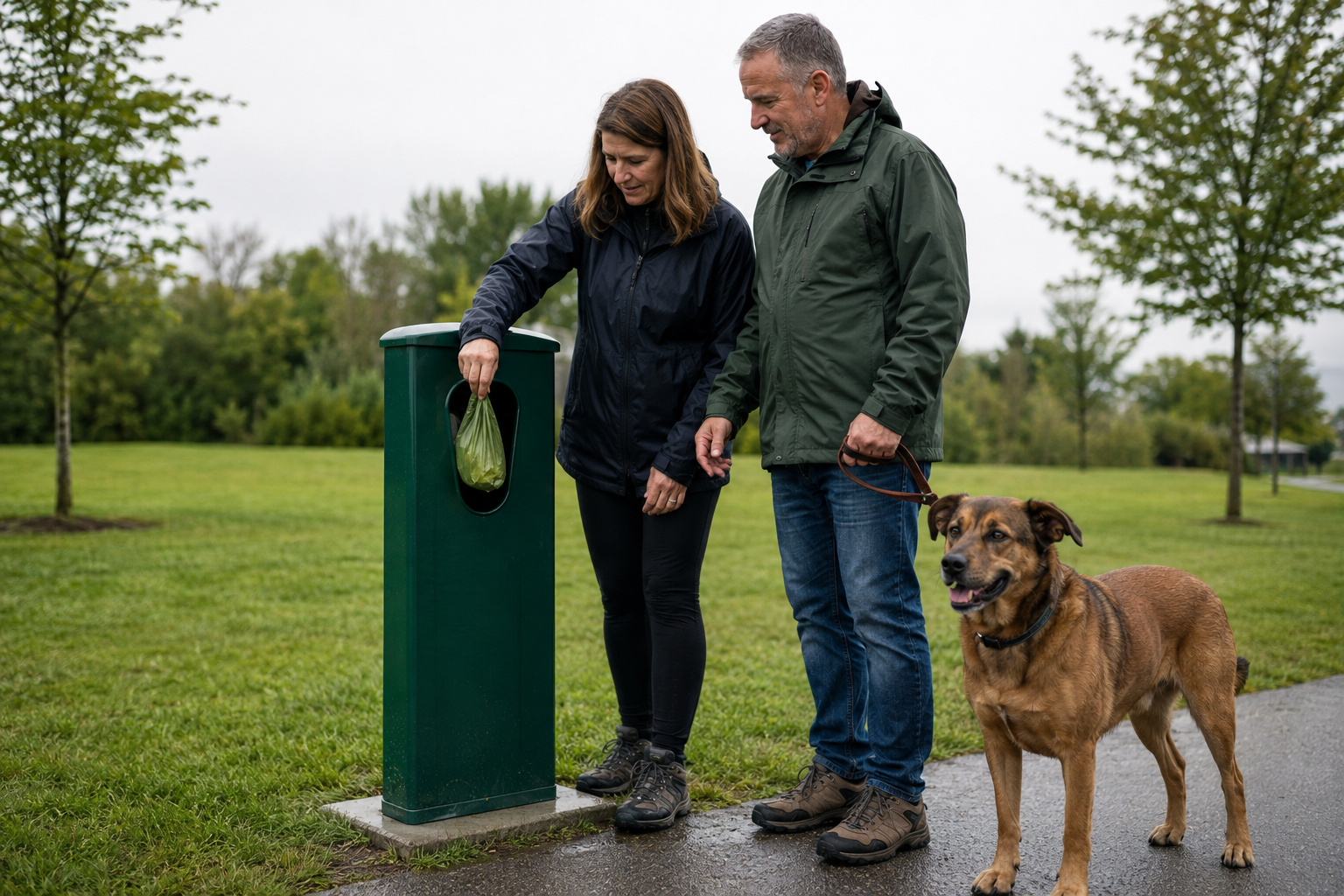
Here is a fact that reframes the whole subject: since 1991, the U.S. Environmental Protection Agency has classified pet waste as an environmental pollutant, in the same regulatory category as oil and toxic chemicals. Not a nuisance. Not a lawn-care afterthought. A pollutant, on par with the things we build spill-response plans around.
You would never guess it from how we handle it. Compared to the elaborate systems engineered for human sewage, dog poop disposal is startlingly primitive: pick it up in a thin plastic bag, drop it in a public bin, and let it ride to a landfill where it will release methane and carbon dioxide for years. The gap between how seriously the science treats dog waste and how casually the sidewalk does is the real story here. A few communities in Canada have started to close it, and what they have learned says less about one clever product than about treating dog waste as its own waste stream that deserves its own infrastructure.
Why the scale of the problem is genuinely large
It is easy to wave off one bagged pile as trivial. The aggregate is not. American dogs produce roughly 10 to 11 million tons of feces a year, and an estimated 40 percent of dog owners never pick any of it up. The uncollected share is where the pollution math turns ugly.
A single gram of dog waste holds an estimated 23 million fecal coliform bacteria. When rain washes it off lawns and curbs into storm drains, most of which run straight to lakes and streams with no treatment stop in between, that bacteria arrives untreated. So does the nitrogen and phosphorus. Research from the University of Minnesota found that pet waste is actually the leading source of phosphorus in the urban watersheds they studied, the nutrient most responsible for the algae blooms that suffocate freshwater ecosystems. Bacterial tracing studies in urban rivers routinely pin 20 to 30 percent of the contamination on dogs; one analysis of Baltimore’s Patapsco River put the figure at 26 percent.
Here is the more encouraging flip side of the same research, and the single most useful number in this article for an individual owner: simply picking up after your dog cuts the phosphorus load into local water by 97 percent and the nitrogen load by 56 percent. Nothing else in the eco-conscious pet-parent playbook comes close to that return on so little effort. The catch is what happens to the bag afterward, and that is where a city’s infrastructure either helps or fails you.
The bag problem that no bag solves
You might assume a “compostable” bag rescues you here. It does not, and it is worth being clear-eyed about why. Composting dog feces is technically possible but demanding: it has to be done separately from food-waste streams, held at higher temperatures for longer to kill pathogens, and the finished product kept out of food gardens. Municipal facilities are not set up for that, so essentially every bag of dog poop, compostable or not, gets pulled and sent to the landfill anyway. There, sealed away from oxygen, it breaks down slowly and belches methane, a greenhouse gas far more potent than the carbon dioxide it would release in open air.
And leaving it on the ground is not a green alternative, whatever the “it’s natural” crowd says. Beyond irritating your neighbors, it is a documented public-health hazard, and it feeds the exact nutrient runoff described above. There is no version of the everyday routine that makes the waste disappear. That is precisely the vacuum a real collection system fills.
What Mississauga actually built
Mississauga, a city of about 800,000 in southeastern Ontario, generates an estimated 23.6 million pounds of dog waste a year. City officials, tired of overflowing bins and contaminated recycling, called a waste-management company named Sutera that had never planned to be in the poop business at all. Sutera got its start building industrial garbage containers, mostly for construction sites, but kept getting asked for something purpose-built for dog waste.
In 2018 the company built it: an in-ground unit that discreetly holds 500 to 600 pounds of waste below grade. Two design choices do the heavy lifting. First, sitting underground keeps the contents cool, which slows the odor and the off-gassing that make above-ground bins so unpleasant. Second, and more important, the unit collects a single, uncontaminated waste stream, nothing but dog poop and the bags it came in. That purity is what makes the downstream options viable, because composting facilities, anaerobic digesters, and waste-to-energy plants can all process a clean stream of one material far more easily than a mixed bin. Instead of daily hand-emptying, a crane truck clears each unit about once a month.
The rollout followed the unglamorous arc of good municipal policy. Mississauga started with a 14-unit pilot in 2019, measured it (less recycling contamination, fewer pickups, minimal staff handling, positive resident feedback), and made it permanent in 2021. The city now runs 24 units that have diverted an estimated 100 metric tonnes of waste from landfill, with more locations under review. The lesson is not “buy this bin.” It is that dog waste responds to being measured and managed like the waste stream it is.
The same idea, pushed further in Waterloo
Nearby Waterloo took the concept one step past diversion and turned the waste into energy. Its “poop power” program feeds 22 in-ground bins into a waste-to-energy facility. These plants are not a clean win, they carry real emissions and pollution tradeoffs of their own, but they keep the material out of the landfill and extract something from it. By 2022, Waterloo had diverted 90,000 pounds of dog waste and generated enough energy to run 25 homes for a year.
The through-line between the two cities is worth naming, because it is the actual policy insight: once you collect dog waste as a dedicated stream, you inherit a menu of options, compost it, digest it, or burn it for power, none of which exist when the same material is buried in a mixed municipal bin. The collection is the unlock.
What this means for you before your city catches up
Sutera has kept installing units across Canada and into the United States, with its first American site breaking ground in Portland, Oregon, and by one count has diverted more than 900,000 pounds of waste, roughly the weight of 68 grown elephants. A companion app points residents to their nearest drop-off. But most people reading this do not have a unit on their block yet, so here is the honest hierarchy of what to do in the meantime.
Pick up every time. That one habit delivers the 97-percent phosphorus reduction and is the highest-impact thing you can do, full stop. Choose recycled-content bags over “compostable” ones, since both end up landfilled but recycled bags at least reuse plastic already in the system rather than manufacturing new material. If you own a yard and want to go further, a home dog-waste digester breaks waste down on-site instead of shipping it to a landfill. And if you want the community-scale fix, you can petition your municipality to pilot a dedicated collection program; the Canadian case studies are exactly the kind of measured, boring evidence city councils respond to.
The most sustainable move is always to generate less waste, and you cannot ask a dog to hold it. What you can do is stop treating a federally recognized pollutant like an afterthought, starting with your own bag and, eventually, your own city’s bins.
References
- “The Poop Problem: What To Do With 10 Million Tons of Dog Waste.” Live Science. livescience.com
- “Nitrogen, Phosphorus From Fertilizers and Pet Waste Polluting Urban Water.” University of Minnesota. twin-cities.umn.edu
- “It’s No Joke: Dog Poop Is Serious Water Pollution.” Baltimore County, Maryland. baltimorecountymd.gov
- “Dog Waste Is Still Causing Quite a Stink in Mississauga.” City of Mississauga. mississauga.ca
Tom Hadley writes about training and behavior, helping owners understand what their pets are trying to tell them. His work covers everyday manners, decoding common behaviors, and the small changes at home that make dogs and cats easier to live with.
Meet our experts ↗Keep reading
 LivingYour Empty Kibble Bag Is a Recycling Dead End. Here's the Ladder OutLeila Torres · 5 min
 LivingDon't Vacuum Up That Fur. It Can Soak Up an Oil Spill.Leila Torres · 6 min
 LivingOnly Three Logos Mean 'Cruelty-Free.' Everything Else Is Theater.Leila Torres · 8 min
 Product PicksThe Escape-Proof Collar Shelters Swear By Comes From a Town of 400Nina Vasquez · 5 min
 LivingYour Dog's Trash Is Mostly Two Things. Everything Else Is a Rounding Error.Nina Vasquez · 8 min
 LivingThe Best Way to Dispose of Dog Poop Without Wrecking the PlanetLeila Torres · 8 min