


Your Empty Kibble Bag Is a Recycling Dead End. Here's the Ladder Out
Pet food bags are foil-and-plastic laminates that curbside recycling can't touch, which is why 99% end up in landfill. From Canidae's Petco refill stations down to bulk bins, here's the ranked ladder of what actually cuts the waste.

Every few weeks you empty a dog food bag, and every few weeks you hesitate over the recycling bin before dropping it in the trash where it belongs. That guilt is well-earned, but the target is usually wrong. The bag is not a personal failure of diligence; it is a genuine recycling dead end by design. Understanding why the bag can’t be recycled is what turns vague eco-guilt into a clear plan, because once you see the problem, the solutions sort themselves into an obvious ladder, from the one that eliminates the bag entirely down to the ones that at least keep it out of the ground. This is that ladder, top rung first.
Why the bag is a dead end
Here is the thing curbside recycling never tells you: most dry pet food bags are not one material, they are a laminate. Layers of plastic bonded to a thin sheet of aluminum foil, engineered that way to keep kibble fresh and grease from bleeding through. That engineering is exactly what makes them unrecyclable in the normal stream. Municipal recycling equipment cannot separate fused plastic-and-foil layers, and even where it technically could, the economics don’t work: it costs more to collect and process the bag than the recovered material is worth, so nobody does it.
The scale of that dead end is bigger than most owners guess. The Pet Sustainability Coalition estimates the United States generates roughly 300 million pounds of pet food and treat packaging waste every year, and more than 99 percent of it goes to landfill rather than getting recycled. So the bag in your hand is not an outlier. It is the overwhelming rule, and that is precisely why the solutions worth knowing are the ones that avoid the bag in the first place.
Rung 1: Skip the bag entirely with a refill station
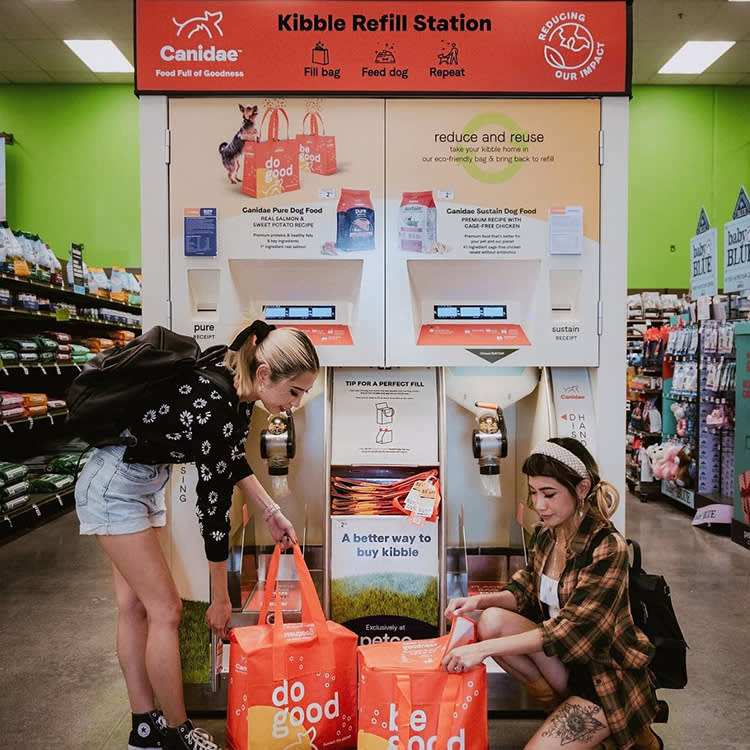
The highest rung on the ladder is not recycling the bag, it is never creating it. Canidae rolled out kibble refill stations in select Petco stores to do exactly that. Instead of buying a new bag on every restock, you refill the same reusable zipper bag. The company estimates the program keeps around 50,000 dog food bags a year out of landfills, cutting the waste at its source rather than trying to clean it up afterward.
The process is refreshingly low-effort: bring your reusable zipper bag, set it in the refill machine, choose how much you want (each bag holds up to 24 pounds), and take a receipt to checkout. Two Canidae formulas launched for refill, salmon and sweet potato, and chicken. Petco estimates the stations also save shoppers real money, roughly 45 percent per pound versus what they’d otherwise pay for packaging, and Canidae ships the food to stores in fully recyclable bulk bags, so the waste reduction runs the whole length of the supply chain rather than just the checkout counter.
Refill programs only move the needle if they’re easy enough that people actually stick with them. The genius of this one is that it asks almost nothing of the shopper beyond bringing a bag back, and it pays them to bother.
The catch, and the reason it’s rung one rather than the only rung, is reach. The stations rolled out to roughly 100 stores concentrated in states like Colorado, Texas, Florida, and Washington, so availability is genuinely regional and worth confirming before you count on it. Petco maintains a store locator so you can check whether one is near you. If it is, this is the best move you can make. If it isn’t, climb down to the next rung.
Rung 2: Mail the bag to TerraCycle
If you can’t skip the bag, the next best thing is diverting it from landfill instead of tossing it. TerraCycle specializes in finding markets for materials curbside programs won’t take, pet food bags very much included, and once it collects enough, those laminates get reprocessed into things like park benches, picnic tables, and playground surfaces. You can mail in empty bags of approved brands using a prepaid shipping label, or buy a zero-waste box you fill with any empty pet food bag, box, or container you have around. It is not free and it is not effortless, but it converts a guaranteed landfill item into a recovered one, which is more than curbside will ever do for a laminate bag.
Rung 3: Buy loose and cook to cut packaging upstream
Cooking for your dog from scratch is a bigger commitment, but it attacks packaging from a direction the other rungs don’t. Buying loose vegetables and butcher-cut meat sidesteps the bag entirely and lets you raid your own kitchen’s food scraps first. It takes time and, importantly, a vet or veterinary nutritionist’s input to keep a home diet actually balanced, so it isn’t for everyone. But for owners already inclined that way, it trims packaging at the source rather than the disposal end.
Rung 4: Find a bulk bin near you
Petco isn’t the only retailer experimenting with refillable formats. Grocers like WinCo stock food for cats, dogs, and even guinea pigs, rabbits, and parrots in some of their bulk-bin sections, and independent refill shops sometimes carry pet food or will consider stocking it if you ask. It’s the lowest rung because availability is spotty and selection is thin, but where it exists, a bulk bin gets you the refill-station benefit without needing a specific brand’s program in your zip code.
The point of laying it out as a ladder is that you don’t need the perfect option to do better than the trash can. Reach for the highest rung you can actually stand on. Some eco-habits are a genuine slog; refilling a bag you were going to fill anyway is not one of them.
References
Leila Torres leads our Living coverage, from home life and travel to the products and rescue stories that come with sharing a life with animals. She edits and writes across the section, with a soft spot for pieces about the bond between people and their pets.
Meet our experts ↗Keep reading
 LivingDog Poop Is a Federally Regulated Pollutant. A Few Cities Finally Treat It Like OneTom Hadley · 7 min
 LivingDon't Vacuum Up That Fur. It Can Soak Up an Oil Spill.Leila Torres · 6 min
 LivingOnly Three Logos Mean 'Cruelty-Free.' Everything Else Is Theater.Leila Torres · 8 min
 Product PicksEco Dog Toys Are the Last Holdout. These $16 Handmade Ones Show Why.Nina Vasquez · 4 min
 Product PicksThese Dog Treats Are Made From Juice Scraps and Bugs. Your Dog Will Beg for Them Anyway.Leila Torres · 5 min
 LivingA Nike Designer Decided Eco Dog Gear Didn't Have to Be UglySasha Ford · 6 min