


The Most Sustainable Dog Bed Is the One You Never Have to Replace
Cloud7 founder Petra Jungebluth left fashion to build dog beds meant to last a dog's entire life. Her real sustainability lesson isn't about materials, it's about durability, and it doubles as a buyer's guide to beds worth keeping.
Ask most brands about sustainability and you get a list of materials: recycled this, organic that, a vegan collection. Ask Petra Jungebluth, the founder of Berlin’s Cloud7, and she points somewhere less obvious. The greenest dog bed, in her telling, is not the one with the most eco-labels. It is the one you buy once and never throw away. That single idea, durability as the environmental strategy, is what makes Cloud7 worth understanding, and it happens to be the most useful lens a shopper can bring to buying any dog bed.
From fashion floors to furniture-grade beds
Jungebluth did not come to pet products from pet products. Around 2010 she was a successful fashion designer, with major labels on her résumé, when she went looking for a dog bed that was sustainable, comfortable, and complementary to her interior rather than an eyesore. Nothing on the market hit all three marks, so she made her own. Cloud7 has since grown into collars, leashes, toys, sweaters, bowls, and blankets, but the founding promise, pet-friendly, eco-friendly, and design-friendly in equal measure, has held.
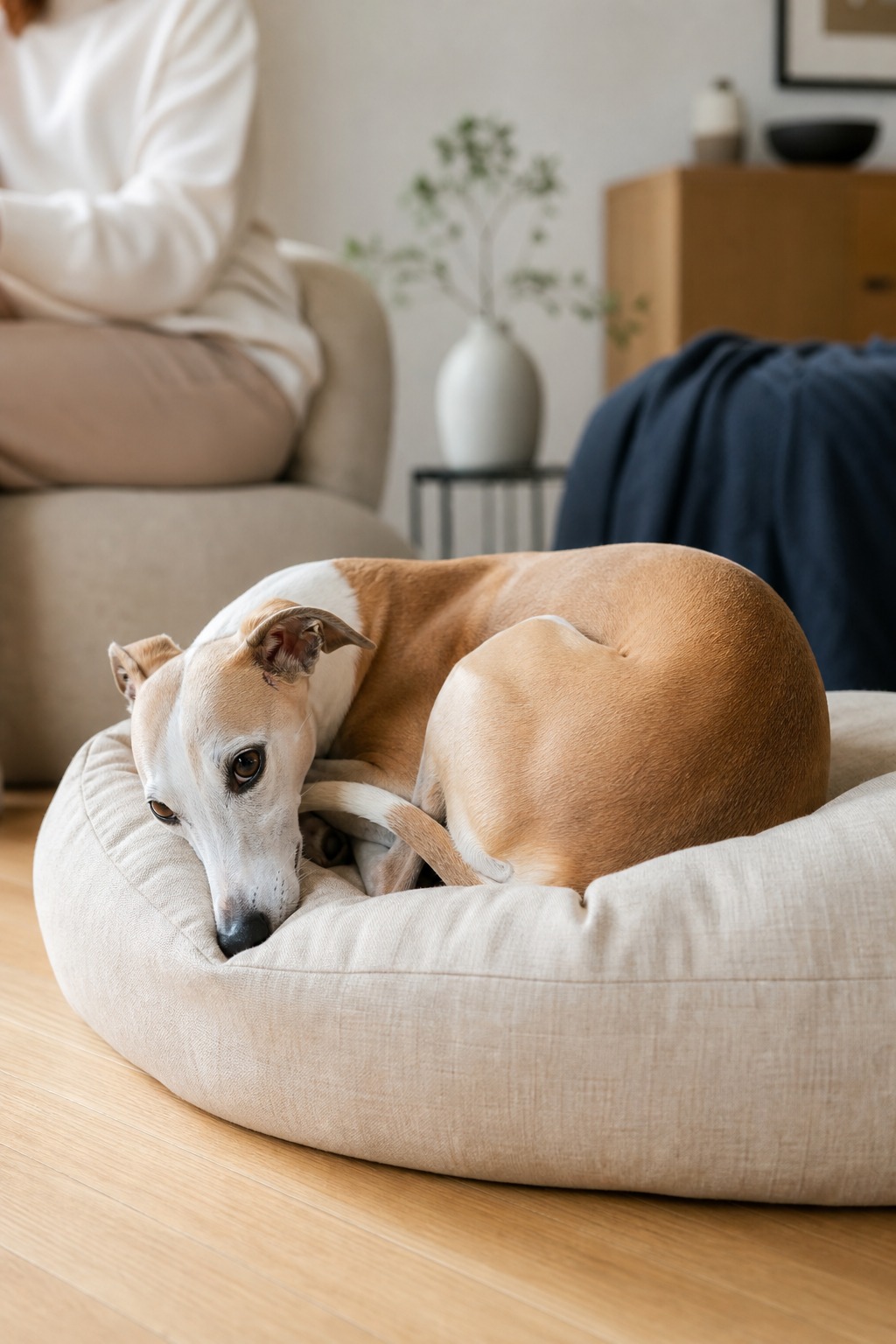
The dogs come first, literally. Cloud7’s official product testers are Freddie and Matti, two longhaired Whippets, and Otto, a rescue from Cyprus. The family lives in the countryside outside Berlin, where the Whippets can hit full speed while Otto gamely, and unsuccessfully, tries to keep up. Otto arrived anxious after years on the streets, but with his two “brothers” he has blossomed into a cuddly companion who occasionally models for the brand, once appearing in a department-store window in Copenhagen. All three test every new product before it goes into production.
Why durability is the sustainability story
Here is the argument at the center of Jungebluth’s approach. When Cloud7 launched its beds around 2010, most dog beds were made from cheap, chemically treated materials, sold at attractive prices with almost no lifespan. They wore out, went to landfill, and got replaced. Cloud7 set out to break that cycle by building beds the way furniture is built.
The specifics matter, because they are exactly what a buyer should look for:
- Furniture-grade fabrics. Cloud7 borrows durable upholstery textiles rather than using thin, disposable pet-market cloth.
- Hand-stuffed mattresses. Each is individually filled by hand, which helps it hold its volume and support even after years of use, instead of flattening into a pancake.
- Replaceable covers. For normal wear, you swap the cover, not the whole bed. The first-generation beds were designed to last a dog’s lifetime, and Jungebluth says they still do.
That last point is the whole philosophy in miniature. A bed that lasts fifteen years and takes a fresh cover twice is dramatically kinder to the planet, and cheaper over time, than three “bargain” beds that each die in eighteen months.
The math on a lifetime bed is better than it looks. People compare sticker prices, but the honest comparison is cost per year of actual use, plus the beds you didn’t send to landfill. A well-built bed with a replaceable cover usually wins on both.
Materials, honestly stated
Cloud7 does use natural, untreated fabrics and recycled fillings wherever possible, and it offers an extensive vegan line of leashes and collars. Jungebluth is candid that the brand is not fully vegan yet, and frames that as a work in progress rather than a finished claim, which is a healthier way to read any brand’s sustainability marketing. Her design instinct, traceable to a German heritage that prizes full functionality, is to avoid anything purely decorative and pair minimalism with high-quality materials. That same rigor shows up in sourcing: the team tests fabric samples through repeated washing and drying before prototyping, then hands the prototypes to the office dogs for real-world evaluation. Patterning for every body type, from Chihuahua to Ridgeback, is its own considerable challenge.
Giving back: the RESC7UE collection
One of Jungebluth’s proudest projects is RESC7UE, a collection created with a group of artists and photographers, with all profits going directly to a hand-picked shelter. She always intended that the moment Cloud7 found even modest success, it would give back to dogs less fortunate than her own. Rather than write a check and walk away, the brand sought a lasting partnership, eventually connecting with Every Day Stray, a shelter in Bulgaria run by a couple from England who relocated specifically to help stray dogs there. Cloud7 stays in constant contact, funding vet costs, new shelter construction, and general upkeep, and even traveled to Bulgaria to make a documentary and a coffee-table book of the local strays. The brand’s collaborations, which have ranged from design houses to travel brands, are chosen on shared values as much as aesthetics, and Jungebluth has hinted at a high-end porcelain dog-bowl partnership in the works.
How to buy a bed that lasts
You do not need to buy Cloud7 specifically to apply its lesson. When you shop for a bed you will not have to replace, look for: a removable, washable, and ideally replaceable cover; a fill that is designed to keep its loft (hand-stuffed or high-density foam beats loose polyfill); fabric that reads as upholstery rather than cheap plush; and a manufacturer that sells replacement parts at all, which is the clearest signal a bed is built to be kept. The market has moved in this direction, with more brands emphasizing recycled materials, replaceable components, and longevity over disposability. Spend a little more once, choose something your dog’s body and your living room can both live with for years, and you will have made the genuinely sustainable choice, which is also, over a dog’s lifetime, the cheaper one.
References
- Cloud7. “RESC7UE Collection.” https://cloud7.de/en/collections/rescue
- U.S. Environmental Protection Agency. “Sustainable Materials Management: Non-Hazardous Materials and Waste Management Hierarchy.” https://www.epa.gov/smm/sustainable-materials-management-non-hazardous-materials-and-waste-management-hierarchy
Marcus Webb writes about the gear, gadgets, and everyday choices that make life with a pet easier. His coverage runs from product picks to training and the causes worth paying attention to, always with an eye on what actually earns a place in your home.
Meet our experts ↗Keep reading
 Product PicksMost Faux Fur Is Just New Plastic in a Nicer Shape. This Dog Bed Isn't.Sara Lim · 6 min
 LivingA Furniture Designer Got Fed Up With Ugly Dog Beds. So He Fixed ThemMarcus Webb · 6 min
 LivingYour Dog Has Two Beds Because They Have Two Kinds of SleepDr. Ravi Mehta · 7 min
 Product PicksStore-Bought Dog Beds Are a Racket. Crochet One From Scrap Yarn.Leila Torres · 5 min
 Product PicksThese Dog Beds Are Handwoven by Indian Artisans, Not Stamped Out in a FactorySasha Ford · 4 min
 Product PicksThis Pet Brand Recycled 500,000 Water Bottles Into Dog Beds, and Made Them CuteNina Vasquez · 6 min