


Everybody Got a Second Dog. Her Order Book Was the First to Know.
A ceramicist in the Mojave takes custom pet portrait commissions. The year the two-pet orders overtook the one-pet orders, she had a better read on American households than most surveys did.
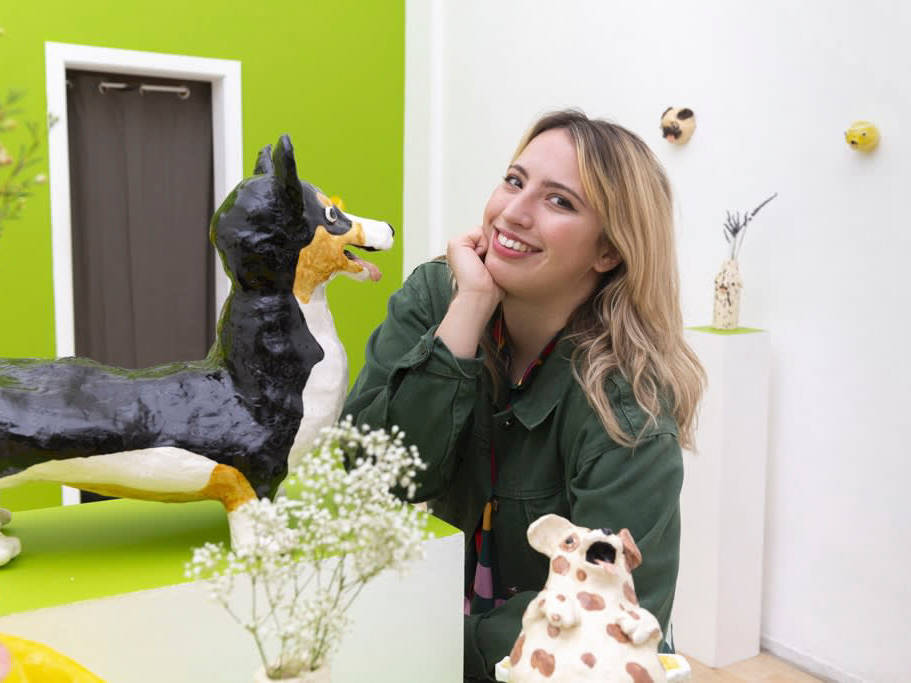
Every so often a small business turns out to be a better instrument than a survey. Katie Kimmel makes custom ceramic pet portraits from a home studio in the Mojave Desert, and she noticed something in her own holiday orders that the national data would take another year to confirm.
Two years before the pandemic, she took roughly 150 vase commissions over the holidays. About 90 of them were a single pet. Then came the year everyone was home, and the orders came back looking different: a much larger share were now two-pet portraits.
Her reaction was to laugh at it. Oh, everybody got a second dog.
They had. And they were commissioning the family portrait to prove it.
What she actually makes
Kimmel works in ceramics: sculptures, furniture, apparel, home goods, and the pet portrait vases that carry months-long waitlists. She studied ceramics, video, and painting at the School of the Art Institute of Chicago, finishing in 2015, and her work has shown at galleries including Hashimoto Contemporary and sold through boutiques like Big Bud Press, Anomie, and The Future Perfect.
Her own household is the source material: two Chihuahuas, Pony and Muffin, a Saint Bernard named Boss, and a large tortoise called Joey, who came to her the way tortoises usually do, passed along by a friend of a friend who was getting too old to keep an animal that outlives everybody.
She is candid that she does not take human commissions. Her reason is very good: with a dog, she cannot accidentally insult the subject.
The waitlist is not really a waitlist
The commission process explains the delay, and it also explains why people wait.
She works from photographs. The sculpture is built first, then shelved for about two weeks to dry, then bisque fired. Then glazing, a first coat of color, another firing to see whether it is finished, and then more firing until the color is actually right. She takes the orders in bulk, so it is normal to still be working through twenty-five of them well after Christmas. She watches low-stakes television while she does it, an entire season of something undemanding per holiday run.
At the beginning, she says, the process was almost unbearably stressful. Now the emotion is out of it and what remains is trust in her own hands.
But here is what a months-long queue for a $400 ceramic dog is really made of, and it is not decor. A commissioned pet portrait is one of the very few objects people buy that is designed to outlast the animal in it. Some of the orders are celebrations. A meaningful share are pre-emptive grief, placed by somebody whose dog has started sleeping more than it used to.
That is why the waitlist holds. Nobody cancels.
How to commission a pet portrait that actually looks like your pet
Since the artist works from photos, the photo is the commission. Most disappointing results are traceable to a bad reference. If you are ordering from Kimmel or anyone else:
- Shoot at the animal’s eye level, not from human standing height. A top-down photo flattens the muzzle and makes every dog look like a different dog.
- Use daylight, indirect. Flash blows out the fur pattern, which is the thing the artist has to reproduce.
- Send the flaws. The crooked ear, the grey coming in around the mouth, the notch in the tail. Owners send the glamour shot and then feel that the finished piece looks like a stranger. It looks like a stranger because you sent a stranger.
- Send three angles, not one: straight on, three-quarter, and profile.
- Order early. A holiday commission placed in November is a February delivery. This is not a shipping problem; it is a kiln problem.
Kimmel’s current custom pricing runs about $375 for a one-pet vase, $425 for two, and $500 for three, before shipping and tax, and commissions open in waves rather than continuously.
The Saint Bernard
The best story in her house is the one that explains the rest of it.
When the pandemic stranded her in the desert, two hours from Los Angeles and a long way from anything, she decided to foster. What she got was a hospice case: a Saint Bernard named Frankenstein, who could barely walk and who died three months later. They took him knowing he would not live long, and immediately, hopelessly, set about trying to cure his cancer with love.
He did not survive. He also completely rearranged her. She became obsessed with getting a Saint Bernard, to the point where she and her husband found out they had each been quietly scheming to surprise the other with one. Had both plans landed, the household would have contained a pair of Chihuahuas and a pair of hundred-pound giants.
They ended up with Boss, who is a genuine pandemic dog: a little feral, and now heavier than she is. Working in the studio with the door propped open, she gets ambushed on a schedule; all three of them come crashing in at once, make a racket, and clear out again. She calls it a happy parade moving through the house all day.
That is the thing she is actually selling. Not a vase. The parade.
What’s new since this was written
The second-dog wave she spotted in her order book has fully reversed in the national numbers. Shelter Animals Count’s 2025 data shows adult and senior dog adoptions falling while juvenile adoptions rise, and shelters reporting longer stays for large dogs in particular. The households that doubled up in 2020 and 2021 are not, on the whole, doubling up again.
Which makes the commissions look different than they did. A ceramic portrait of two dogs, ordered in a boom year, is now frequently a portrait of one dog who is still here and one who is not. The waitlist did not shorten. What people are buying quietly changed underneath it.
References
- Katie Kimmel. Custom Work. katiekimmel.com
- Hashimoto Contemporary. Katie Kimmel. hashimotocontemporary.com
- Shelter Animals Count. 2025 Annual Data Report. shelteranimalscount.org
- American Veterinary Medical Association. Pet Ownership and Demographics Sourcebook. avma.org
Jordan Ellis is a certified professional dog trainer with a decade of experience working with rescue organisations and private clients. They specialise in anxiety, reactivity, and positive reinforcement methods, and review all training and behaviour content at The Pet Times.
Meet our experts ↗Keep reading
 Product PicksThe Bridgerton Dog Collection Was Supposed to Sell Out. Two Years Later, It's Still Here.Leila Torres · 5 min
 Product PicksA Designer Dog Collab Lives or Dies on a Hole in the BackSasha Ford · 6 min
 Product PicksMost Cats Don't Need a Sweater. The Ones That Do Deserve This One.Sasha Ford · 5 min
 Product PicksHer Fleece Sparks $1,000 Bidding Wars. The Dog Version Is $165.Sara Lim · 5 min
 Product PicksYour Cat Will Probably Ignore This $13 Gift. Buy It Anyway.Sara Lim · 6 min
 Product PicksDog Clothes Got Good. This Brand Is the Reason.Sara Lim · 8 min