


Your Cat Will Probably Ignore This $13 Gift. Buy It Anyway.
A tiny terracotta catnip kit is the rare cat present that isn't kitsch, isn't expensive, and works even when the cat refuses to participate.

Buying for a cat person is a specific kind of trap. The market is saturated with things shaped like cats, and the person you are buying for almost certainly already owns a set of cat-shaped oven mitts, and does not need a second set.
The alternatives are worse: a $90 designer scratching post you are not confident they will like, or nothing.
So here is the third option, and it costs thirteen dollars.
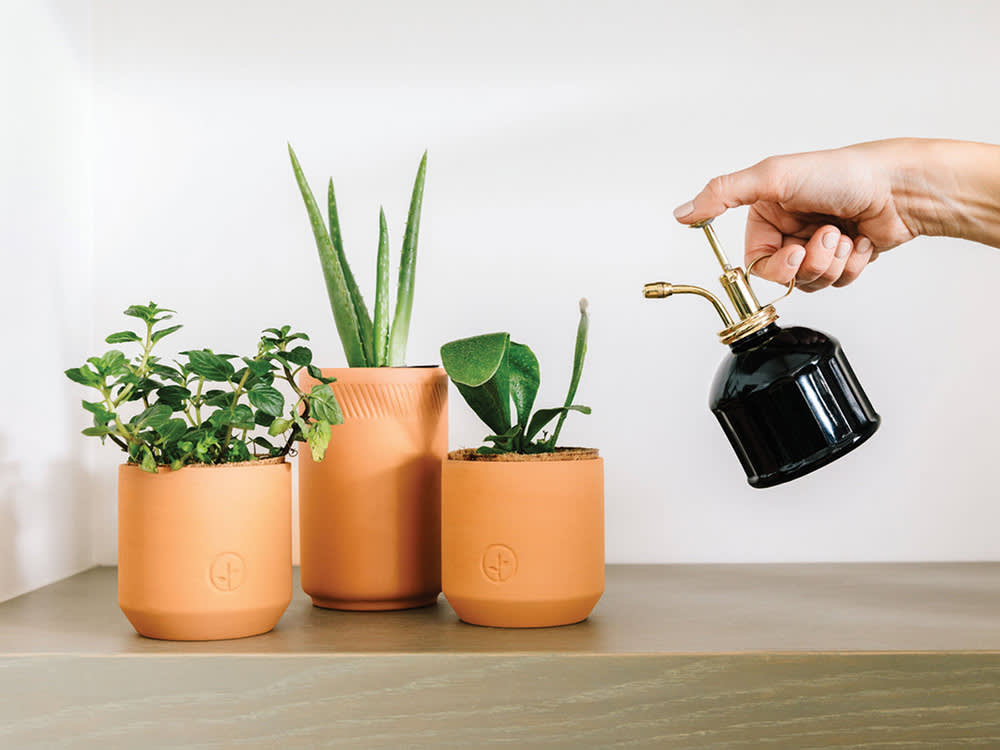
Modern Sprout Curious Catnip Tiny Terracotta Kit — $13
Sold direct by Modern Sprout, not on Amazon.
What you actually get
A very small terracotta pot, and inside it, everything the plant needs: seeds, a growing medium, a coco husk liner, and plant food. The instructions are printed on the cardboard label wrapped around the pot.
Assembly is a nesting doll. The seeds go into the growing medium, the medium goes into the husk liner, the liner goes into the terracotta pot. Water it. Add the plant food. Catnip sprouts in about a week.
When the plants are big enough, they move on: out into the garden, or up into a roomier pot. The terracotta is then yours again for whatever comes next. The footprint is 3.5 by 3.5 inches, which means it fits on a windowsill in an apartment where nothing else fits anywhere.
They are, in practice, close to unkillable. Water occasionally. That is it. The one thing they genuinely want is direct sun; a kit grown in a dim corner comes up spindly and wan, and the same plants moved into a bright window straighten themselves out within days.
The complaint, because there is one
The instructions are thin.
Not wrong, just brief, because they are printed on a label that wraps around a pot the size of a shot glass. If you are a confident gardener, it is plenty. If you are a person who has killed a succulent, you will want slightly more hand-holding than the label provides, and you will end up looking things up.
That is the entire list of faults.
The part you should know before you buy it
Here is the honest disclosure, and it is the reason for the headline: there is a decent chance the cat ignores the catnip completely.
This is not a defect in the product. It is a fact about cats, and it is genetic.
Roughly a third of cats do not respond to catnip at all. The response is an inherited trait, controlled by an autosomal dominant gene, and a cat who did not inherit it will walk past a fresh plant with no interest whatsoever. It is also age-linked: kittens under about three months typically show no response, and it can take up to six months to develop. A cat who ignores catnip at ten weeks may love it at eight months.
Cats do not choose this and cannot be trained into it. If your cat is one of the third, growing them the world’s finest catnip changes nothing.
If that turns out to be your cat, the alternatives are real and worth knowing:
- Silver vine (Actinidia polygama) is the big one. In a study of hundreds of domestic cats, silver vine produced a response in a substantially higher proportion of cats than catnip did, including many of the cats who did not react to catnip at all. If catnip is a dud in your house, silver vine is the next thing to try, not a second bag of catnip.
- Valerian root and Tatarian honeysuckle also work on some non-responders.
None of that makes the grow kit a bad gift. It makes it a gift with a known 30 percent failure rate on the intended recipient, which is roughly the same as any present.
Why it is worth it even then
Two reasons.
One: fresh catnip is better catnip. The active compound is nepetalactone, and it degrades over time. Dried catnip loses potency sitting on a shelf in a bag, which is why the sad grey stuff at the back of the cupboard produces nothing while a fresh leaf produces bedlam. A living plant is the most potent form available, and it is renewable.
Two: even the cat who ignores it benefits from the plant being there. A cat who has something safe to chew is a cat who is less interested in chewing the pothos, and a considerable number of common houseplants are toxic to cats. Catnip is not toxic to cats, and neither is the closely related cat grass. Giving a cat a legal target is one of the cheapest pieces of harm reduction in the house.
There is a very common outcome, incidentally, in which the cat ignores the catnip and goes right on chewing the succulents, purely out of spite. This is the cat you were always going to have.
“A cat who chews plants is not being naughty, and she will not stop being a cat because you asked her to,” says Dr. Lena Park. “Give her something safe to chew and put the toxic ones out of reach. That is the whole intervention, and it works far better than scolding.”
Who it is actually for
This is a stocking stuffer, a white elephant, a housewarming, a thank-you. It is small, it is cheap, it is not kitsch, it is alive, and live plants improve almost any room.
And the failure case is unusually forgiving. If nothing sprouts, if the seeds drown, if the recipient forgets it for a month: they still have a nice little terracotta pot. That is a better floor than most gifts have.
What newer research adds
The interesting recent finding is that catnip may not be recreation at all.
A team of researchers reported that when cats rub against catnip and silver vine, they transfer the plants’ active compounds onto their fur, and that those compounds, nepetalactone and nepetalactol, repel mosquitoes. The rolling and rubbing behavior, in other words, looks less like a party and more like a cat applying insect repellent to herself.
That reframes the whole thing rather charmingly. The plant on your windowsill is not just a toy. It may be a functional piece of equipment your cat has been using correctly for thousands of years, and you have been laughing at her the entire time.
References
- Modern Sprout, “Tiny Terracotta Kits.” https://modernsprout.com/products/tiny-terracotta-kits
- Bol, S., et al. “Responsiveness of cats (Felidae) to silver vine (Actinidia polygama), Tatarian honeysuckle (Lonicera tatarica), valerian (Valeriana officinalis) and catnip (Nepeta cataria).” BMC Veterinary Research, 2017. https://bmcvetres.biomedcentral.com/articles/10.1186/s12917-017-0987-6
- Uenoyama, R., et al. “The characteristic response of domestic cats to plant iridoids allows them to gain chemical defense against mosquitoes.” Science Advances, 2021. https://www.science.org/doi/10.1126/sciadv.abd9135
- ASPCA, “Toxic and Non-Toxic Plants: Catnip.” https://www.aspca.org/pet-care/animal-poison-control/toxic-and-non-toxic-plants
- Cornell Feline Health Center, “Catnip.” https://www.vet.cornell.edu/departments-centers-and-institutes/cornell-feline-health-center
Sara Lim leads our Product Picks coverage, testing and comparing the things pets and their owners actually use. From everyday essentials to home-and-style finds, she focuses on honest, useful recommendations rather than hype.
Meet our experts ↗Keep reading
 Product PicksMost Cat Gifts Fail the Chic Test. These Clear It.Claire Sutton · 6 min
 Product PicksYour Cat Doesn't Want a Present. She Wants Territory.Sara Lim · 6 min
 Product PicksClawed Monet and Frida Catlo: The Artist Behind Every Cat Lover's Favorite GiftSara Lim · 5 min
 Product PicksGifts for the Cat Person Who Insists They 'Don't Need Anything'Sasha Ford · 6 min
 LivingThe Cat Decides When the Photo Shoot Is Over. Never the Photographer.Sasha Ford · 6 min
 Product PicksMost Cats Don't Need a Sweater. The Ones That Do Deserve This One.Sasha Ford · 5 min