


Can't Brush Your Cat's Teeth? Stop Aiming for Perfect and Stack Wins
Daily brushing is the gold standard for cat teeth, and most cats will never allow it. A vet reframes feline dental care as a stack of small, imperfect habits, and explains the one thing no home routine can catch.

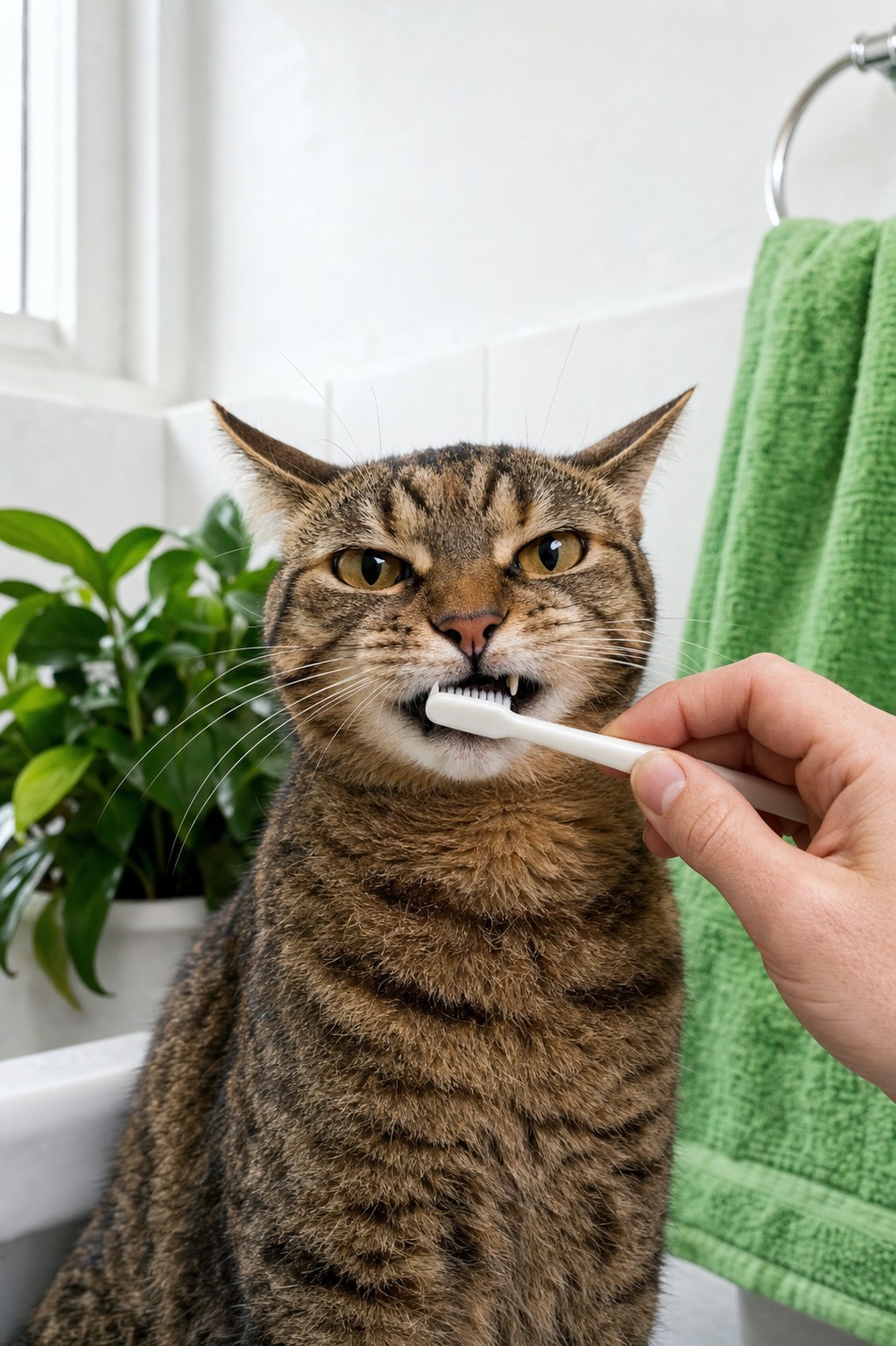
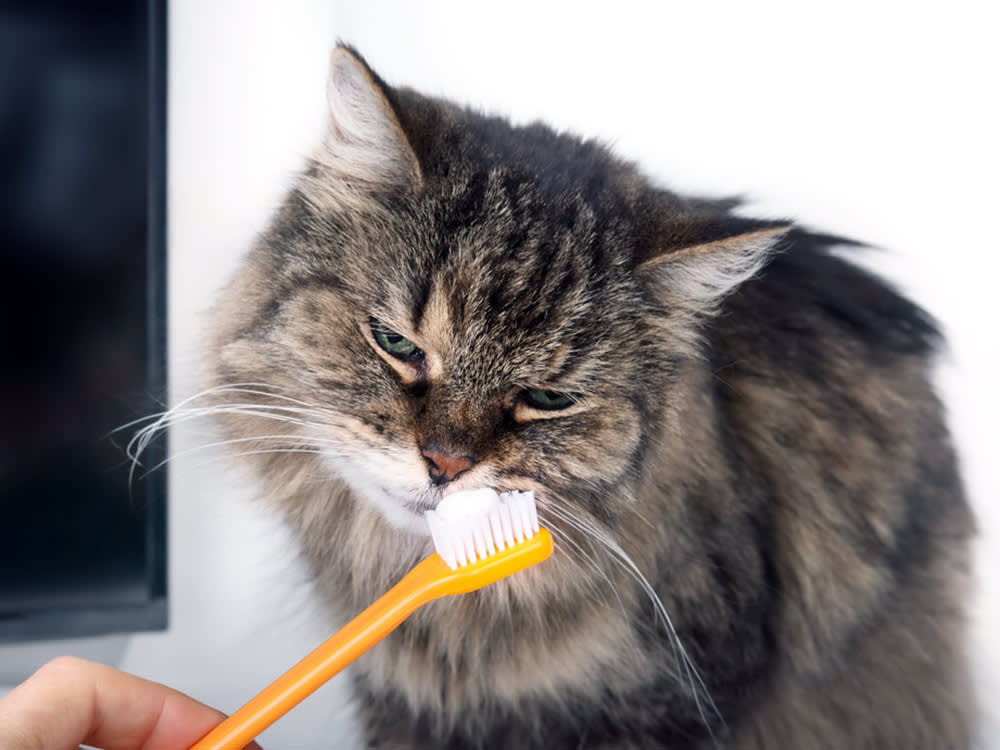
The standard advice on cat teeth is both correct and quietly useless to most people who hear it: brush your cat’s teeth every day. It is correct because daily brushing really is the most effective thing you can do at home. It is useless because a large share of cats will never tolerate it, and the owners of those cats walk away feeling like they have already failed at a task they have not even started.
So let me offer a more workable frame. Feline dental care is not a pass-fail exam with a toothbrush as the only answer. It is a stack of small, imperfect habits, and the goal is not a perfect routine, it is to reduce plaque by whatever combination of methods your specific cat will actually allow. A cat who gets brushed twice a week, chews a dental treat most days, and sees a vet twice a year is in far better shape than a cat whose owner tried to brush daily, gave up in week one, and did nothing after that. Some, done consistently, beats perfect, abandoned. Once you accept that, the whole project gets less stressful and a lot more effective.
Why you cannot just skip this
It would be easier to decide dental care is optional, and it is not, because the stakes are higher than bad breath. Dental disease in cats is not an occasional problem, it is close to universal. Roughly 85 to 90 percent of cats over the age of three have some form of dental disease, and radiographic signs of periodontal bone or root loss appear in the large majority of cats by their senior years.
Periodontal disease is painful, and it does not stay confined to the teeth. It works into the gums, the ligaments that anchor the teeth, and eventually the jawbone, and that low-grade infection asks something of the whole body over time. Chipping away at plaque, by any method your cat accepts, is one of the most valuable things you can do for their long-term comfort.
Rule one: never turn it into a fight
Before any technique, one hard rule, because it is the mistake stressed owners reach for first.
“People panic and think, I have to do this, I have to do it now, so they pin the cat and force it,” Dr. Kohl says. “That backfires almost every time. It is unkind, and it teaches your cat that anything near their mouth means a fight, which makes every future attempt harder. Forcing a cat to accept something rarely works, and it burns the trust you need.”
Everyone’s safety, including your hands, comes first. A cat who bites during brushing is not a cat to overpower. It is a cat to route around.
The brushing on-ramp, for cats who will get there
If your cat has any tolerance to build on, brushing is still the most effective single tool, and you get there by degrees over a few weeks of short, low-pressure sessions.
Begin without a brush at all: while petting your cat, touch the outside of their mouth and lips, once or twice a day for about five days, until mouth contact stops registering as an ambush. Then lift a lip and touch a finger to the gums and teeth, rewarding the instant they allow it, keeping sessions under two minutes for a week or two. Next, add pet toothpaste, never the human kind, which can be toxic to cats, on your finger for a few days. Once your cat accepts a finger in their mouth calmly, wrap it in medical gauze, touch it to the teeth, and reward, then work up toward an actual brush. If your cat plateaus at any step, that step is not a failure. It is just where this particular cat’s tolerance sits, and you build the rest of the stack around it.
The rest of the stack, for cats who won’t
When the brush is a permanent no, you are not out of options, you are just leaning on the other habits.
“If brushing is genuinely miserable for both of you, or your cat tries to bite, you have not failed, you have learned something about your cat,” Dr. Kohl says. “Then you tackle it from other angles: dental treats, dental diets, and water additives. The single most important move is to look for the Veterinary Oral Health Council seal on whatever you buy.”
That VOHC seal is the part worth underlining, because the dental-product aisle is full of things that do nothing. The Veterinary Oral Health Council only awards its seal to products that have been tested and proven to reduce plaque and tartar when used as directed, so checking VOHC.org before you buy is the difference between spending money on real prevention and spending it on flavored filler. Ideally you combine a VOHC treat or additive with whatever brushing your cat tolerates, but if brushing is off the table entirely, these are worthwhile on their own.
The thing no home routine can catch
Here is the part most brushing articles leave out, and it is the reason home care can never be the whole plan: some of the most painful feline dental problems are invisible and untreatable at home no matter how diligent you are.
The clearest example is tooth resorption, a condition where a tooth breaks down from the inside out, eventually exposing the sensitive inner tissue. Cornell’s College of Veterinary Medicine estimates it affects somewhere between 20 and 60 percent of all cats and close to three-quarters of cats over the age of five. There is no toothpaste, treat, or additive that prevents or fixes it, affected teeth usually have to be extracted by a vet, and much of the damage happens below the gumline where you simply cannot see it. The same goes for early periodontal pockets and bone loss.
This is also where the profession’s own guidance has landed. The FelineVMA (the veterinary group formerly known as the American Association of Feline Practitioners) published updated feline oral health and dental care guidelines in 2025, and their throughline is exactly this stacked approach: daily brushing stays the home-care gold standard, but it is meant to work alongside VOHC-accepted products and, crucially, regular anesthetized oral exams with dental radiographs, because that is the only setting where resorptive lesions and disease below the gumline can actually be found and treated. The current standard of care does not ask brushing to carry the whole load, and neither should you.
That is why professional exams are not an optional extra on top of home care, they are the part that catches what home care cannot.
“Up to 60 percent of painful dental problems in cats can only be found with an X-ray under anesthesia,” Dr. Kohl says. “Anesthesia sounds intimidating, and anesthesia-free cleanings are marketed as the gentle alternative, but they cannot probe below the gumline or take the radiographs where the real disease hides. Talk to your vet about lowering anesthetic risk for your individual cat rather than avoiding the cleaning that actually diagnoses the problem.”
Put the stack together
So the honest, workable plan looks like this: brush on the days your cat allows it and do not spiral on the days they do not, back that up with VOHC-accepted treats, diets, or water additives, and keep annual or twice-yearly vet exams that include a real oral evaluation and cleaning under anesthesia when the vet recommends one. No single layer has to be perfect. Stacked together and kept up, they add real years of comfort to your cat’s mouth, and that, not a flawless nightly brushing streak, is the actual goal.
References
- Lobprise, Heidi, et al. “2025 FelineVMA Feline Oral Health and Dental Care Guidelines.” Journal of Feline Medicine and Surgery, 2025. https://journals.sagepub.com/doi/10.1177/1098612X251398793
- “Feline Dental Disease.” Cornell University College of Veterinary Medicine, Cornell Feline Health Center. https://www.vet.cornell.edu/departments-centers-and-institutes/cornell-feline-health-center/health-information/feline-health-topics/feline-dental-disease
- “Tooth Resorption in Cats.” Cornell Feline Health Center, Cornell University College of Veterinary Medicine. https://www.vet.cornell.edu/departments-centers-and-institutes/cornell-feline-health-center/health-information/feline-health-topics/tooth-resorption
- Veterinary Oral Health Council. Accepted Products for Cats. https://vohc.org/accepted-products/
- “Dental Cleaning in Cats.” VCA Animal Hospitals. https://vcahospitals.com/know-your-pet/dental-cleaning-in-cats
Not a substitute for your vet. Our guidance is educational. For urgent symptoms, contact a vet or emergency clinic right away. Editorial standards
Dr. Kohl is a board-certified veterinary dentist with a particular interest in preventive oral care. She reviews all dental health content at The Pet Times and contributes practical guides on home dental routines, professional cleaning, and oral disease prevention.
Meet our experts ↗Keep reading
 Health & WellnessThat Weird Jaw Jitter? Your Cat Is Hunting an Animal They'll Never Catch.Dr. Lena Park · 5 min
 Health & WellnessYour Cat's Bad Tooth Doesn't Stay in the MouthDr. Amara Solis · 6 min
 First DaysYour Kitten Is Losing Teeth Right Now and You'll Probably Never See It HappenDr. Priya Nair · 6 min
 Health & WellnessThat Sore in Your Cat's Mouth Isn't Nothing. Here's How to Read ItDr. Ravi Mehta · 6 min
 Health & WellnessYour Cat's Drool Is Only Cute If Your Hand Is on ThemDr. Lena Park · 8 min
 Health & WellnessBrushing a Cat's Teeth Sounds Impossible. The Trick Is to Not Brush at FirstDr. Mara Chen · 9 min