


Most Cat 'Probiotics' Are Selling You Hope. Buy the Strain, Not the Label.
The cat-supplement aisle is full of tubs promising a happier gut. Almost none of them name the one thing that decides whether they work. Here's the question that separates a real probiotic from marketing, plus the picks worth your money.

Affiliate disclosure. This article contains affiliate links. We may earn a small commission if you buy through a link, at no extra cost to you. How we handle recommendations.
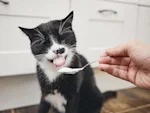
We have all been sold on gut health by now, for ourselves. The kombucha, the “12 strains” yogurt, the powder that promises to fix everything from digestion to mood. That marketing has crossed the aisle to the pet-supplement shelf, and cats are the newest target. The pitch is the same: your cat’s microbiome is out of balance, and this tub will fix it.
Some of that is true. Cats do carry trillions of gut microbes, that ecosystem does affect digestion and immune function, and a good probiotic can genuinely help, especially through stress, travel, a diet change, or a course of antibiotics. But the shelf is also full of products that work only in the marketing copy. The difference between the two isn’t the price or the packaging. It comes down to one thing most labels quietly leave off.
The one question that filters out the junk
Before you buy any cat probiotic, ask: does it name a specific strain, and does it tell you how many live organisms you’re actually getting?
A real probiotic is a defined strain, written out like a scientific name with an alphanumeric code, at a stated dose. That dose is measured in colony-forming units, or CFUs, the count of live, active microbes in one serving. A label that just says “probiotic blend” or “supports digestion” without naming the strain or the CFU count is telling you it hasn’t been tested for cats and is hoping you won’t notice.
The strain is the whole story, because effects don’t transfer from one microbe to another. A strain proven to firm up a cat’s stool tells you nothing about the unnamed one in the next tub over. If a label won’t tell me exactly what’s inside and how much, I treat it as an unproven product, not a probiotic.
The reason to care about this isn’t only wasted money. It’s timing. Probiotics work best as a steady, preventive habit rather than an emergency fix, so you want the microbes doing their quiet maintenance while your cat is healthy, not scrambling to add them after the diarrhea starts. Buying the wrong tub means months of feeding your cat nothing while believing you’re protecting them.
What a good one actually does
When the immune system detects friendly microbes in the gut, it responds, and a well-chosen strain tips the balance of the resident ecosystem toward the helpful bacteria and away from the troublemakers. Day to day, that can mean steadier digestion, less gas, firmer stool, and better nutrient absorption. Under stress, the payoff is bigger: boarding, a move, a new pet, or a car trip can throw a cat’s gut into chaos, and that’s exactly when a probiotic earns its keep.
None of this replaces good food. A probiotic is a supplement on top of a complete, balanced diet, not a substitute for one. If your cat’s base diet is wrong, no tub of bacteria will fix it.
The picks worth considering
A quick note on how to read these: they’re ranked by the standard this article opened with — the products that name their strains and doses come first, and we’ve flagged where you’re buying palatability rather than proof.
A multi-strain probiotic powder
Heads up. leads because it’s the option that answers the label question. This kind of formula pairs prebiotics with a defined blend, in this case 12 strains delivering 5 billion CFUs per scoop. Prebiotics are the fiber that feeds the probiotics once they arrive, so a combined pre- and probiotic scoop is doing two jobs at once. Powders let you scale the dose to a small cat and mix it invisibly into wet food.
Duck-flavored probiotic soft chews
Heads up. solve the real-world problem, which is that a supplement your cat refuses is worthless. These are built as a treat first, aimed at the predictable rough patches — a kennel stay, a road trip, a new roommate with paws — when digestion tends to go sideways. If your cat treats powders as an insult, a chew they’ll actually eat beats a “better” product they won’t.
The Honest Kitchen Instant Goat’s Milk
Heads up. comes last on purpose: it’s the gentlest entry point but the least clinical of the three. It’s a dehydrated goat’s-milk powder made to human-food standards that you rehydrate and pour over a meal or serve on its own; goat’s milk carries naturally occurring probiotics, sits easily in most cats’ stomachs, and the ingredient list is short and free of the usual filler. Think of it as a palatable, low-stakes way to introduce friendly bacteria to a cat who turns up their nose at anything resembling a supplement.
For house-brand and subscription options, two are worth naming even though they aren’t on Amazon. Pet Naturals Daily Probiotic for Cats is a widely available daily chew, and Nom Nom Full-Spectrum Probiotic is a vet-formulated powder loaded with prebiotic fiber, sold direct rather than through retailers. Because those go through their own stores, we’ve flagged them as follow-ups rather than tagged links.
What the research actually backs
Here’s where the evidence points, and it’s worth knowing before you shop. The best-studied probiotic in cats is a single strain, Enterococcus faecium SF68, the one inside the veterinary product FortiFlora. In shelter studies of hundreds of cats, it reduced the rate of diarrhea and helped cats hold onto their gut-microbe diversity under the stress of a shelter environment, while cats on a placebo lost diversity. A separate study in kittens found it measurably boosted a marker of immune function. That is the kind of named-strain, dose-specific, peer-reviewed evidence the question at the top of this article is really asking for.
The honest takeaway: most over-the-counter cat probiotics have far less research behind them than their marketing implies, and SF68 is the one with the strongest track record for the common problem people actually reach for a probiotic to solve. If your goal is evidence over vibes, that’s the strain to ask your vet about by name.
When a probiotic is the wrong tool
A probiotic is maintenance and mild support, not medicine. Diarrhea or vomiting that lasts more than a day or two, blood in the stool, weight loss, or a cat who stops eating is a vet visit, not a supplement problem. Chronic digestive trouble can signal food intolerance, parasites, or inflammatory disease, and sprinkling bacteria on top won’t touch the underlying cause. Use probiotics to keep a healthy gut healthy and to smooth over predictable stress, and call your vet when something is actually wrong.
FAQs
Do healthy cats need a probiotic?
Not strictly, but many can benefit, particularly around predictable stress like travel, boarding, a new pet, or antibiotics. Think of it as preventive support rather than a daily necessity.
Can I just give my cat yogurt?
A tiny spoonful of plain, unsweetened yogurt is a fine occasional treat for cats that tolerate dairy, but it’s not a reliable probiotic. The live-culture count is low and undefined, and many cats are lactose intolerant. A cat-specific product with a named strain is far more dependable.
How long until a probiotic works?
For general gut support, give it a few weeks of consistent daily use. For acute stress like a trip, starting several days ahead helps. If you see no change in a stubborn digestive problem after a few weeks, that’s a sign to see your vet rather than to keep guessing.
References
- Effect of the Probiotic Enterococcus faecium SF68 on Presence of Diarrhea in Cats and Dogs Housed in an Animal Shelter (PMC)
- Effect of supplementation with Enterococcus faecium (SF68) on immune functions in cats (PubMed)
- Effect of Enterococcus faecium SF68 on Gastrointestinal Signs and Fecal Microbiome in Cats Administered Amoxicillin-Clavulanate (ScienceDirect)
Not a substitute for your vet. Our guidance is educational. For urgent symptoms, contact a vet or emergency clinic right away. Editorial standards
Dr. Nair is a veterinarian focused on diet and feeding. She covers everyday nutrition, treats, and the many "can they eat this?" questions owners ask, grounding each answer in what is actually safe and sensible for dogs and cats.
Meet our experts ↗Keep reading
 FoodThe Right Fiber for Your Cat's Problem: A Match-It GuideDr. Mara Chen · 9 min
 FoodYogurt Won't Fix Your Cat's Gut. Here's What Actually Might.Dr. Lena Park · 6 min
 Health & WellnessYour Pet's Gut Is an Organ. You're Probably Damaging It by AccidentDr. Priya Nair · 7 min
 Health & WellnessOne in Three Dogs Has 'Too Much' E. Coli. The Number Isn't the Scary Part.Dr. Ravi Mehta · 7 min
 Product PicksHolistic Pet Products: What's Actually Worth It, and What's Just WooDr. Ravi Mehta · 7 min
 Health & WellnessCBD Is King in the Pet Aisle. The Crown Is Unregulated.Dr. Priya Nair · 8 min