


Your Cat Can't Spit Out a Hair Tie. That's the Whole Problem.
A cat's tongue is built to move things one direction: down. Which turns your hair tie into a linear foreign body, one of the few emergencies where the clock, not the object, decides whether the cat lives.

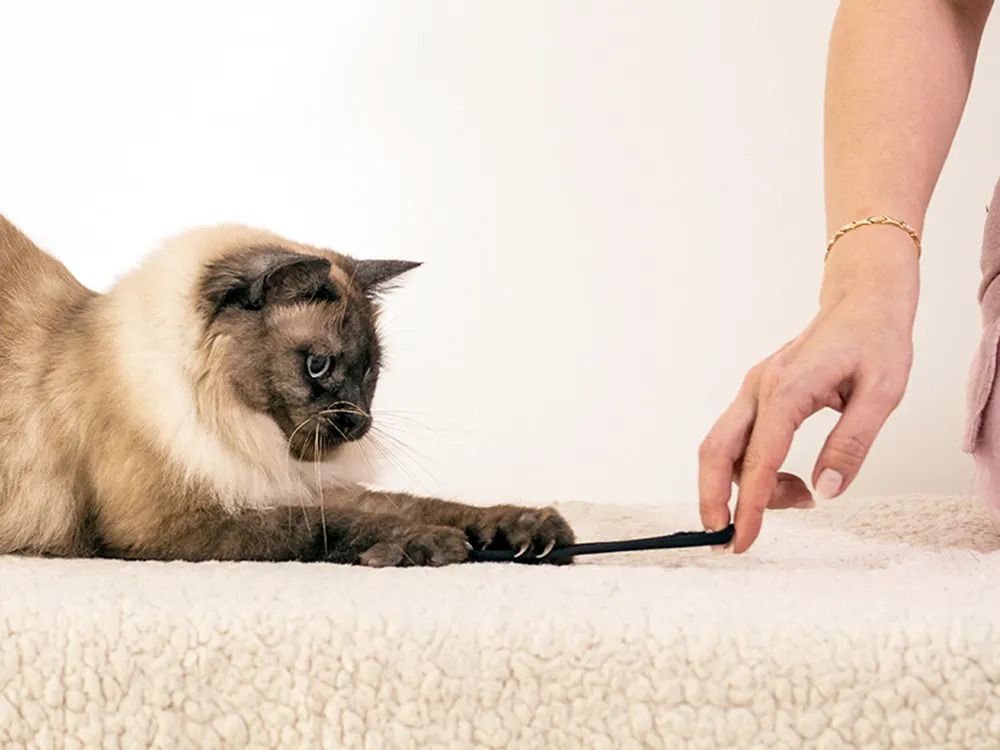
Every cat person has done the thing. You stretch a hair tie between two fingers, aim down the hallway, and let go. The cat detonates. It is the cheapest entertainment in the house, and for a lot of cats it is their favorite toy on earth.
I want to be precise about the risk, because the version people usually hear is vague and therefore easy to dismiss. “Small objects are a choking hazard” doesn’t change anyone’s behavior. Here is the version that should.
A cat’s tongue is covered in backward-facing keratin barbs. They are built to strip meat and pull loose fur off a coat, and they only move things one direction: toward the throat. This means a cat who gets a hair tie hooked on their tongue and decides they don’t want it has almost no mechanism for getting rid of it. Their equipment is designed to swallow. So they swallow.
That is the whole problem. Not that hair ties are appealing, which they obviously are. That a cat who changes their mind about a hair tie usually cannot act on it.
Why cats can’t leave them alone
None of the appeal is mysterious, and it is worth naming because it tells you why “just train the cat not to” is a losing strategy.
Hair ties are small, light, and low-friction, so they skitter across wood and tile the way a fleeing insect does. They are grabbable: a cat can hook one with a single claw and fling it, which is exactly the motion a cat uses on real prey. They are stretchy and chewy, which sits right on top of a lot of cats’ texture preferences — the same cats who go for shoelaces, drawstrings, phone cables, and the tails of their toy mice. Some have beads or metal crimps that click on a hard floor. And they smell like you, which for a bonded cat is its own draw.
Add it up and a hair tie hits nearly every button a cat has. Indoor cats retain the full predatory drive of an animal built to hunt many small things per day, and they will find outlets for it. If you leave a hair tie on the bathroom counter, you have provisioned a hunt.
What a linear foreign body actually does
This is the part that separates a hair tie from, say, a swallowed bottle cap.
A solid object that gets stuck causes a blockage. Bad, but conceptually simple: something is in the pipe and the pipe is closed.
A stringy object — thread, tinsel, dental floss, ribbon, a hair tie stretched into a strand — does something different and worse. Frequently one end anchors somewhere, often looped around the base of the tongue, or caught at the outlet of the stomach. The rest streams down into the intestine. The intestine’s job is to keep pushing, so it pushes. But the string can’t go anywhere, because it’s tethered.
So the bowel bunches itself up along the string, gathering like fabric on a drawstring. Vets call this plication. And now the string is a taut line running through a concertina of intestine, and every contraction drags the bowel wall against it. Over hours, it saws. A cut through the bowel wall spills intestinal contents into the abdomen, which is septic peritonitis, which is a life-threatening infection layered on top of the original problem.
None of that requires the cat to have eaten something big. It requires the cat to have eaten something long.
The mistake I see is people treating this like a swallowing problem, when it’s a sawing problem. A hair tie sitting in a stomach is often a fixable afternoon. The same hair tie strung through eighteen inches of bowel two days later is a very different surgery, and a very different conversation.
The clock is the prognosis
There’s an unusual amount of good recent data on this, and it all points the same direction.
A 2023 retrospective in the Journal of Feline Medicine and Surgery reviewed twelve years of cats operated on for gastrointestinal foreign bodies and found that the overall outlook was good — cats who go to surgery for this generally survive, and catastrophic complications like the surgical site coming apart afterward are rare. That’s the reassuring half.
The other half: linear foreign bodies were the group that drove the deaths, needed the more aggressive surgery, and took the harder recoveries. In a more recent series, overall survival sat around 77%, with complications like septic peritonitis and sepsis showing up in about a fifth of cases, and the deaths were concentrated among the linear cases.
The number that should stick with you is this one. In that same body of work, the cats who survived went to surgery on average around 67 hours after the object went in. The ones who didn’t averaged around 96 hours.
Roughly a day of delay is the difference. Not a different object, not a different cat, not a different surgeon. A day.
This is why “let’s wait and see if it comes out in the litter box” is such a costly instinct. It is not a neutral choice to observe. It is a bet against a clock you can’t see.
What to watch for, and when to go
Signs that something is obstructing a cat:
- Repeated vomiting, especially vomiting that keeps happening after the stomach is empty
- Refusing food, which in a cat is always significant
- Lethargy, hiding, sitting hunched
- Drooling, or pawing at the mouth
- A belly that is tense or painful to touch
- Straining in the litter box with nothing to show for it
Go now if any of those follow a known or suspected string. Go now, without waiting for more signs, if you saw your cat eat a hair tie. Go now if you can see string emerging from the mouth or the rear.
And on that last one: do not pull it. I know the urge is enormous. If the other end is anchored around the tongue base or wound through bowel, pulling can lacerate the intestine along its whole length. Leave it. Tell the vet it’s there.
The honest advice on prevention
You will find guidance suggesting supervised hair-tie play, and for some cats — the large, thick, boring elastics, with a cat who bats and does not chew — that’s defensible.
But be truthful about which cat you have. If yours chews cords, chews shoelaces, chews the drawstring of your hoodie, or has ever eaten something that wasn’t food, they do not get hair ties. Not supervised, not “just while I’m here.” Cats are quicker than the moment you looked away, and the thin decorative ones with beads and glitter are the worst of both worlds: more attractive, more chewable, more pieces.
The workable fix is not a behavior change in the cat. It’s a habit change in you. Hair ties live in a drawer or a closed jar. When you take your hair down, the tie goes on your wrist, not on the counter. Then replace the entertainment you took away: wand toys that let them chase and catch, food puzzles that make them work for dinner, a few minutes of real hunting simulation a day. A cat with enough legitimate prey doesn’t need to invent some.
What newer research adds
The clearest recent shift is a better handle on how these surgeries actually go, and it cuts in two directions worth knowing.
The good news is that outcomes are better than the folklore suggests. Cats who make it to surgery in reasonable shape do well, and the feared complication of the intestinal repair falling apart afterward turns out to be uncommon. Newer surgical techniques for retrieving linear foreign bodies through a single incision, rather than opening the bowel in several places, appear to work and cut down on how much gut has to be cut.
The bad news is that all of that upside is conditional on time. Every recent series lands on the same finding: the damage is a function of how long the string has been sawing, and the delay between ingestion and surgery is one of the strongest predictors of whether a cat lives. The surgical advances buy you a better operation. They do not buy you an extra day.
Which is the practical takeaway. If the hair tie went in, the right response is a phone call, tonight.
References
- Gollnick, H. R., et al. “Retrospective evaluation of surgical treatment of linear and discrete gastrointestinal foreign bodies in cats: 2009–2021,” Journal of Feline Medicine and Surgery — 2023.
- Miller, J., et al. “Linear and discrete foreign body small intestinal obstruction outcomes, complication risk factors, and single incision red rubber catheter technique success in cats,” Veterinary Surgery — 2024.
- Linear Foreign Bodies in Dogs and Cats — Veterinary Information Network.
- Pica in Cats — Cornell Feline Health Center.
Common questions
What are the signs of an obstruction in a cat?
Repeated vomiting, refusing food, lethargy, hiding, straining without producing stool, a painful or tense belly, and drooling. A cat who ate something stringy and then starts vomiting is an emergency until proven otherwise, and the vomiting can start hours or days after the fact.
Why is string worse than a solid object?
Because one end tends to catch, often around the base of the tongue or at the stomach outlet, while the gut keeps trying to push the rest along. The intestine bunches up along the anchored string like fabric on a drawstring, and the string can then saw through the bowel wall from the inside, spilling gut contents into the abdomen.
I can see string hanging out of my cat's mouth or rear. Can I pull it?
No. If a length of it is anchored deeper inside, pulling can slice the intestine. Do not pull, do not cut it flush and hope. Go straight to a vet and tell them there is a visible string.
How do I stop my cat playing with hair ties?
You change your habits, not the cat's. A hair tie triggers most of a cat's prey wiring, and expecting them to override that is unrealistic. Keep hair ties in a closed drawer or a lidded jar, wear them on your wrist instead of setting them down, and give the cat wand toys and food puzzles that scratch the same itch safely.
Not a substitute for your vet. Our guidance is educational. For urgent symptoms, contact a vet or emergency clinic right away. Editorial standards
Dr. Mehta is a board-certified veterinary nutritionist who evaluates pet food formulations, ingredient quality, and the science behind dietary trends. He writes and reviews all nutrition content at The Pet Times, including our food rankings and feeding guides.
Meet our experts ↗Keep reading
 Health & WellnessGarlic and Cats: The Toxin That Hides in Plain Sight on Your PlateDr. Amara Solis · 6 min
 Health & WellnessNeosporin's Third Ingredient Is the One That Can Kill Your CatDr. Amara Solis · 8 min
 Health & WellnessMost Cat Colds Are Harmless. Learn the One Kind That Isn't.Dr. Mara Chen · 7 min
 Health & WellnessYour Cat Peeing on Your Bed Isn't Spite. It's a Symptom.Dr. Priya Nair · 8 min
 Health & WellnessThe Toy Brick Your Cat Swallowed Won't Show Up on an X-RayDr. Mara Chen · 7 min
 Health & WellnessYour Kitten Can't Poop: When It's a Pumpkin Fix and When It's an EmergencyDr. Priya Nair · 7 min