


A Cat Rights a Stumble With Its Whole Body. That Could Help People Walk Again
When a cat trips, it does not just fix the slipping leg, it recruits muscles across its entire body. Researchers think decoding that whole-body reflex could help people with spinal cord injuries regain their balance.

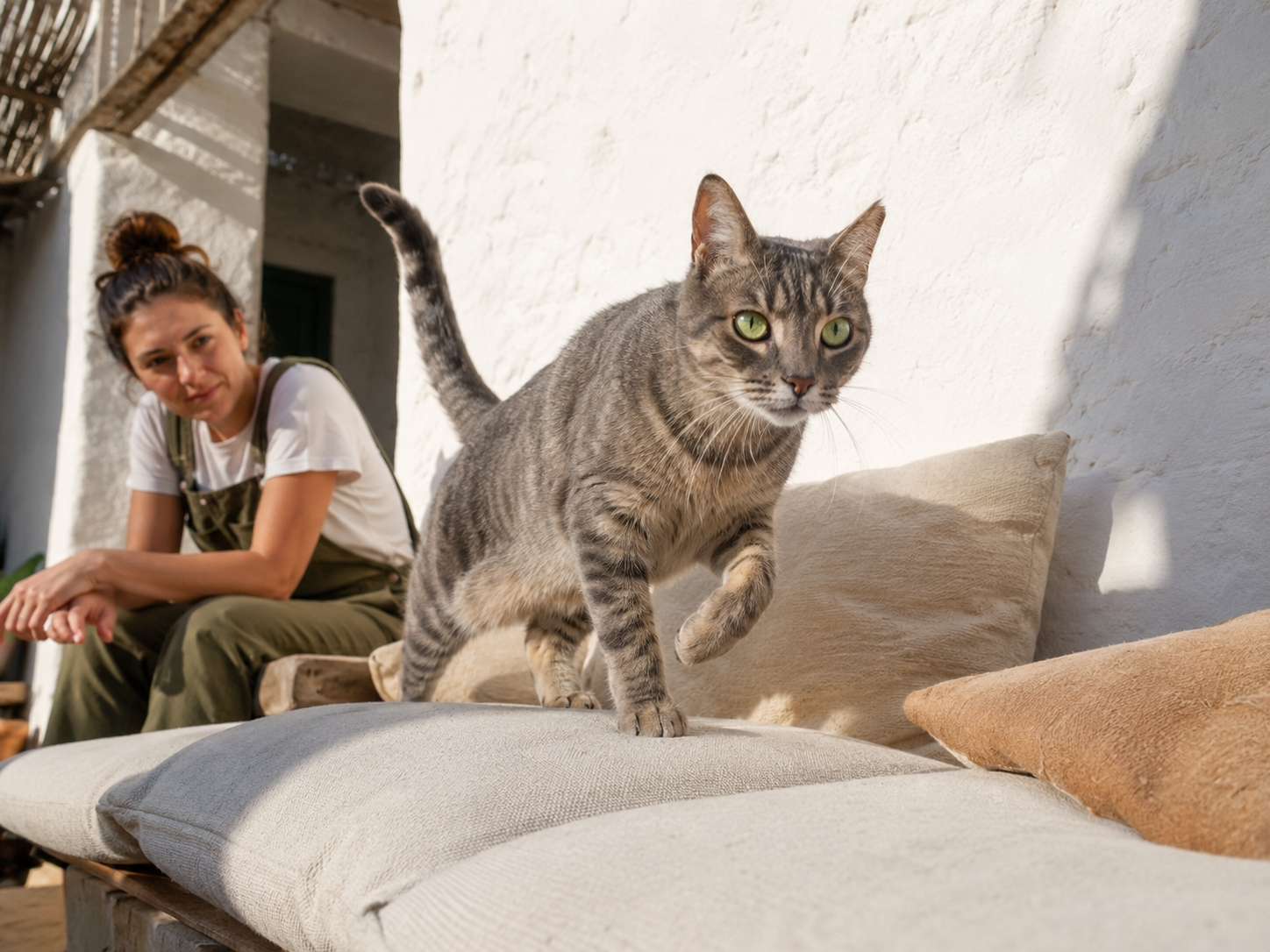
The famous thing about cats is that they land on their feet. The scientifically interesting thing is how. When a cat trips mid-stride, it does not simply correct the leg that slipped. It recruits muscles across its entire body, redistributing its weight onto the three legs still planted, and rebalances the whole system in a fraction of a second. That whole-body reflex, not the flashy midair righting, is what has caught the attention of researchers trying to help people with spinal cord injuries walk again.
The distinction matters, because it reframes the whole problem. Restoring walking after a partial spinal injury is not about repairing one weak leg. It is about restoring the coordinated, body-wide response that keeps an animal upright when something goes wrong, and the cat happens to be one of the best windows we have into how that response is built.
What the researchers actually found
In work from a Georgia Institute of Technology lab, researchers lightly stimulated the sensory nerve that carries touch from the top of a cat’s back foot, mimicking the feeling of clipping an obstacle mid-step, and watched how the animal rebalanced. The cats, being cats, kept their footing. They did it not by bracing the touched leg but by adjusting muscles throughout the body.
The biggest corrections showed up in the back leg on the opposite side from the one that was touched. Those muscles fired harder to bend the knee and hip, the cats lifted their toes higher, bent their joints more, lengthened their stride, and kept their feet off the ground a beat longer, all to clear the imagined obstacle and stay balanced.
Crucially, timing mattered. The team applied the touch at different points in the walking cycle and found the response was strongest during the swing phase and the transition out of stance, the moments when a foot is off the ground and most vulnerable to a trip. That specificity is a big part of what makes the work useful.
What is fascinating is that the cat does not just fix the leg that slipped. It recruits muscles all over the body to stay upright, and it does it precisely when in the step it is most needed. That whole-body, well-timed coordination is exactly what we would love to help restore in people.
Why a cat, and not a mouse
Scientists have studied the neurological control of movement extensively in mice. But for these particular questions, cats are a far better stand-in for humans, and the reason is posture. Mice move in a low crouch, which makes them unlikely to fall or struggle with balance no matter what their limbs are sensing. Cats, like people, walk upright on their legs and rely on sensory feedback from those limbs to stay balanced. So what happens in a cat’s body when it stumbles is much closer to what happens in ours than anything you would see in a mouse.
That overlap is what makes the work promising. The idea is that the way touch activates spinal circuits could help people with spinal cord injuries by improving nerve function below the injured region. If researchers can map precisely how balance is coordinated, they get closer to reactivating the connection between a person’s brain and spinal cord below an injury.
Where this sits in a fast-moving field
This study is one thread in a much larger, rapidly advancing effort to restore movement after spinal cord injury. In parallel work, teams using targeted electrical stimulation of the spinal cord and brain-spine neural interfaces have helped some paralyzed people stand and take steps again, results that were barely imaginable a decade ago. Animal models that capture whole-body balance, the cat among them, remain valuable precisely because they reveal the sensory feedback loops those stimulation approaches are trying to reawaken.
The practical hope has not changed: the more precisely we understand how balance is coordinated across the whole body, the closer we get to helping people regain it. So our cats have, in their aloof and accidental way, contributed something real. They are far too busy ignoring us to accept the thanks.
References
- Merlet, A. N., et al. “Sensory perturbations from hindlimb cutaneous afferents generate coordinated functional responses in all four limbs during locomotion in intact cats.” eNeuro, 2022. https://www.eneuro.org/content/9/1/ENEURO.0178-21.2021
- “Cat Locomotion Could Unlock Better Human Spinal Cord Injury Treatment.” Georgia Institute of Technology. https://research.gatech.edu/cat-locomotion-could-unlock-better-human-spinal-cord-injury-treatment
- Lorach, H., et al. “Walking naturally after spinal cord injury using a brain-spine interface.” Nature, 2023. https://www.nature.com/articles/s41586-023-06094-5
Not a substitute for your vet. Our guidance is educational. For urgent symptoms, contact a vet or emergency clinic right away. Editorial standards
Dr. Mehta is a board-certified veterinary nutritionist who evaluates pet food formulations, ingredient quality, and the science behind dietary trends. He writes and reviews all nutrition content at The Pet Times, including our food rankings and feeding guides.
Meet our experts ↗Keep reading
 Health & WellnessYour Litter Box Isn't the Threat. Your Cutting Board Is.Dr. Priya Nair · 7 min
 Health & WellnessIf You Can Smell Your Cat's Fart, Your Cat Is Telling You SomethingDr. Amara Solis · 6 min
 Health & WellnessThe Bird Flu Blind Spot Isn't Your Cat. It's That Nobody's Watching CatsDr. Mara Chen · 5 min
 Health & WellnessBright Red or Dark and Tarry? The Detail That Tells You How Worried to Be About Cat StoolDr. Mara Chen · 6 min
 Health & WellnessYes, Female Cats Spray. Spaying Doesn't Always Stop It.Dr. Lena Park · 7 min
 Health & WellnessYour Cat's Litter Box Is a Daily Health Report. Learn to Read It.Dr. Nina Kohl · 8 min