


Your Cat Can Tell You're Sick. Empathy Has Little to Do With It.
That bedside vigil when you're ill feels like devotion. The likelier explanation is your cat reading your smell and your routine like a book, which is arguably more impressive.

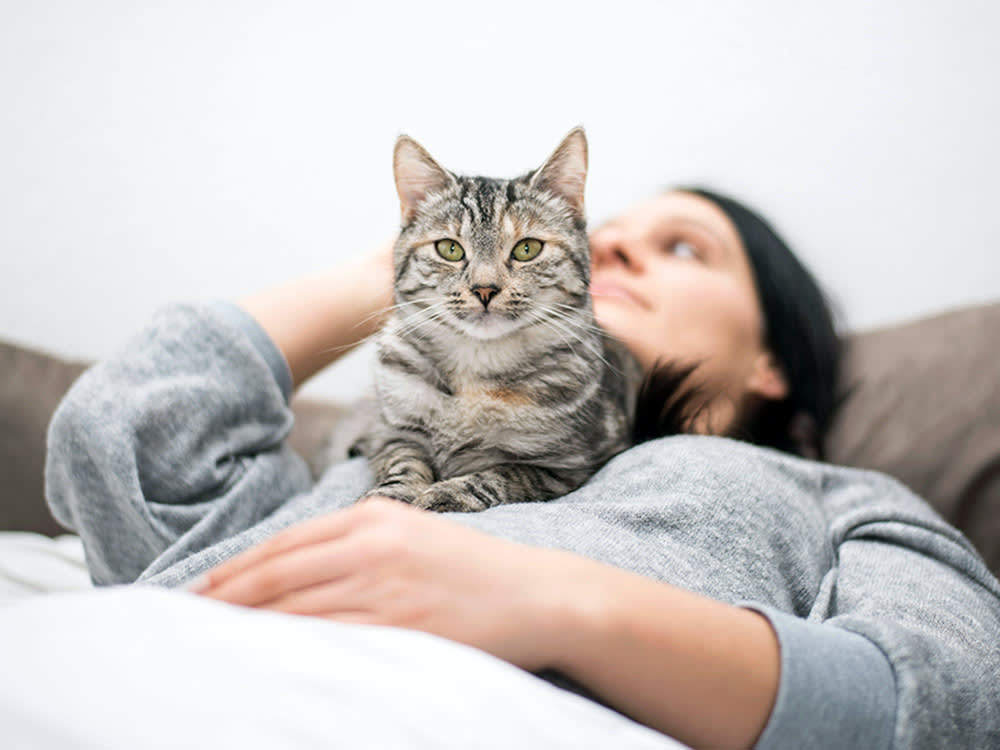
You are sick, buried under a blanket, and your cat will not leave your side. It is tempting to read that as devotion, your aloof roommate finally showing they care. The more likely truth is less sentimental and, honestly, more interesting: your cat has almost certainly noticed you are unwell, but through their nose and their sharp sense of routine, not through worry. Cats are not tiny nurses. They are exceptional change detectors, and illness sets off a lot of change.
The honest state of the science
Start with a caveat most articles skip: there is very little direct research on whether cats can detect human illness. Nobody has run the kind of studies on cats that exist for dogs. So the fully honest answer is that we cannot prove it.
But we can reason from what we do know about feline biology and behavior, plus a mountain of owner reports, and that combination points fairly clearly in one direction. Cats can very probably tell when something is “off” with their person. The debate is really about how, not whether.
Reading you by smell
Dogs are the famous medical detectors. They have been shown to sniff out certain cancers, Parkinson’s disease, and infections like malaria, to sense drops in a diabetic person’s blood sugar, and to alert before some seizures. They pull this off because illness changes the body’s chemistry, releasing volatile organic compounds, or VOCs, and shifting hormone levels that a powerful nose can pick up.
A cat’s sense of smell is not as sharp as a dog’s, but it is far keener than ours and tuned to a wide range of scents. There is no reason to think the same VOCs and odor changes that dogs detect would be invisible to a cat. The prevailing view among behavior experts is that cats are perfectly capable of smelling the chemical signature of illness, even if we have not formally tested it.
People want the answer to be that their cat senses their pain and comes to comfort them, and I never want to crush that, because the bond is real. But mechanically, what a cat is likely doing is detecting a change, in how you smell, how you move, how your day is structured, and responding to the change. Noticing you’re different is a genuine skill. It just isn’t the same thing as sympathy.
Reading you by routine
Smell is only half of it. The other half is that cats are relentless observers of pattern. They thrive on predictability and notice immediately when the normal rhythm of the household breaks.
When you are sick, that rhythm breaks in obvious ways. You spend far more time in bed or on the couch. You may be slower with meals and less on top of litter box scooping. To a creature that tracks the day’s routine closely, every one of those shifts is a flashing signal that something has changed. Your cat does not need a diagnosis to register that today is not like other days.
So why the cuddling?
Here is where the comforting story and the practical one meet. Yes, your cat may be drawn to you when you are unwell. But part of the reason is delightfully unromantic: a sick person is a still, warm, available person. You are lying down more, moving less, and radiating heat under a blanket, which is close to a cat’s idea of a perfect nap spot. More rest on your part simply means more opportunity for your cat to settle in against you.
That does not rule out genuine attachment. It just means the snuggle you are getting is likely a blend of “I sense you’re different” and “you finally stopped moving around.”
The famous stories
Anecdotes are not evidence, but a few are hard to ignore. The best known is Oscar, a cat at a Rhode Island nursing home who reportedly had an uncanny habit of curling up beside residents in their final hours, and was credited with anticipating more than a hundred deaths before his own passing in 2022. Whether he sensed subtle chemical changes as the body declined or simply noticed people going very still, no one can say for sure. In another widely shared story, a woman credited her cat with drawing her attention to a lump that turned out to be breast cancer.
Stories like these live at the extreme end. But nearly every cat owner has a smaller version, a pet who seemed to know when they were hurting and stuck close. Taken together with the biology, they make a reasonable case.
What’s new since this was written
The research gap has not closed much: cats remain far less studied than dogs when it comes to detecting human illness. But the broader field of medical scent detection keeps growing, with dogs and even electronic “e-nose” sensors being explored for spotting disease by smell. Every finding there strengthens the plausibility of the feline version, since it confirms that illness really does leave a detectable scent trail.
The practical takeaway for cat parents is simple and kind. Your cat probably does clock when you are unwell, through senses far better than yours. You do not need to decide whether it counts as love. Enjoy the company, rest up, and let them have the warm spot.
References
- Understanding Animal Research. “The science of sniffs: disease-smelling dogs.” understandinganimalresearch.org.uk
- Dosa, D.M. “A Day in the Life of Oscar the Cat.” New England Journal of Medicine. nejm.org
- International Cat Care. “The cat’s senses: smell.” icatcare.org
Common questions
Do cats sense illness by smell?
Probably in part. Illness changes body odor and releases volatile organic compounds, and cats have a keen sense of smell that can likely detect those shifts, similar to how dogs are known to.
Is my cat cuddling me because they're worried?
Maybe, but there's a simpler reason too: when you're sick you rest more and stay still longer, which gives your cat more warm, quiet opportunities to curl up with you.
Dr. Kohl is a board-certified veterinary dentist with a particular interest in preventive oral care. She reviews all dental health content at The Pet Times and contributes practical guides on home dental routines, professional cleaning, and oral disease prevention.
Meet our experts ↗Keep reading
 LivingShe Sued the Blue Angels Over Her Dying Cat. The Noise Science Is RealMarcus Webb · 5 min
 LivingA Robotaxi Killed a Beloved Bodega Cat. Five Weeks Later It Ran Over a Dog.Nina Vasquez · 4 min
 Health & WellnessCat Scratch Fever Isn't a Rock Song. It's a Real Infection (You Still Don't Need to Panic).Dr. Nina Kohl · 5 min
 LivingYour Kid Isn't Scaring the Cat on Purpose. Here's the Fix.Dr. Nina Kohl · 6 min
 LivingWhy CatVideoFest Won't Cut One Big Check: The Case for Hyperlocal CharityJames Okafor · 6 min
 LivingNobody Gives Up a Cat They Love on a Whim. Here Are the 5 Real Reasons, and the Fixes.Dr. Amara Solis · 6 min