


Bone Broth Won't Rebuild Your Dog's Joints. Here's What It Actually Does.
Bone broth is marketed as a joint-healing superfood for dogs. The science is more modest, and more useful. Here's what it genuinely helps with, what it doesn't, and a vet-friendly recipe to make at home.

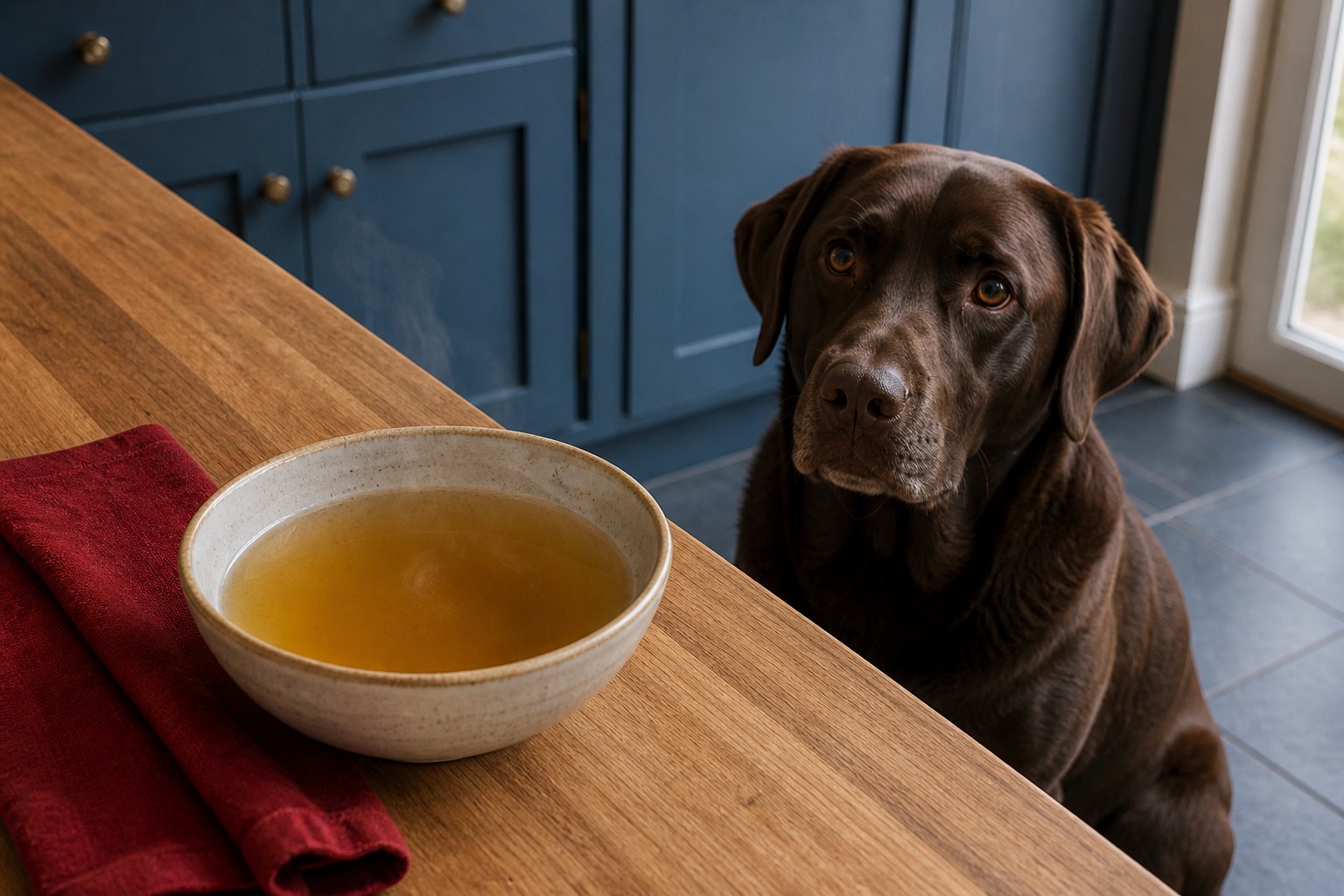
Bone broth has become the wellness world’s favorite potion, and where humans go, the dog aisle follows. It’s now sold as a superfood that heals joints, seals “leaky gut,” and turbocharges immunity. Some of that holds up. A lot of it is marketing running well ahead of the evidence. So let’s do the useful thing and separate what bone broth genuinely does for your dog from what the label wants you to believe, and then make some.
What bone broth actually is
At its heart, bone broth is nothing exotic: a mineral-dense stock you get by simmering bones, usually alongside dog-safe herbs and vegetables, for an unusually long time, upward of a full day in a traditional recipe. That marathon cook is the whole point, and it’s what separates broth from stock. Stock simmers for maybe two to four hours; bone broth goes long enough that the bones themselves start to crumble, extracting as much collagen and mineral content from the bones and connective tissue as possible. (An instant pot can shortcut it to roughly four and a half hours.) The result is a nutrient-dense, easily absorbed, genuinely tasty liquid most dogs adore.
The honest version of the benefits
Here’s where careful reading matters, because the gap between “contains” and “delivers a meaningful dose” is where the hype lives.
Joints. Bone broth contains glucosamine, chondroitin, and hyaluronic acid, the same compounds in joint supplements, which is why it’s pitched for arthritis and mobility. The catch is quantity: the amounts that end up in a bowl of broth are well below the doses used in the clinical studies that show a joint benefit. Broth may support comfort at the margins; it is not a substitute for a proper joint supplement or veterinary treatment.
Bones and muscle. The collagen in animal bones breaks down during that long cook into gelatin, supplying protein and the amino acids proline and glycine. Interestingly, the strongest research isn’t on broth itself but on hydrolyzed collagen peptides, which are absorbed intact and appear to accumulate in cartilage. Broth gives you some of these building blocks, just in gentler concentrations than a targeted supplement.
Gut. Glutamine, another amino acid in broth, helps support the intestinal lining, and animal research suggests the gelatin and amino acids can protect the digestive mucosa and lower inflammation. For a dog with a stressed or irritated gut, that’s a plausible, modest help, not a cure for a diagnosed condition.
Hydration and recovery. This is where bone broth genuinely shines, and it’s the least glamorous claim. For a dog bouncing back from diarrhea or a stint of not eating, broth is hydrating, gentle on the stomach, and appetizing enough to coax a picky or nauseated dog into taking in fluids and calories. It’s also a great way to rehydrate freeze-dried food or entice a senior with a fading appetite.
I love bone broth as a hydration tool, an appetite booster, and a bland-diet helper, and I’m honest with clients that it won’t reverse arthritis or hip dysplasia. Think of it as a supportive extra on top of a complete diet, not a treatment. If your dog has a real joint or gut problem, we dose the actual therapeutic, and broth rides alongside it.
The safety line that matters most
Only ever give your dog homemade broth or a product formulated for pets. Human bone broth is frequently made with onions and garlic, both toxic to dogs, so it’s off-limits. And whatever you do, never feed the cooked bones themselves, which can splinter.
A vet-friendly recipe
This simple marrow-broth recipe makes it easy to add minerals and moisture to your dog’s meals. It’s adapted from a whole-food canine nutrition guide (credited below).
Ingredients
- 3 to 4 pounds (or more) raw marrow bones (chicken, turkey, rabbit, beef, pork, or oxtail)
- 3 inches of ginger root, sliced
- 2 ounces of curly parsley, chopped (only curly, other types can be problematic)
- 4 ounces of shiitake mushrooms
- 2 stalks of celery, chopped
- 1/4 cup raw apple cider vinegar (it helps draw minerals and marrow out of the bones)
- 6 quarts of water
Directions
- Combine everything in a big stockpot, a slow cooker, or an instant pot.
- Cook on low for 12 to 24 hours: about 12 hours at a stove simmer, 24 hours in a slow cooker on low, or 3 to 4 hours in an instant pot.
- Let it cool, then remove and discard the bones. (Never feed cooked bones.)
- Refrigerate so the fat rises to the top, then skim and discard it.
A note on efficiency: raw bones are ideal, but you can toss in already-cooked bones (from, say, a roast) to squeeze out the last of their nutrients, knowing some have already been lost.
Serving and storing
Any vegetables or meat you strain out can be spooned onto meals as a topper. Store the broth in an airtight container in the fridge for up to a week, or freeze it for up to 12 months. Freezing it in ice cube trays is the pro move: you get single-serving portions ready to thaw and warm.
How much? Introduce it slowly, as with any new food, and watch for any reaction. For small dogs (roughly 15 to 30 pounds), a couple of tablespoons stirred into a meal is plenty, warming the food up nicely from the fridge. If your dog tolerates it well, you can scale up with size, to a ceiling of about six ounces a day for large breeds.
Bonus: a summer pupsicle
When it’s hot, turn broth into a cooling treat with the same nutrients as the warm version. Make the chicken broth as above, remove the bones and grind them fine in a food processor, return the ground bone to the broth and mix, then pour into a silicone mold and freeze. Instant frozen reward.
What newer research adds
The most current takeaway is a helpful gut-check on the hype: reviews of bone broth for dogs consistently note that its glucosamine, chondroitin, and collagen concentrations fall short of the therapeutic doses shown to move the needle on joint disease, and that broth itself, as opposed to its isolated components, simply hasn’t been rigorously studied. That’s not a reason to skip it. It’s a reason to use it for what it reliably delivers, hydration, palatability, and easy nutrition during recovery, while leaving diagnosed joint or gut conditions to your vet and a properly dosed treatment. Broth is a lovely support tool. It was never a shortcut.
References
- Morgan, Judy, DVM, and Hue Grant. “Yin & Yang Nutrition for Dogs: Maximizing Health with Whole Foods, Not Drugs.” Thirty-Six Paws Press. (Recipe adapted, used with permission.)
- American Kennel Club. “Bone Broth for Dogs: A Superfood With Many Benefits.” https://www.akc.org/expert-advice/health/bone-broth-for-dogs/
- Comblain, F., et al. “A Randomized, Double-Blind, Placebo-Controlled Study of the Efficacy of a Diet Supplemented with Collagen Hydrolysate in Dogs.” Veterinary literature on collagen supplementation. https://pubmed.ncbi.nlm.nih.gov/28542871/
Not a substitute for your vet. Our guidance is educational. For urgent symptoms, contact a vet or emergency clinic right away. Editorial standards
Dr. Mehta is a board-certified veterinary nutritionist who evaluates pet food formulations, ingredient quality, and the science behind dietary trends. He writes and reviews all nutrition content at The Pet Times, including our food rankings and feeding guides.
Meet our experts ↗Keep reading
 Product PicksDad Grass Made a CBD Bone and a CBD-Free 'Joint' Toy. For Most Dogs, Buy the ToyDr. Mara Chen · 5 min
 FoodThe Store-Bought Cracker Is Wrecking Your Dog's Snack. This 4-Ingredient Biscuit Fixes It.Dr. Priya Nair · 5 min
 Health & WellnessThe Joint Supplement in Every Pet Aisle May Do Nothing. The Science Is Brutal.Dr. Ravi Mehta · 6 min
 FoodCamelina Oil for Dogs: A Real Coat Booster That Can't Replace Fish OilDr. Mara Chen · 5 min
 FoodDump-and-Go Crockpot Dog Dinner: Chicken, Rice, and Almost No EffortDr. Priya Nair · 4 min
 FoodCooking for Your Dog Is the Easy Part. Balancing It Is Where People Fail.Dr. Priya Nair · 7 min