


Dad Grass Made a CBD Bone and a CBD-Free 'Joint' Toy. For Most Dogs, Buy the Toy
The hemp brand Dad Grass now sells a CBD dog bone and a plush toy shaped like a pack of joints. Here's an honest look at both, what the research actually says about CBD for dogs, and the label checklist that separates a legit product from a scam.

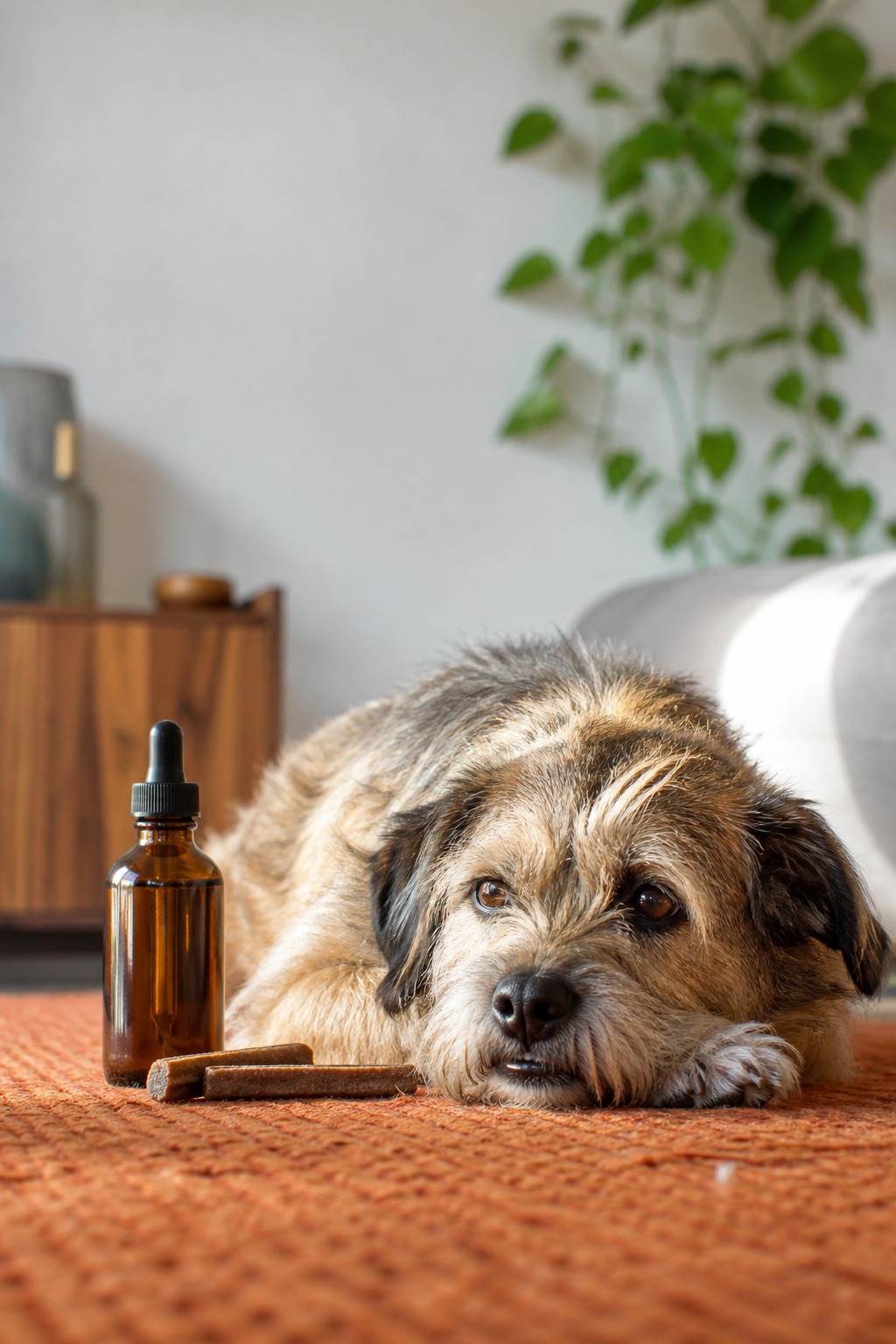
Dad Grass, the hemp brand known for straightforward, non-intoxicating pre-rolls and a late-’60s aesthetic, has launched two products for dogs: a CBD-infused bone and a plush pack of toy “joints” that contains no CBD at all. Here is the slightly contrarian buying advice up front. For most dogs, the CBD-free toy is the smarter purchase, and if you do want to try actual CBD, the brand on the bag matters far less than whether the product can prove what is in it. Let’s take both in turn.
The two products, honestly
The CBD bone carries four milligrams of the same organic, full-spectrum CBD the brand uses in its human edibles. The recipe is dairy-free, gluten-free, 100 percent vegan, and pumpkin-flavored, and the packaging is fully compostable. Four milligrams is a low, single-treat dose, which is fine for a cautious trial but worth understanding (more on the dosing math below).
The plush toy joints contain no CBD whatsoever. It is simply a squeaker toy that looks like something between a pack of cigarillos and a deck of cards, letting your dog in on the joke without ingesting anything. For the many dogs whose owners are curious about the aesthetic but unsure about the supplement, this is the low-stakes pick, all vibe, no pharmacology.
Dad Grass launched in mid-2020 and quickly built a following; for the dog line it enlisted LA photographer Scottie Cameron for a shoot the brand dubbed “Doggy Styles: Vol. 1,” pups posed with vintage TVs, record players, and Fender guitars. “You just have to give into the madness and hope for the best,” Cameron told Dad Grass about shooting dogs. “Luckily dogs are truly wonderful and even when they’re being insane you get great pictures.” The branding is charming. It is also not evidence that the CBD works, which is a separate question.
What the research actually says
CBD for dogs is genuinely promising and genuinely unsettled, and both halves of that sentence matter. The most-cited controlled work, a randomized, placebo-controlled, blinded crossover study out of Cornell, found that 2 mg of CBD per kilogram of body weight, given twice daily, significantly increased comfort and activity in dogs with osteoarthritis, with no major side effects beyond a rise in a liver enzyme (alkaline phosphatase). A 2024 double-blind, placebo-controlled crossover study went further, examining CBD with and without NSAIDs in dogs with mobility problems, part of a growing body of research supporting modest benefits for arthritis pain and, in some cases, as an add-on for certain seizure disorders.
That is real support, but note the dose. Two milligrams per kilogram twice daily means a 20-kilogram (44-pound) dog would need about 40 mg per dose in the studies, ten of these 4 mg bones. The bone is a treat, in other words, not a therapeutic dose, which is another reason to think of it as a novelty rather than medicine.
The early research on CBD for dogs is real, especially for arthritis pain and some seizure cases, but it isn’t a regulated medication, and product quality is all over the map. Loop in your vet before you start, particularly if your dog is on other medications, because CBD can interact with them and can bump liver enzymes. And be honest with yourself about dose, a single low-CBD treat is very different from what the studies actually used.
The label checklist that separates real from junk
The biggest problem in this category is not whether CBD can help, it is that the CBD-for-pets market is largely unregulated, and independent testing repeatedly finds products whose real CBD content does not match the label, sometimes wildly. Before you buy any CBD product for your dog, from any brand, run this checklist:
- A current third-party Certificate of Analysis (COA). The single most important item. A legitimate product links to recent lab results confirming the actual CBD content and, crucially, that THC is at or near zero. No COA, no purchase.
- CBD content stated in milligrams, per treat or per milliliter. If you cannot calculate a dose, you cannot use it responsibly.
- A THC check. THC is toxic to dogs. Full-spectrum products should show trace-or-zero THC on the COA; if the number is not there, walk away.
- Contaminant screening. The COA should also cover pesticides, heavy metals, and solvents, since hemp readily absorbs contaminants from soil.
- Realistic claims. Any product promising to “cure” anxiety, cancer, or seizures is lying. The honest framing is “may help,” under veterinary guidance.
The bottom line
CBD is not a scam, but the market around it often is, and a 4 mg pumpkin bone is a treat with a good story rather than a treatment. If your dog has arthritis or another condition you are hoping CBD might ease, the productive move is a conversation with your vet about a properly dosed, lab-verified product, not a novelty bone. And if you mostly liked the idea, buy the toy: it delivers the whole joke at zero risk.
This article is here to share information, not to serve as medical advice. Talk with your veterinarian before making decisions about your dog’s health.
References
- Gamble, Lauri-Jo, et al. “Pharmacokinetics, Safety, and Clinical Efficacy of Cannabidiol Treatment in Osteoarthritic Dogs.” Frontiers in Veterinary Science, vol. 5, 2018. https://doi.org/10.3389/fvets.2018.00165
- “Evaluation of the Effect of Cannabidiol Administration With and Without Nonsteroidal Anti-Inflammatory Drugs in Dogs With Mobility Disorders.” Frontiers in Veterinary Science, 2024. https://doi.org/10.3389/fvets.2024.1449343
- U.S. Food and Drug Administration. “FDA and Cannabis-Derived Products.” https://www.fda.gov/news-events/public-health-focus/fda-regulation-cannabis-and-cannabis-derived-products
Not a substitute for your vet. Our guidance is educational. For urgent symptoms, contact a vet or emergency clinic right away. Editorial standards
Dr. Chen is a small-animal veterinarian who leads health and safety coverage at The Pet Times. She writes and reviews the bulk of our illness, condition, and safety content, translating clinical guidance into clear, practical advice owners can act on at home.
Meet our experts ↗Keep reading
 Product PicksHolistic Pet Products: What's Actually Worth It, and What's Just WooDr. Ravi Mehta · 7 min
 FoodCamelina Oil for Dogs: A Real Coat Booster That Can't Replace Fish OilDr. Mara Chen · 5 min
 FoodNobody Checked That Calming Chew Before It Hit the ShelfDr. Priya Nair · 7 min
 FoodSkip the Supplement Aisle. Your Dog Gets These From Real Food.Dr. Amara Solis · 6 min
 FoodCranberry Pills Won't Cure Your Dog's UTI. Here's What They Might DoDr. Priya Nair · 6 min
 Health & WellnessThe Joint Supplement in Every Pet Aisle May Do Nothing. The Science Is Brutal.Dr. Ravi Mehta · 6 min