


Pet-Safe Flooring, Ranked by How Your Dog Actually Uses the Floor
Your dog breathes, licks, and naps at floor level all day. Here is how to choose flooring around traction, off-gassing, and cleanup, with the materials that win on each.

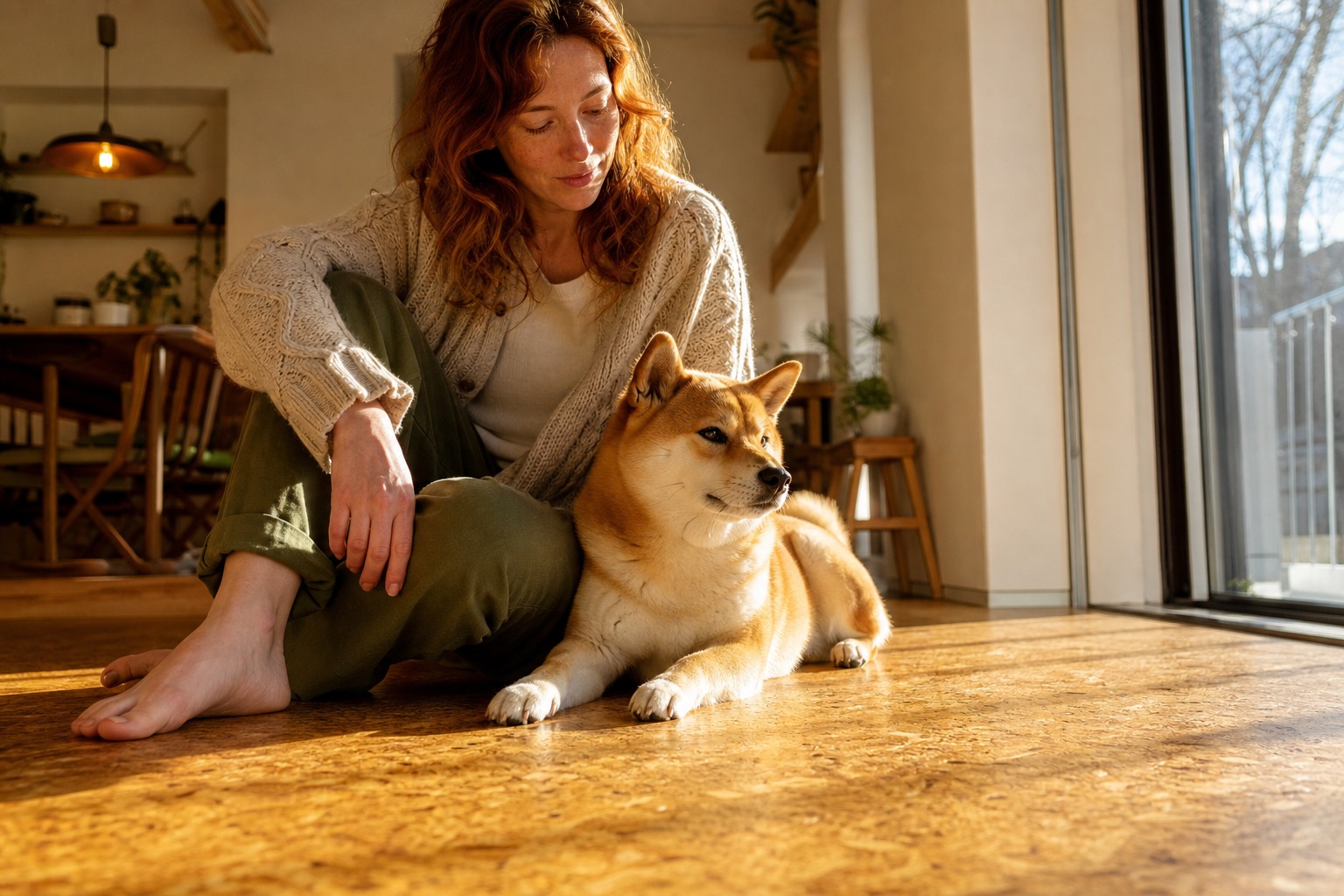
Most flooring guides are written for the person standing five feet up, choosing a color. Your dog lives somewhere else entirely. They spend roughly half the day in contact with the floor, breathe the air that pools in the lowest twelve inches of the room, and will, given the chance, lick whatever is down there. So the right question is not “what looks good and resists scratches.” It is “what does this surface do to an animal who breathes it, walks on it, and naps on it all day.” Sort flooring that way and the rankings shift. The two things that matter most to a dog, traction underfoot and what the material puts into the air, are exactly the two things décor-first guides skip.
The Three Things a Floor Does to a Dog
Before any material, get clear on the jobs a floor performs from a dog’s point of view, because every material is a trade-off across them.
Traction comes first, and it is the one owners underestimate. A floor that is too slick forces a dog to splay their legs to stay upright, which over years stresses hips, knees, and elbows, and for a senior or a large breed it turns getting up into a daily struggle. Polished hardwood and glossy tile are the worst offenders here. A floor your dog can grip is, for an aging dog, as much a health choice as a comfort one.
Air quality comes second, and it is invisible, which is why it gets ignored. Flooring and its adhesives off-gas volatile organic compounds, and because VOCs are heavier-than-air and settle low, a dog inhales a higher concentration than you do standing up. Veterinary and indoor-air sources link VOC exposure in pets to eye, nose, and throat irritation, and chronic exposure is associated with more serious effects on the liver, kidneys, and nervous system. A dog who naps on the floor eight hours a day is the household member most exposed.
Cleanup comes third. Pets bring in water, mud, dander, and the occasional accident. A floor that needs harsh chemical cleaners to stay sanitary trades one hazard for another, since most conventional floor cleaners are not safe for an animal that licks its paws and the baseboards.
A genuinely pet-safe floor wins on all three. Here is how the common materials actually score.
Cork: The Best All-Around Pet Floor
Cork is the surface most owners have never considered and the one that most often wins. Harvested from the bark of the cork oak, which regrows every decade or so without the tree being cut, it gives underfoot, so it is gentle on joints and quieter under nails. It is naturally resistant to mold and mildew, which matters in a home with water bowls and damp paws, and it has real grip, so a dog is not skating across it. The catch: it can dent under heavy furniture and needs a low-VOC sealant refreshed every few years to stay water-resistant. For an aging dog or a multi-dog household, the cushioning alone makes it worth that maintenance.
Tile and Stone: The Cleanup Champion
Ceramic, porcelain, glass tile, and natural stone are nearly indestructible and the easiest surfaces to keep sanitary, which is why they belong wherever messes concentrate, the kitchen, the mudroom, the spot under the water bowl. They off-gas essentially nothing. Their weakness is the dog’s weakness: they are hard and, when glossy, slick. Choose a matte or textured finish for grip, and put a washable runner or a few rugs along your dog’s main routes so a senior is not navigating a skating rink. In a bathroom or entryway, tile is hard to beat.
Bamboo and FSC-Certified Wood: The Looks-Like-Wood Pick
If you want the warmth of wood, two versions clear the pet bar. Bamboo, a fast-growing grass rather than a tree, is harder than most hardwoods and can be sanded and refinished several times. Genuine hardwood works too, provided it is FSC-certified (so it came from a responsibly managed forest, not old growth) or, better, reclaimed. Both should be finished with a zero- to low-VOC, plant-based sealant. The shared caveat is traction and water: a high-gloss finish is slippery, and standing water from a tipped bowl will eventually warp even sealed wood, so wipe spills fast and skip the glossy sheen.
Linoleum: The Antibacterial Workhorse
True linoleum, made from linseed oil and not to be confused with vinyl, is naturally antibacterial and antistatic, so it repels dust and dander rather than collecting them, a real advantage in an allergy-prone household. It comes in nearly any color, gives slightly underfoot, and cleans easily. It does off-gas linoleic acid as it cures, which is far milder than vinyl’s emissions and fades over the first weeks. For a busy kitchen or a home with a shedding dog, it is an underrated choice.
Why Vinyl Sits at the Bottom
Vinyl is cheap, comes in endless patterns, and is genuinely tempting, which is why it deserves a clear warning rather than a shrug. Polyvinyl chloride is one of the most environmentally hazardous consumer materials in production: manufacturing it releases dioxin, among the most toxic chemicals known, and the finished plank off-gasses both VOCs and the slower, longer-lasting SVOCs that settle into household dust, exactly the dust a floor-dwelling dog breathes and ingests. The Healthy Building Network rates PVC among the worst materials for a home. If budget forces vinyl, insist on a certified low-VOC product and ventilate hard for the first weeks, when emissions peak, but in a home built around a dog’s health, it is the material to design out.
Cost: Pet-Safe Rarely Means Expensive
The assumption that the healthy option costs more does not hold. Cork, linoleum, and matte tile run comparable to mid-grade vinyl, and several pet-safe choices are cheaper than premium hardwood. Where a green choice costs more upfront, it usually earns it back: durability that outlasts the replacement cycle, or, for any energy-efficiency upgrade you bundle in, lower monthly bills.
Cleaning Any Pet Floor Safely
Whatever you install, clean it with something safe to lick. Plain white vinegar, a half cup per gallon of warm water, is one of the oldest and cheapest options and works on cork, tile, linoleum, and sealed wood alike. Skip aerosol cleaners, fragranced “fresh” sprays, and anything with a warning to keep pets off until dry, since a dog will be nose-down on that surface long before it has aired out.
A Quick Glossary
FSC-certified. The Forest Stewardship Council label certifies that wood came from a well-managed forest rather than old growth.
Off-gassing. The release of vapors from a material. Interior-grade plywood emits urea formaldehyde, a carcinogen, so use exterior-grade where you can.
VOCs. Volatile organic compounds go airborne at room temperature and are a leading source of indoor air pollution. Because they settle low, a floor-level dog inhales more than you do.
SVOCs. Semi-volatile organic compounds off-gas more slowly than VOCs and bind to household dust, which pets ingest through grooming. They are a particular concern with vinyl.
Rapidly renewable resources. Materials like bamboo and cork that regrow faster than we use them.
References
- “Volatile Organic Compounds’ Impact on Indoor Air Quality.” U.S. Environmental Protection Agency.
- “Indoor Air Quality and Pets.” Animal Wellness Magazine.
- “PVC: The Poison Plastic.” Healthy Building Network.
- “Forest Management Certification.” Forest Stewardship Council.
Leila Torres leads our Living coverage, from home life and travel to the products and rescue stories that come with sharing a life with animals. She edits and writes across the section, with a soft spot for pieces about the bond between people and their pets.
Meet our experts ↗Keep reading
 Product PicksThe World's Happiest Country Also Makes the Case for a Tiny Dog WardrobeTom Hadley · 6 min
 Product PicksThis Pet Brand Recycled 500,000 Water Bottles Into Dog Beds, and Made Them CuteNina Vasquez · 6 min
 LivingPet Composting: Turning Your Pet's Remains Into New LifeClaire Sutton · 9 min
 Living'Pet-Safe' Is a Marketing Word. Read the Label Instead.Dr. Nina Kohl · 7 min
 LivingPet-Safe Cleaning Is About How You Clean, Not Just What You BuyNina Vasquez · 6 min
 LivingYour Pet's Toy Pile Is Working Against YouNina Vasquez · 6 min