


A Major Museum Put 130 Pet Photos on Its Walls and Dared You to Call It Frivolous
Fotografiska New York's 'Best in Show' took the thing we're all a little embarrassed about, loving our pets to the point of madness, and treated it as serious art. Two dozen photographers, an animal-welfare mission, and a surprisingly moving argument about why the obsession matters.

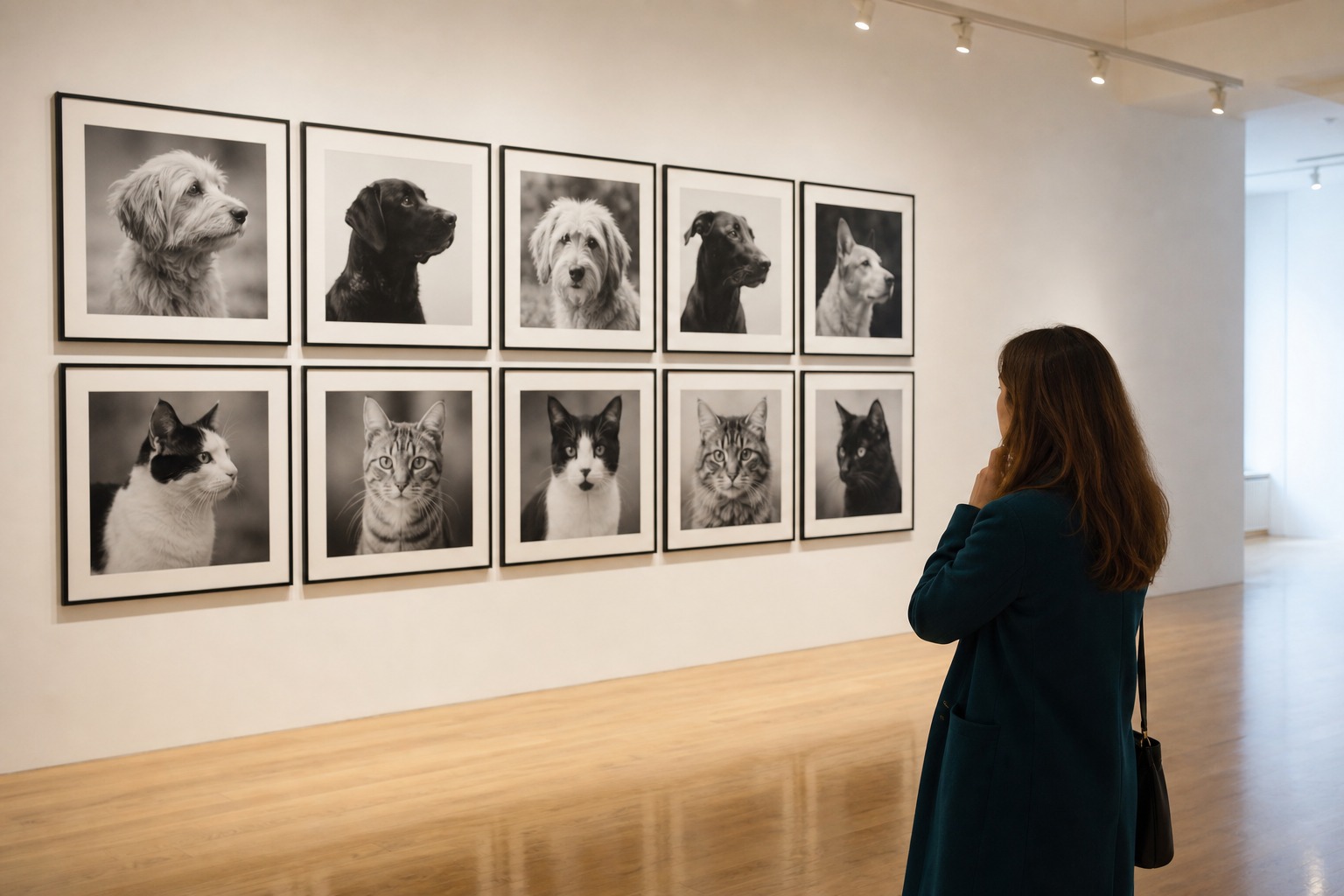
Say the words “best in show” and most people’s minds go straight to Christopher Guest’s 2000 mockumentary, all those impeccably deranged owners loving their dogs into oblivion. The joke of that film lands because it isn’t really a joke: the people are ridiculous, and they’re also all of us. Anyone who has narrated an inner monologue for their cat knows the line between devotion and lunacy is thinner than we like to admit.
In the fall of 2023, Fotografiska New York built an entire exhibition on exactly that thin line, and refused to treat it as a punchline. “Best in Show: Pets in Contemporary Photography,” which opened September 22, 2023, and ran into January 2024, gathered the work of roughly two dozen photographers across two floors of the museum, more than 130 images alongside video installations and sculpture, all pointed at a single question most galleries would consider too soft to hang on a wall: what is this thing we feel for our animals, and why is it so powerful?
Taking the obsession seriously
The premise was a small act of nerve. Pet love is easy to dismiss as sentimental, the stuff of greeting cards and phone wallpapers. Fotografiska’s argument was that it’s actually one of the more revealing relationships in modern life, and worth the same scrutiny a museum would give any other subject.
The show’s framing traced the surge in pet devotion to the pandemic, when households across big cities filled with newly adopted animals and the sidewalks became, as the museum’s leadership put it, nearly impossible to walk without passing a parade of dogs and their smitten people. From that cultural moment, the exhibition fanned out to explore how our animals stand in for things much larger than themselves, status, loyalty, comfort, power, and how the bond looks different through two dozen very different lenses.
The roster mixed legends with contemporary voices. William Wegman, forever associated with his impeccably deadpan Weimaraners, hung alongside Elliott Erwitt, the great humanist photographer whose dog pictures are really pictures about being alive, and Walter Chandoha, effectively the first professional cat photographer. Around those names orbited an international cast of current artists, each documenting animals in a way that scrambled expectations.
Two artists who reframed the animal
Among the contemporary work, two photographers made the exhibition’s thesis vivid.
Sophie Gamand contributed images from two of her best-known series. One, a set of portraits of dogs mid-bath, soggy, undignified, weirdly soulful, had been the project that changed her life a decade earlier; by her own account, it went viral, earned her a book deal and major photography awards, and proved to her that a career built on her own dog photography was even possible. For the exhibition to feature it years later read, to her, like a full circle. Her other series in the show carried an explicit mission: portraits of Pit Bulls crowned in flower garlands, made to soften the reputation of a breed she sees as chronically misjudged, and to help her subjects get adopted. She’s been candid that she believes the work has shifted the culture around Pit Bulls, and equally candid that it hasn’t shifted it far enough, the discrimination is still there.
Dolly Faibyshev, meanwhile, turned her camera on the human circus of the show-dog world, the behind-the-scenes of competitive dog shows, where the animals are, as she likes to note, refreshingly unbothered by the lens in a way people never are. She traces her own path into photography partly to an early love of Erwitt’s dog pictures, and the thing she absorbed from them is telling: even when a dog is in the frame, the picture is finally about the picture, not the pet.
Art with a job to do
What kept “Best in Show” from being a purely aesthetic exercise was its second agenda: advocacy. The museum partnered with the actor and longtime animal activist Katherine Heigl, whose Jason Debus Heigl Foundation is devoted to animal welfare, and directed a portion of the exhibition’s ticketing proceeds to that foundation. Over the run, the museum also staged events tied to adoption efforts in collaboration with a rescue organization, so the show wasn’t only asking visitors to feel their pet love more deeply, it was routing that feeling toward animals still waiting for homes.
That’s the quiet cleverness of the whole thing. Come for the giddy recognition, the pride of seeing your own relationship with your pet reflected on a museum wall, and leave with something sturdier: a slightly deeper understanding of the animals you live with, and a nudge toward helping the ones who don’t yet have anyone.
What newer research adds
The exhibition has since closed in New York, but its life didn’t end there, “Best in Show: Pets in Contemporary Photography” traveled onward, including a run at The Momentary in Bentonville, Arkansas, extending the show’s reach well beyond the original New York audience. That afterlife is itself evidence of the show’s underlying bet: interest in pets-as-serious-subject hasn’t faded as a passing pandemic-era quirk. If anything, museums and galleries have kept leaning into animal-centered exhibitions in the years since, a sign that the cultural obsession “Best in Show” set out to examine is less a moment than a permanent feature of how we live now.
References
- Fotografiska New York, “Best in Show” exhibition page
- Time Out New York, “Best in Show, Fotografiska’s new exhibit, showcases photographs of dogs and cats”
- The Momentary, “Best in Show: Pets in Contemporary Photography”
Leila Torres leads our Living coverage, from home life and travel to the products and rescue stories that come with sharing a life with animals. She edits and writes across the section, with a soft spot for pieces about the bond between people and their pets.
Meet our experts ↗Keep reading
 LivingThis California Bill Could Force Landlords to Finally Allow PetsMarcus Webb · 6 min
 LivingYour Dog Isn't a Sofa. Pennsylvania's House Just Voted to Say So.Claire Sutton · 4 min
 LivingThe Vet at the Ukrainian Border Treats Animals to Reach the People Holding ThemDr. Amara Solis · 6 min
 LivingYour Dog Dies and Work Gives You Zero Days Off. That's Starting to Change.Jordan Ellis · 5 min
 Living5 Latinx-Owned Pet Brands Worth Your Money Every Month, Not Just OneLeila Torres · 4 min
 LivingYou Don't Have to Adopt a Dog to Get the BenefitClaire Sutton · 6 min